In this article9 sections
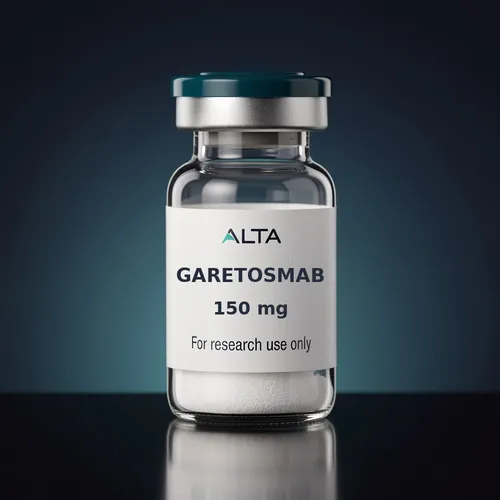
Garetosmab is a fully human , made by Regeneron, that binds and neutralises activin A, a signalling protein in the same family as myostatin. It was developed for fibrodysplasia ossificans progressiva (FOP), an ultra-rare disorder in which soft tissue turns to bone, and was approved by the FDA for that disease in August 2026 under the brand name PASATRU. It also appears in obesity research as the third component of Regeneron's COURAGE triplet with trevogrumab and semaglutide, which is why people reading about muscle preservation on drugs encounter it. This article covers both stories and the safety findings from each. It exists because visitors to our retatrutide page ask about it. Garetosmab is a hospital biologic; ALTA PEPTIDES supplies a research-grade version for laboratory use only and this is not guidance on using anything.
- Garetosmab is a fully human IgG4 monoclonal antibody that binds and neutralises activin A. Regeneron scientists identified activin A as the driver of abnormal bone formation in fibrodysplasia ossificans progressiva (FOP).
- In the OPTIMA trial (63 adults), garetosmab at 3 mg/kg and 10 mg/kg reduced new heterotopic bone lesions by 94% and 90% versus placebo at 56 weeks, with no deaths.
- The FDA approved garetosmab as PASATRU (garetosmab-grts) for adults with FOP on 19 August 2026, the first approved treatment for the disease shown to reduce both new lesions and flare-ups.
- In the earlier LUMINA-1 trial, five of 44 participants died during the open-label period; the deaths were judged unlikely to be related but causality could not be excluded.
- In obesity, garetosmab has been tested only in the COURAGE triplet with trevogrumab and semaglutide, which preserved the most but had a 30.9% discontinuation rate and two deaths.
- Garetosmab is a hospital-administered biologic for an ultra-rare disease. It is not a peptide; ALTA PEPTIDES supplies a research-grade version for laboratory use only.
What garetosmab is and why activin A
Activin A is a member of the TGF-beta superfamily. In muscle it signals, like myostatin, through the activin type II receptors to limit growth; in FOP it does something stranger. FOP is caused by mutations in ACVR1, a type I receptor for bone morphogenetic proteins. Regeneron scientists discovered that activin A, which normally blocks the ACVR1 receptor, instead activates the mutant form and triggers heterotopic ossification, the growth of bone in muscle, tendon and ligament. An antibody that removes activin A from the equation should therefore stop new bone from forming. Garetosmab is an IgG4 antibody produced in Regeneron's VelocImmune mice and given by intravenous infusion every four weeks. Our myostatin inhibitor pillar places it on the pathway alongside the other antibodies.
LUMINA-1: the phase 2 trial and its deaths
LUMINA-1 randomised 44 adults with FOP to garetosmab or placebo for a 28-week double-blind period, followed by a 28-week open-label period in which everyone received the antibody. Published in Nature Medicine in September 2023, the trial reported reductions in new lesions and flare-ups on treatment. It also reported that five of the 44 participants (11.4%) died during the open-label period. The investigators judged the deaths unlikely to be related to garetosmab, noting that they were consistent with the known causes of death and life expectancy of people with FOP of similar age and severity, but stated that causality could not be ruled out. Dosing in the extension was suspended for a time after a fatal event that was initially, and incorrectly, believed to be bleeding-related. Those five deaths are the reason garetosmab's safety is scrutinised so closely wherever it appears, including in obesity.
OPTIMA: the phase 3 trial and FDA approval
OPTIMA enrolled 63 adults with FOP and randomised them to placebo (21), garetosmab 3 mg/kg (19) or garetosmab 10 mg/kg (23) by infusion every four weeks for 56 weeks. Regeneron announced on 17 September 2025 that the primary endpoint was met:
- New heterotopic bone lesions (by whole-body CT): 19 on placebo, 1 on 3 mg/kg (94% reduction, p=0.0274), 2 on 10 mg/kg (90% reduction, p=0.0260).
- Clinician-assessed flare-ups: 70 on placebo, 53 on 3 mg/kg (20% reduction, not significant), 9 on 10 mg/kg (89% reduction, p=0.0007).
- Total volume of new lesions (post-hoc): 10.45 cm3 on placebo versus 0.01 and 0.02 cm3 on garetosmab, reductions above 99%.
There were no deaths in OPTIMA and no discontinuations in the garetosmab arms. Skin and soft tissue infections rose with dose (7, 9 and 15 participants on placebo, 3 mg/kg and 10 mg/kg). Nosebleeds did not rise with dose (5, 10 and 4) and there were no serious bleeding events, a relevant finding given the history of ACE-031, the earlier activin-pathway drug halted for bleeding. Musculoskeletal pain events fell on treatment. The independent data monitoring committee recommended moving placebo participants onto garetosmab as soon as possible.
The FDA accepted the biologics licence application for priority review in February 2026 and approved PASATRU (garetosmab-grts) for adults with FOP on 19 August 2026, describing it as the first and only treatment shown in a placebo-controlled trial to reduce both new lesions and flare-ups. A paediatric phase 3, OPTIMA 2, is planned. FOP affects approximately 900 diagnosed people worldwide.
Garetosmab in obesity: the COURAGE triplet
Because activin A and myostatin share receptors, blocking both should protect muscle more completely than blocking one, and mouse and primate work from Regeneron supported that. In COURAGE, one arm of 147 adults with obesity received semaglutide 2.4 mg plus trevogrumab 400 mg plus garetosmab 10 mg/kg. At 26 weeks that triplet produced the best body composition in the trial: body weight -13.4% against -10.6% on semaglutide alone, fat mass -27.1% against -15.7%, and lean mass loss of 0.9 kg (7.4% of the total lost) against 3.3 kg (33.0%). The cost was tolerability. Discontinuations due to adverse events were 30.9% in the triplet against 4.6% on semaglutide alone, and two participants in the triplet arm died: one of undetermined cause with multiple cardiovascular risk factors, one of cardiac arrest with a history of cardiovascular disease. Regeneron reported no causal association identified. No deaths occurred in the arms without garetosmab. The maintenance phase of COURAGE continues with trevogrumab alone. Full figures are in our trevogrumab article.
Where it sits against GLP-1 peptides
Garetosmab has no role in weight loss on its own and is not being developed as a stand-alone obesity drug. Its obesity data come entirely from one arm of one phase 2 trial, as an add-on to a myostatin antibody and semaglutide, and that arm's safety profile makes a phase 3 in that form unlikely without changes. Retatrutide, the triple agonist that has completed phase 3 for obesity, works on entirely different receptors and is summarised in our phase 3 article. The weight and metabolic category lists what we supply; none of it is an antibody. For the related antibodies see apitegromab and bimagrumab.
What ALTA PEPTIDES supplies
Garetosmab is a prescription biologic infused in hospital for an ultra-rare disease. It is not a peptide and cannot be made by peptide synthesis; research-grade versions are recombinant antibodies made in cell culture. A research-grade vial is not Regeneron's branded product; its identity rests on the manufacturer's certificate of analysis. ALTA PEPTIDES supplies a research-grade version as a laboratory reagent only, under our research use policy.
Further reading
See trevogrumab and garetosmab for the pair in obesity and why neither is for sale, trevogrumab side effects for the COURAGE adverse events, and the UK availability timeline for the PASATRU price and regulatory status.
Sources
- Regeneron press release, 17 September 2025: "Regeneron Announces Positive Phase 3 Trial in Adults with Ultra-Rare Genetic Disorder Fibrodysplasia Ossificans Progressiva (FOP), Demonstrating that Garetosmab Prevents Greater than 99% of Abnormal Bone Formation" (OPTIMA design, lesion counts, flare-ups, volumes, adverse events).
- Regeneron press release, 19 August 2026: FDA approval of PASATRU (garetosmab-grts) for adults with FOP; Regeneron press release, February 2026: BLA accepted for priority review.
- Di Rocco et al., Nature Medicine, September 2023: "Garetosmab in fibrodysplasia ossificans progressiva: a randomized, double-blind, placebo-controlled phase 2 trial" (LUMINA-1, 44 participants, five deaths in open-label period).
- Regeneron press release, 17 September 2025: complete 26-week results from the phase 2 COURAGE trial (triplet arm figures, discontinuations, deaths).
Questions people ask
Is garetosmab approved?
In the United States, yes: the FDA approved it as PASATRU for adults with fibrodysplasia ossificans progressiva on 19 August 2026. It is not approved for obesity or any other use, and it is not licensed in the UK or EU at the time of writing; Regeneron said global submissions would follow in 2026.
Can you buy garetosmab?
The branded medicine is a prescription infusion for a disease that affects roughly 900 diagnosed people worldwide, supplied through hospitals. Research-grade garetosmab, made by a third-party manufacturer, is available as a laboratory reagent for research; ALTA PEPTIDES supplies it, not for human use.
What is the difference between garetosmab and trevogrumab?
Both are Regeneron antibodies acting on the same receptor pathway. Trevogrumab blocks myostatin; garetosmab blocks activin A. In the COURAGE obesity trial they were combined in one arm, and our trevogrumab article gives the full results.
What is fibrodysplasia ossificans progressiva?
An ultra-rare genetic disorder caused by mutations in the ACVR1 gene, in which muscles, tendons and ligaments are progressively replaced by bone. Most people with it are wheelchair-bound by 30 and median survival is around 56 years. Regeneron's work showed that activin A, which normally does not signal through ACVR1, does so through the mutant receptor and drives the new bone.
Information, not advice. This article summarises published research; nothing here is guidance on human or veterinary use. Products are sold under our research use policy.