In this article18 sections
A drug that protects muscle. It's an antibody from Scholar Rock that stops myostatin, the body's main brake on muscle, from switching on. It is approved in the US for the muscle-wasting disease SMA. With the weight-loss drug tirzepatide it didn't add weight loss, but it made far more of the weight lost come from fat instead of muscle.
Apitegromab is a drug that protects muscle. It is an antibody, made by the US company Scholar Rock, that stops myostatin, the body's main brake on muscle growth, from ever switching on. In September 2026 it became the first drug of its kind approved anywhere, for a muscle-wasting disease in children called spinal muscular atrophy (SMA). It matters to people following weight-loss drugs because of a second trial: given alongside tirzepatide (Mounjaro), it changed what the weight lost was made of, so far more of it was fat and far less was muscle. This article explains what apitegromab is, what the trials found, its side effects, its price, and whether it is available in the UK. It describes published research only; apitegromab is a hospital medicine, ALTA PEPTIDES supplies only a research-grade version for laboratory use only, and nothing here is guidance on using any drug.
- Apitegromab is a fully human IgG4 that binds promyostatin and latent myostatin, blocking myostatin before it is activated. It is a biologic, not a peptide.
- The FDA approved it as ISEMBYLD (apitegromab-mstn) on 11 September 2026 for spinal muscular atrophy in people aged 2 and over on an SMN2-targeted treatment, a year after a complete response letter (23 September 2025) that related solely to a third-party fill-finish facility.
- SAPPHIRE, a in 188 people with spinal muscular atrophy aged 2 to 21, met its primary endpoint; in the main efficacy population (ages 2 to 12), 10 mg/kg gave a 2.2-point improvement in the Hammersmith motor scale at one year versus placebo.
- In the EMBRAZE trial (102 adults with obesity), apitegromab with tirzepatide caused 1.9 kg less loss than tirzepatide with placebo at 24 weeks, a 54.9% retention, with similar total weight loss (12.3% versus 13.4%).
- Fractures occurred in 9% of SAPPHIRE participants on 10 mg/kg versus 2% on placebo; the label carries a fracture warning.
- Apitegromab is a hospital-administered infusion approved only for SMA in the United States. It is not approved for obesity; ALTA PEPTIDES supplies a research-grade version for laboratory use only.
What is apitegromab?
In shortAn antibody that stops the body's muscle brake from switching on, so less muscle is lost.
A US biotech. Brand name ISEMBYLD.
Holds it before it switches on.
A large protein given by drip every 4 weeks. Not a peptide.
For SMA only. Not for weight loss.
- 01Myostatin is made
As an inactive 'parcel'
- 02Apitegromab grabs it
While it's still inactive
- 03Never switched on
So the brake isn't applied
- 04Muscle is protected
Less muscle lost
Scholar Rock; mechanism as described in this article.
Your muscles have a built-in brake called myostatin. It tells muscle cells to stop growing, and it is why muscle doesn't keep building indefinitely. Apitegromab is an antibody, a large Y-shaped protein of the kind the immune system makes, designed to latch onto myostatin and hold it. What makes it different from earlier attempts is when it grabs it: myostatin is made in an inactive "parcel" first and only switched on later, and apitegromab holds it while it is still in that inactive form, so it never gets switched on. Because only myostatin comes packaged that way, apitegromab is very selective, which is Scholar Rock's explanation for why it worked where a generation of earlier myostatin drugs failed. It is given as an infusion into a vein every four weeks. It is a biologic made in living cells, not a peptide.
What is apitegromab approved for?
In shortOnly spinal muscular atrophy, in the US, since September 2026.
Spinal muscular atrophy, in the United States. SMA is a genetic disease in which the nerve cells that control muscles die off, so muscles weaken and waste. Two existing drugs, nusinersen and risdiplam, protect those nerve cells, but they don't act on the muscle itself, and strength still falls. Apitegromab is meant to work on the muscle side, on top of those drugs. The FDA approved it on 11 September 2026 under the brand name ISEMBYLD, for adults and children aged 2 and over who are already on one of the nerve-protecting treatments. It is not approved for obesity, for muscle loss in older people, or for anything else, and it has no licence in the UK or the EU.
Does apitegromab cause weight loss?
In shortNo. With tirzepatide, weight loss was the same, but far more of it was fat and less was muscle.
With vs without apitegromab: about the same.
54.9% of the expected loss prevented.
24 weeks. Phase 2, so early evidence.
EMBRAZE: Scholar Rock, 18 June 2025; Nature Medicine 2026. Lean mass measured by DXA scan.
No, and that is the interesting part. In the EMBRAZE trial, 102 adults with obesity all took tirzepatide for 24 weeks, and half also got apitegromab. Both groups lost a similar amount of weight: 12.3% with apitegromab and 13.4% without. What changed was what the weight was made of. On tirzepatide alone, about 70% of the weight lost was fat and 30% was lean mass (mostly muscle). With apitegromab added, it was 85% fat and 15% lean. In kilograms, people on apitegromab lost 1.9 kg less lean mass, which Scholar Rock described as keeping 54.9% of the lean mass that would otherwise have gone. So apitegromab isn't a weight-loss drug; it is being tested as a way to make weight loss on drugs like tirzepatide and retatrutide healthier. Our article on muscle loss on GLP-1 drugs explains why that matters.
What did the SMA trial show?
In shortA third of children on it improved their movement scores, against about one in eight on placebo.
Hammersmith motor scale, 52 weeks.
Ages 2 to 21, nine countries.
Entered the ONYX follow-on study.
Share of the main efficacy group gaining 3 or more points. Scholar Rock, 11 September 2026.
The SAPPHIRE trial tested apitegromab in 188 people with SMA aged 2 to 21, all already on nusinersen or risdiplam, for about a year. Motor function was measured on the Hammersmith scale, a standard test of things like rolling, sitting and standing. In the main group (ages 2 to 12), children on apitegromab scored 2.2 points better than those on placebo after a year. More telling for families: about a third of children on apitegromab (34.2%) gained 3 or more points, against 13.5% on placebo. Children on placebo, on their existing treatment alone, lost function over the year. For a disease where holding steady is a good outcome, that is a meaningful result.
What are the side effects?
In shortMostly colds and stomach upsets. Fractures were more common, and the label warns about them.
Plus headache and stomach upsets.
Printed on the US label.
No serious events or dropouts blamed on it.
Share of participants with a fracture. ISEMBYLD US label via Scholar Rock, 11 Sep 2026; EMBRAZE, 2025.
In the SMA trial the most common side effects were colds and other respiratory infections, vomiting, cough, viral infections, headache, stomach upsets, sore throat and allergic-type reactions. The one that stands out is broken bones: fractures happened in 9% of people on the 10 mg/kg dose against 2% on placebo, and the approved label carries a warning that the drug may increase fracture risk. In the obesity trial with tirzepatide, side effects were similar with and without apitegromab, with no serious problems or dropouts blamed on it and no deaths. Scholar Rock reports more than 500 people treated across its studies, some for over seven years.
Does a higher dose build more muscle?
In shortOnly up to a point. Doubling the standard dose did no better, because the target was already fully blocked.
- 01Low dose
Some myostatin still free
- 02Full dose (10 mg/kg)
All the target held
- 03Double dose (20 mg/kg)
Nothing extra to hold
- 04Result
Effect levels off: a ceiling
All data are from SMA or weight loss.
At the standard dose, in SAPPHIRE.
Myostatin inhibitors are on WADA's list.
Hammersmith motor scale points. TOPAZ: Crawford et al., JAMA Neurology 2024 (17 children, no placebo). SAPPHIRE: Scholar Rock, 2025. The two trials measured differently, so compare within each trial, not across.
This is the question many people ask, and the trials give a fairly clear answer: more helps up to a point, then it stops helping. Apitegromab works by holding on to inactive myostatin. Once there is enough of the drug in the body to hold all of it, adding more has nothing left to grab, so the effect levels off. Doctors call this a ceiling, or target saturation, and the trial data show it happening.
In the earlier phase 2 trial, TOPAZ, a small group of children with SMA were split between a very low dose (2 mg/kg) and a high dose (20 mg/kg). After a year, motor scores had risen by 5.3 points on the low dose and 7.1 points on the high dose, and Scholar Rock reported that the higher dose bound more of its target. So going from a very low dose to a full dose did seem to help. But that group was only 17 children, without a placebo comparison, so it is a hint rather than proof.
The bigger phase 3 trial, SAPPHIRE, then tested two full doses against placebo: 10 mg/kg and 20 mg/kg. Doubling the dose did not do better. Compared with placebo, children on 10 mg/kg gained 2.2 points, while those on 20 mg/kg gained 1.4 points, a result that on its own was not statistically clear. Blood tests showed why: both doses locked up the target to a similar degree. The 10 mg/kg dose already does the full job, and it is the dose that went forward. The obesity trial, EMBRAZE, also used 10 mg/kg.
Three more things matter for anyone thinking about apitegromab as a muscle builder. First, it has never been tested in healthy people trying to build muscle; every result comes from people with a muscle-wasting disease or from people losing weight, where it reduced muscle loss rather than adding new muscle. Second, the fracture signal in SAPPHIRE is a reminder that blocking a growth signal has effects beyond muscle, and nothing is known about higher or longer exposure in healthy adults. Third, myostatin inhibitors are banned in sport at all times under the World Anti-Doping Agency's list. And in practice the question is academic: real apitegromab is available only as a hospital infusion for SMA in the US, and anything sold online under the name is not the drug. Our article on apitegromab and bodybuilding looks at the muscle-growth question in more depth.
When could apitegromab be available in the UK?
In shortNot soon. The EU application was withdrawn, and there's no obesity phase 3 yet.
- Jun 2025Obesity trial reads out
EMBRAZE, with tirzepatide.
- Sep 2025FDA says not yet
Only because of a third-party factory.
- Aug 2026EU application withdrawn
Same factory; resubmission planned.
- 11 Sep 2026FDA approves ISEMBYLD
For SMA. First drug of its kind.
- Not yetUK, and obesity
No UK licence; no phase 3 obesity trial announced.
Scholar Rock releases, 2025 to 2026.
For SMA, not yet and not soon. Scholar Rock's European application was withdrawn in August 2026 after the same third-party factory that delayed the US approval failed an inspection; the company plans to resubmit using a different factory. A UK licence from the MHRA, and then an NHS decision from NICE, would come after that. For obesity, it is much further off: EMBRAZE was a small, short phase 2 trial, and no phase 3 obesity trial had been announced at the time of writing. Our myostatin inhibitor guide keeps a dated timeline for all four antibodies.
How much does apitegromab cost?
In shortAbout $310,000 a year in the US for SMA. No UK price.
Net cost for a typical SMA patient.
Wholesale list price.
Not licensed here.
Reuters and Scrip, 14 September 2026.
In the US, Scholar Rock said ISEMBYLD would cost about $310,000 a year net for a typical patient, with a wholesale price of $11,659 per vial. That is a rare-disease price for a drug given to a few thousand people, and it tells you little about what an obesity version might cost, except that antibodies are expensive to make. There is no UK or EU price.
Can you buy apitegromab?
In shortNo. Anything sold online under the name is not the real drug.
Given by drip in a clinical setting.
Recombinant antibody from a third-party maker; check the CoA.
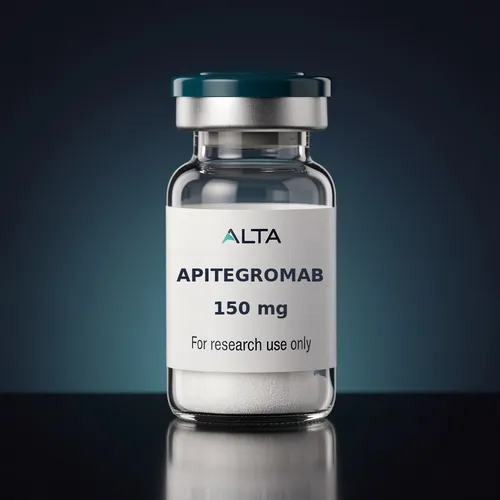
150 mg vials, laboratory research only.
From this article.
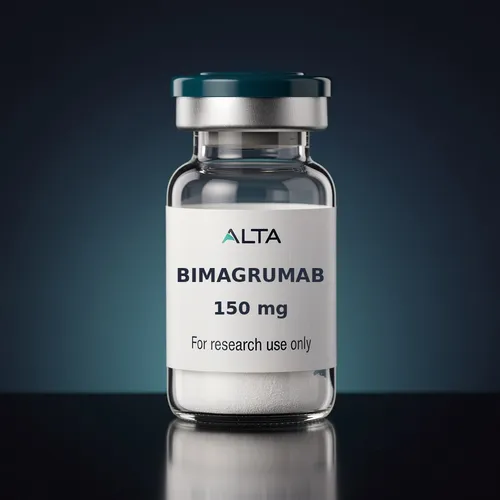
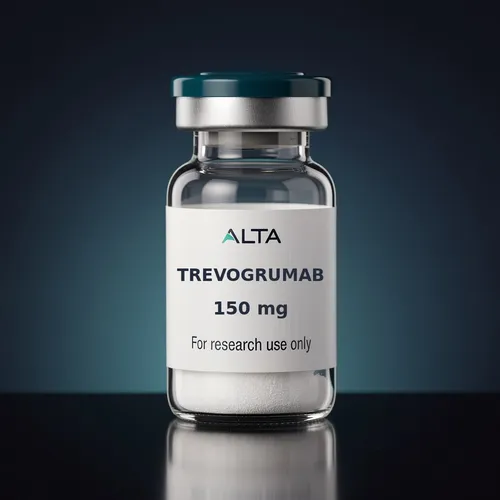
No. Outside the US prescription programme for SMA, the branded medicine is not available. It is a large antibody grown in cell cultures in specialist plants and can't be made the way peptides are. Research-grade apitegromab, made by a third-party manufacturer, is sold as a laboratory reagent. A research-grade vial is not the branded medicine, and its identity and purity rest on the manufacturer's certificate of analysis. ALTA PEPTIDES supplies research-grade versions of these antibodies as laboratory reagents under our research use policy: recombinant antibodies made by a third-party manufacturer, not the products of the originator companies.
Apitegromab vs bimagrumab and trevogrumab
In shortApitegromab is the most targeted of the four. Wider blockers keep more muscle but have more side effects.
Swipe the table to compare →
| Apitegromab | Trevogrumab | Trevo + garetosmab | Bimagrumab | |
|---|---|---|---|---|
| Made by | Scholar Rock | Regeneron | Regeneron | Eli Lilly |
| What it blocks | Myostatin, before activation | Active myostatin | Myostatin + activin A | The shared receptor (ActRII) |
| Weight-loss partner | Tirzepatide | Semaglutide | Semaglutide | Semaglutide |
| Share of loss that was muscle | 15% | 18% | 7% | 7% |
| Stopped for side effects | None blamed on it | ~11% (higher dose) | 30.9%, 2 deaths | 9% |
| Approved | US, SMA | No | Garetosmab: US, FOP | No |
EMBRAZE (24 wk), COURAGE (26 wk), BELIEVE (72 wk); trials differ in length and design, so compare with care. Partner drug alone: about 30% muscle.
Four antibodies that protect muscle have been tested alongside weight-loss drugs, and they block the muscle brakes in different places. Apitegromab is the narrowest: it holds myostatin only, before it switches on. Trevogrumab blocks the active form of myostatin, and is sometimes combined with garetosmab, which blocks a second brake, activin A. Bimagrumab blocks the receptor that all these brakes press on, the widest approach. Broadly, the wider the block, the more muscle is kept during weight loss, and the more effects there are elsewhere in the body. The table sets out the headline numbers side by side.
How does it compare with retatrutide?
In shortRetatrutide causes the weight loss; apitegromab is tested to protect muscle during it.
| Retatrutide | Apitegromab | |
|---|---|---|
| What it does | Drives weight loss | Protects muscle during weight loss |
| How | GLP-1, GIP and glucagon hormones | Blocks the muscle brake, myostatin |
| Type | Peptide injection | Antibody infusion |
| Stage | Phase 3 completed | Phase 2 in obesity |
| Tested together? | No | No |
From this article and our retatrutide summary.
They do different jobs, so they aren't rivals. Retatrutide drives weight loss by acting on three appetite and metabolism hormones (, and glucagon), and has completed phase 3 trials; our retatrutide summary gives the results. Apitegromab doesn't add weight loss, but on the EMBRAZE evidence it could change the make-up of that loss toward fat. It has never been tested with retatrutide. If a combination like this reaches the market, it will be a prescription infusion given alongside a weight-loss drug.
Everything above is the quick version. The sections below go deeper.
How apitegromab works: why "latent" matters
In shortIt grabs myostatin before it's switched on, which is why it's so selective.
Myostatin is made as a precursor, promyostatin, which is cut to a latent complex and only then to the short mature protein that binds the activin type II receptors on muscle. Most earlier anti-myostatin antibodies bound the mature form, which is structurally close to activin A and GDF11, and cross-reactivity was a recurring problem. Apitegromab binds the precursor and latent forms, which are unique to myostatin, so it is selective in a way the older antibodies were not, and it acts upstream of activation in the muscle itself. Our myostatin inhibitor guide sets out the pathway and the earlier failures.
SAPPHIRE in detail
In shortThe full design and statistics of the SMA trial.
SAPPHIRE was a randomised, double-blind, placebo-controlled phase 3 in 188 people with 5q SMA aged 2 to 21 across nine countries, all on nusinersen or risdiplam, randomised 1:1:1 to apitegromab 20 mg/kg, 10 mg/kg or placebo by intravenous infusion every four weeks for about a year. In the main efficacy population (ages 2 to 12, n=103), apitegromab 10 mg/kg produced a 2.2-point improvement over placebo on the Hammersmith Functional Motor Scale-Expanded at 52 weeks (nominal p=0.0121); the combined-dose analysis in the original readout was a 1.8-point improvement. A gain of 3 or more points was seen in 34.2% of the 10 mg/kg group against 13.5% on placebo (odds ratio 3.8). Scholar Rock reports that 98% of SAPPHIRE participants entered the ONYX extension.
EMBRAZE in detail
In shortThe full figures from the obesity trial, and its limits.
EMBRAZE was a randomised, double-blind, placebo-controlled phase 2 proof-of-concept trial in 102 adults with overweight or obesity, randomised 1:1 to tirzepatide plus apitegromab 10 mg/kg or tirzepatide plus placebo for 24 weeks. Scholar Rock announced results on 18 June 2025 and the paper appeared in Nature Medicine in 2026. Lean mass loss was 1.9 kg smaller with apitegromab (80% CI 1.2 to 2.7; p=0.001), expressed as 54.9% preservation of lean mass relative to tirzepatide alone. Weight lost was 85% fat and 15% lean with apitegromab against 70% fat and 30% lean without; total weight loss was 12.3% against 13.4%, and fat mass lost was 18.8 lb against 17.7 lb. Adverse events were similar between groups and consistent with tirzepatide's known profile, with no serious adverse events or discontinuations attributed to apitegromab and no deaths. The trial was short and small, and lean mass by scan is a stand-in for muscle rather than a measure of strength or function. The pattern matches Regeneron's COURAGE trial with semaglutide: the antibody doesn't change how much weight is lost, but shifts what is lost toward fat.
The FDA rejection and approval, step by step
In shortRejected in 2025 over a factory, approved in 2026 once it was fixed.
The FDA gave the licence application priority review in 2025, with a decision expected that September. On 23 September 2025 it issued a complete response letter instead. Scholar Rock said the letter related "solely" to observations from a routine inspection of Catalent Indiana, a third-party fill-finish facility, and raised no concern about apitegromab's safety or effectiveness. The company resubmitted after the site was fixed, and on 11 September 2026 the FDA approved ISEMBYLD (apitegromab-mstn), ahead of a 30 September target date, and awarded Scholar Rock a rare paediatric disease priority review voucher. In Europe, the marketing authorisation application was withdrawn in August 2026 after the same facility received an "official action indicated" inspection classification; the company said it would resubmit naming an alternative fill-finish site.
Further reading
The myostatin inhibitor guide covers all four antibodies and the UK timeline, muscle loss on GLP-1 peptides has the tirzepatide body-composition figures EMBRAZE set out to change, and the GLP-1 explainer covers the weight-loss drugs themselves.
Sources
- Scholar Rock press release, 11 September 2026: "Scholar Rock Announces FDA Approval of ISEMBYLD (apitegromab-mstn)" (SAPPHIRE design and results, adverse reactions, fracture rate, label, priority review voucher).
- Scholar Rock press release, 23 September 2025: FDA complete response letter relating solely to observations at the Catalent Indiana fill-finish facility.
- Scholar Rock press release, August 2026: update on the European marketing authorisation application and Catalent Indiana inspection classification.
- Scholar Rock press release, 18 June 2025: phase 2 EMBRAZE trial results; Nature Medicine 2026: "Apitegromab for lean mass preservation during tirzepatide-induced weight loss: a randomized, double-blind, placebo-controlled phase 2 trial".
- Crawford TO, et al. Safety and efficacy of apitegromab in patients with spinal muscular atrophy types 2 and 3: the phase 2 TOPAZ study. JAMA Neurology 2024 (PMID 38330285); Scholar Rock press release, April 2021: 12-month TOPAZ top-line results (2 mg/kg versus 20 mg/kg, target engagement).
- Scholar Rock, 2025 MDA Clinical & Scientific Conference presentation of SAPPHIRE: dose-level results (10 mg/kg +2.2 and 20 mg/kg +1.4 HFMSE points versus placebo) and similar target engagement at both doses.
- Reuters and Scrip, 14 September 2026: ISEMBYLD net annual cost of about $310,000 and wholesale acquisition cost of $11,659 per vial.
Questions people ask
Is apitegromab approved?
Yes, in the United States only, as ISEMBYLD (apitegromab-mstn) for spinal muscular atrophy in people aged 2 and over who are on an SMN2-targeted treatment, approved 11 September 2026. It is not approved for obesity anywhere. The European application was withdrawn in August 2026 over a manufacturing-site issue, with resubmission planned using a different facility. There is no UK licence.
Does apitegromab cause weight loss?
No. In EMBRAZE, total weight loss was similar with and without it (12.3% versus 13.4%). What changed was the make-up of the loss: 85% fat with apitegromab against 70% fat without. It is being studied as an add-on to weight-loss drugs, not as a weight-loss drug.
Does more apitegromab build more muscle?
Not beyond the standard dose. In the SAPPHIRE trial, 20 mg/kg did no better than 10 mg/kg (1.4 versus 2.2 points over placebo), and both doses bound the target to a similar degree, which is a ceiling effect. It has never been tested for muscle building in healthy people, and myostatin inhibitors are banned in sport.
Can you buy apitegromab?
The branded medicine only on a US prescription for SMA, given by infusion through Scholar Rock's programme. Research-grade apitegromab, made by a third-party manufacturer, is available as a laboratory reagent for research; ALTA PEPTIDES supplies it, not for human use.
How much does Isembyld cost?
Scholar Rock put the US net cost at about $310,000 a year for a typical patient, with a wholesale price of $11,659 per vial. There is no UK or EU price.
What is the difference between apitegromab and bimagrumab?
Apitegromab grabs myostatin only, and only before it is switched on, which makes it very selective. Bimagrumab blocks the receptor that myostatin and several related signals all use, which gives a bigger effect on muscle but more effects elsewhere. Our bimagrumab article covers it.
Information, not advice. This article summarises published research; nothing here is guidance on human or veterinary use. Products are sold under our research use policy.