In this article9 sections
How much muscle do you lose on Ozempic is one of the most searched questions about the drugs, with Ozempic muscle loss and GLP-1 loss close behind, and it now has trial answers for semaglutide, tirzepatide and retatrutide from body composition substudies of their own programmes. This article sets those figures out per drug, explains what a DXA scan's lean mass number does and does not measure, reports what share of the weight lost was lean tissue in each trial, and links to the four antibody programmes that exist to change that share. It exists because visitors to our retatrutide page ask about muscle loss. It is descriptive: it reports what trials measured and what their protocols included, and it is not guidance on using anything.
- Lean mass on a scan is everything that is not fat or bone mineral: muscle, but also water, organs and connective tissue. Some loss is expected whenever a smaller body needs less of all of them.
- Semaglutide 2.4 mg, STEP 1 DXA substudy (140 people, 68 weeks): body weight -15.0%, fat mass -19.3%, lean body mass -9.7%; the lean proportion of the body rose by 3.0 percentage points.
- Tirzepatide, SURMOUNT-1 DXA substudy (160 people, 72 weeks): fat mass -33.9%, lean mass -10.9%; about 75% of the weight lost was fat and 25% lean, the same ratio as placebo.
- Retatrutide, body composition substudy in type 2 diabetes (36 weeks): fat mass -26.1% at 8 mg and -23.2% at 12 mg; lean mass loss up to 6.5 kg; the authors reported a fat-to-total loss ratio consistent with other treatments.
- In the antibody trials, the GLP-1 comparator arms lost 33% (semaglutide, COURAGE), 30% (tirzepatide, EMBRAZE) and 28.2% (semaglutide, BELIEVE) of total weight as lean mass.
- Four antibody programmes are trying to change the ratio: trevogrumab and garetosmab (Regeneron), apitegromab (Scholar Rock), bimagrumab (Lilly). None is approved for this and ALTA PEPTIDES stocks none of them.
What lean mass means on a DXA scan
Dual-energy X-ray absorptiometry divides the body into three compartments: fat mass, bone mineral, and lean soft tissue, which is everything else. Lean mass therefore includes skeletal muscle but also water, organs, skin and connective tissue. When a person loses a large amount of weight, some lean mass goes with it regardless of the method, because a lighter body carries less water, less blood volume and less of the muscle needed to move it. The question the trials ask is not whether lean mass falls but whether it falls out of proportion, and the usual yardstick is the share of total weight lost that is lean: and the figures below give it for each drug. None of the substudies measured muscle strength or function directly; they measured tissue.
Semaglutide: the STEP 1 DXA substudy
STEP 1 randomised 1,961 adults with overweight or obesity to semaglutide 2.4 mg weekly or placebo for 68 weeks, with lifestyle intervention in both arms. A substudy of 140 participants (95 on semaglutide, 45 on placebo; mean weight 98.4 kg, 76% female) had DXA scans at screening and week 68. On semaglutide, body weight fell 15.0%, total fat mass fell 19.3%, visceral fat fell 27.4%, and total lean body mass fell 9.7%. Because fat fell faster than lean tissue, the lean proportion of the body rose by 3.0 percentage points, and the lean-to-fat ratio improved most in those who lost 15% or more. Applying the substudy's percentages to its average participant (53.9% lean at baseline) gives about 5 kg of lean mass out of roughly 15 kg lost, a little over a third; that is our arithmetic, not a figure the authors reported. In the COURAGE antibody trial's semaglutide-alone arm, measured over 26 weeks, the lean share was 33.0%; in BELIEVE's semaglutide-alone arm over 72 weeks it was 28.2%. Muscle loss on semaglutide, in other words, runs at roughly a third of the total in every trial that has measured it.
Tirzepatide: the SURMOUNT-1 DXA substudy
SURMOUNT-1 randomised 2,539 adults to tirzepatide or placebo for 72 weeks. Its DXA substudy of 160 participants (124 on tirzepatide, 36 on placebo; mean weight 102.5 kg, BMI 38) was published in Diabetes, Obesity and Metabolism in 2025. Fat mass fell 33.9% and lean mass fell 10.9% on tirzepatide. Of the weight lost, approximately 75% was fat and 25% lean, and the same ratio was seen in the placebo group, which the authors interpreted as a proportionate loss rather than an excessive one. In the EMBRAZE antibody trial's tirzepatide-alone arm, over 24 weeks, the lean share was 30%. Tirzepatide muscle loss therefore sits at a quarter to a third of total loss, similar to semaglutide's.
Retatrutide: the phase 2 body composition substudy
Retatrutide is the , GLP-1 and glucagon triple agonist that has completed for obesity. The body composition data published so far come from a substudy of the phase 2 trial in type 2 diabetes, reported in The Lancet Diabetes and Endocrinology in 2025: 189 participants across placebo, dulaglutide and four retatrutide groups, scanned at baseline and 36 weeks. Fat mass fell 4.9% at 0.5 mg, 15.2% at 4 mg, 26.1% at 8 mg and 23.2% at 12 mg, against 4.5% on placebo and 2.6% on dulaglutide. Lean mass loss reached up to 6.5 kg in the higher-dose groups. The authors concluded that retatrutide reduced fat mass more than lean mass and that its ratio of fat loss to total loss was consistent with most other weight-loss treatments; retatrutide muscle loss, on this evidence, is proportionate to its larger total loss rather than out of line with it. Phase 3 body composition results have not been published. Our phase 3 summary covers what has.
What the trial protocols included
None of the substudies above was designed to prevent lean mass loss, and their protocols are worth reporting for that reason. STEP 1 gave all participants a lifestyle intervention: a reduced-calorie diet and 150 minutes a week of physical activity, with counselling every four weeks. SURMOUNT-1 included a similar lifestyle intervention. The antibody trials paired the GLP-1 drug with an antibody rather than with a training programme, and they are the only trials to date that have measured whether lean mass loss on these drugs can be changed by a drug. Whether resistance training or higher protein intake changes the DXA figures on GLP-1 drugs is being studied separately and is not something these trials measured; we report their protocols, not recommendations.
The antibody trials built to change the ratio
Four programmes pair a GLP-1 drug with an antibody that blocks myostatin or activin signalling in muscle. Regeneron's COURAGE added trevogrumab, with and without garetosmab, to semaglutide and cut the lean share of loss from 33.0% to 16.8% and 18.1% with trevogrumab and to 7.4% with the triplet, at a heavy tolerability cost; see trevogrumab and garetosmab. Scholar Rock's EMBRAZE added apitegromab to tirzepatide and preserved 54.9% of lean mass, cutting the lean share from 30% to 15%. Lilly's BELIEVE added bimagrumab to semaglutide and raised the fat share of loss from 71.8% to 92.8%; see bimagrumab vs retatrutide. All are phase 2; none is approved for this use; none has been tested with retatrutide. The pillar article explains the mechanism and the UK availability timeline keeps their status current.
What ALTA PEPTIDES supplies
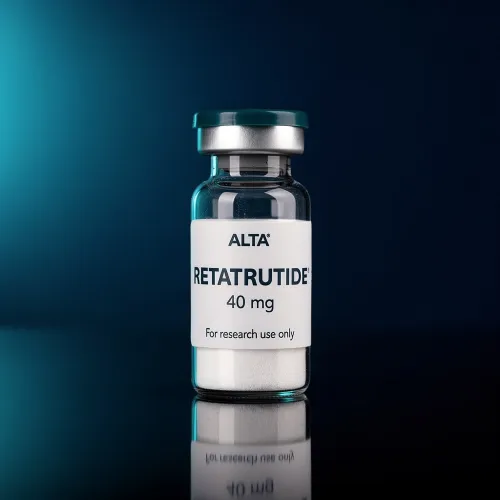
Retatrutide is supplied by ALTA PEPTIDES as a synthetic research peptide for laboratory use under our research use policy. The antibodies are not peptides; ALTA PEPTIDES supplies research-grade versions as laboratory reagents only. For the claims made about myostatin inhibitors and muscle growth in healthy people, see myostatin inhibitors for muscle growth; for the side effect records, trevogrumab side effects and bimagrumab side effects. The weight and metabolic category lists what we supply.
Sources
- Wilding et al., "Impact of Semaglutide on Body Composition in Adults with Overweight or Obesity: Exploratory Analysis of the STEP 1 Study", ENDO 2021 (Endocrine Society, March 2021), and Wilding et al., New England Journal of Medicine, 2021 (STEP 1 design and lifestyle intervention).
- Look et al., Diabetes, Obesity and Metabolism, 2025: "Body composition changes during weight reduction with tirzepatide in the SURMOUNT-1 study of adults with obesity or overweight" (160 participants; fat mass -33.9%, lean mass -10.9%; about 75% fat, 25% lean).
- The Lancet Diabetes and Endocrinology, 2025: "Effects of retatrutide on body composition in people with type 2 diabetes: a substudy of a phase 2, double-blind, parallel-group, placebo-controlled, randomised trial".
- Regeneron press release, 17 September 2025: COURAGE 26-week results (lean share by arm).
- Scholar Rock press release, 18 June 2025, and Nature Medicine 2026: EMBRAZE trial of apitegromab with tirzepatide (lean share, 54.9% preservation).
- Heymsfield et al., Nature Medicine, March 2026: BELIEVE trial of bimagrumab and semaglutide (share of loss from fat by arm).
Questions people ask
How much muscle do you lose on Ozempic or Wegovy?
In the STEP 1 DXA substudy of semaglutide 2.4 mg, lean body mass fell 9.7% over 68 weeks while fat mass fell 19.3% and body weight fell 15.0%. Applying those percentages to the substudy's average participant gives roughly 5 kg of lean mass out of about 15 kg lost, about a third. Lean mass is not all muscle; the substudy did not measure muscle directly.
Does tirzepatide cause muscle loss?
Some. In the SURMOUNT-1 DXA substudy, lean mass fell 10.9% over 72 weeks while fat mass fell 33.9%; about a quarter of the weight lost was lean, the same proportion as in the placebo group, which the authors took to mean the loss was proportionate rather than excessive.
Is retatrutide worse for muscle than other GLP-1 drugs?
The available data say no. In the phase 2 body composition substudy, the authors reported that retatrutide's ratio of fat loss to total weight loss was consistent with most other weight-loss treatments, with lean mass loss of up to 6.5 kg at the higher doses over 36 weeks. Phase 3 body composition data have not been published.
Can the lean mass loss be prevented?
That is what the antibody trials test. Adding trevogrumab to semaglutide roughly halved lean mass loss in COURAGE; adding apitegromab to tirzepatide preserved 54.9% of it in EMBRAZE; adding bimagrumab to semaglutide in BELIEVE preserved lean mass and raised the fat share of loss to 92.8%. All are phase 2 and none is approved for this use.
Information, not advice. This article summarises published research; nothing here is guidance on human or veterinary use. Products are sold under our research use policy.