 No. 012
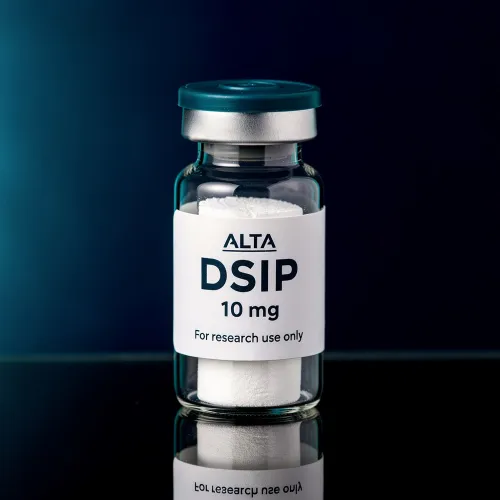
DSIP, delta sleep-inducing peptide, is a nonapeptide first isolated from rabbit cerebral blood in 1977 and studied for its effect on slow-wave sleep and stress hormones. The evidence is old and mixed, which the product page explains. Stocked in 10 mg lot-tested vials.
In brief: Sleep peptides are compounds studied for slow-wave sleep and stress-hormone endpoints; DSIP, delta sleep-inducing peptide, is the one with a dedicated literature. ALTA PEPTIDES stocks DSIP (10 mg) in UK stock, with the certificate of analysis published for DSIP (lot 2608055), dispatched the same working day before 1pm. Research use only.
The sleep range compared
| Compound | Mechanism | Size | Price | Per mg | Certificate |
|---|---|---|---|---|---|
| DSIPDelta sleep-inducing peptide | Nonapeptide; HPA-axis and sleep-EEG modulation | 10 mg vial | £24.99 | £2.50/mg | Lot 2608055 (manufacturer certificate) |
What the research covers
DSIP is a nonapeptide isolated from rabbit cerebral venous blood in 1977 by Schoenenberger and Monnier, named for the increase in delta-wave sleep it produced in recipient rabbits. Animal work in rabbits and rats reports increased slow-wave EEG sleep, reduced stress-induced corticotropin release, and effects on body temperature and pain thresholds; some studies failed to replicate the sleep effect. Small human studies in the 1980s and 1990s in insomnia and in alcohol or opioid withdrawal reported mixed results, and none was large or well controlled by modern standards. The more consistent thread is HPA-axis modulation rather than sleep itself. Its receptor and mechanism remain unknown, and it is not licensed as a medicine anywhere. The sleep peptides article and the DSIP explainer cover the literature.
Searches for peptides for sleep mostly land on DSIP because of its name. The body's own sleep peptides, orexin, melanin-concentrating hormone and the pineal system, are what any sleep peptide research is measured against. None of them is a research product we sell, and the licensed sleep medicines that target orexin are small molecules, not peptides.
Where DSIP sits
DSIP is the only compound in this category. Two neighbours share endpoints with it. Epitalon, in longevity and cellular, is studied for melatonin-rhythm normalisation in aged animals, so the two are often run on circadian readouts together. Selank, in brain and focus, is studied for GABAergic modulation, and DSIP with Selank is the HPA-axis pairing in the stack builder. DSIP is relatively fragile in solution and light-sensitive because of its tryptophan residue; the product page gives the storage detail.
Buying in the UK
DSIP is not a controlled substance in the UK and is not a licensed medicine anywhere: an unlicensed research chemical, legal to buy and possess, supplied for laboratory use only and not for human use.
Everything on this page is held in UK stock and dispatched the same working day before 1pm Monday to Friday by Royal Mail Tracked 48 (£4.95, free over £75) in plain packaging. Certificates: published for DSIP (lot 2608055). That is the manufacturer's or supplier's paperwork published as received; ALTA's own independent test of each lot is added to the certificates page as it arrives. DSIP counts towards the automatic stack discount when ordered with another single-compound peptide: 10% off the peptide lines for two compounds, 15% for three, 20% for four or more, via the stack builder.
Questions
DSIP has the dedicated sleep literature: rabbit and rat EEG studies and small mixed human studies. Epitalon is studied for melatonin rhythm rather than sleep directly. No peptide is a licensed sleep medicine anywhere.
No. It is an unlicensed research peptide with an old and mixed literature, supplied as a laboratory reagent. Nothing on this site is guidance on using it for sleep or anything else.
Yes. DSIP is not a controlled substance; it is legal to buy and possess as a research chemical and is sold for laboratory use only, not for human use.
DSIP: the manufacturer's QC batch certificate for lot 2608055 is published on the certificates page, reporting purity 98.94% by HPLC and identity by mass spectrometry. ALTA's own independent third-party test of each lot is pending and is published on the same page as it arrives; no lot is described as independently tested until it is.
Guides for this category
- Semax vs Selank: what each peptide is and how the research differsAn ACTH fragment analogue and a tuftsin analogue, both from the same Moscow institute, with different proposed mechanisms and a shared evidence gap outside Russia.
- What is DSIP? The delta sleep-inducing peptide, its origin and what the research showsA nine-residue peptide found in the blood of sleeping rabbits nearly fifty years ago, with a name that promises more than the evidence has delivered, and a genuinely unresolved question about where it comes from.
- Peptides studied for sleep: DSIP, epitalon and what the research measuredSleep is regulated by peptides, from orexin to the pineal system, and two research peptides sit in that literature: DSIP, named for the slow-wave sleep it produced in rabbits in 1977, and epitalon, studied for melatonin rhythm. What the research measured and where it stands.
- What is epitalon? The four-amino-acid ageing peptide and what the evidence really showsEpitalon (epithalon) is a four-amino-acid peptide, Ala-Glu-Asp-Gly, designed in St Petersburg from a cow pineal-gland extract. It switched on telomerase and lengthened telomeres in human cells, and modestly extended the lives of the longest-lived mice. Almost all of that work comes from one group; a 2025 UK study has now repeated the telomere finding in cells. What it is, what the evidence shows and its limits.
Other research areas
- Weight & Metabolic: GLP-1 family and mitochondrial peptides studied for energy balance and metabolism.
- Recovery & Repair: Peptides studied in tissue, tendon and gut models.
- Copper & Skin: GHK-Cu and copper-peptide stacks studied in dermal and wound models.
- Brain & Focus: Nootropic peptides from the Russian literature, supplied as lyophilised powder.
- Growth Hormone: GHRH analogues and secretagogues studied for pulsatile GH release.
- Longevity & Cellular: Peptides studied in ageing, telomere and mitochondrial research.
- Libido & Tanning: Melanocortin receptor agonists.
- Myostatin Antibodies: Research-grade antibodies against myostatin, activin A and the activin type II receptors.
- Water & Accessories: Bacteriostatic water, syringes and swabs for reconstitution.
Related: certificates of analysis, peptide calculator, build a stack, FAQ, all research peptides.
Research use only
Every product on this site is sold as a laboratory reagent for in-vitro and analytical research. Not for human or veterinary use, not a medicine, not a supplement. By ordering you confirm you are 18 or over and accept our research use policy.