 No. 005
 BlendNo. 006
GLOW Stack
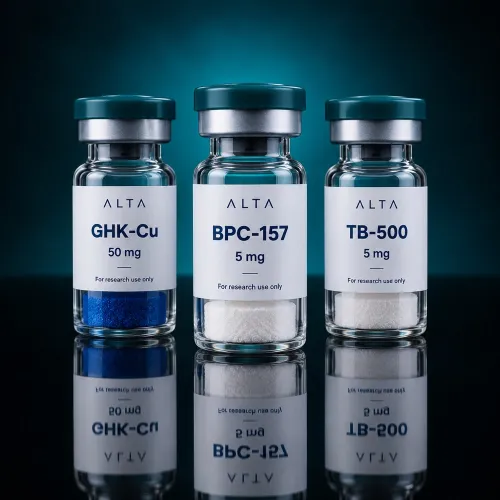
GHK-Cu 50 mg + BPC-157 5 mg + TB-500 5 mg, three vials
- Size
- 50 mg + 5 mg + 5 mg
- HPLC
- ≥99%
- Lot
- per vial
£54.99£0.92/mg
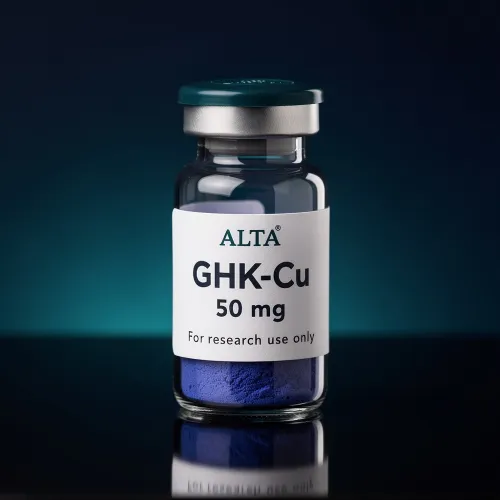
GHK-Cu, the copper complex of glycyl-histidyl-lysine, has one of the largest literatures in dermal research: collagen and elastin synthesis, wound contraction, antioxidant enzyme activity and hair-follicle models. It is stocked here as the lyophilised research peptide in 50 mg vials, and in the GLOW stack with BPC-157 and TB-500. Both are refrigerated rather than frozen, and both carry a per-lot certificate.
In brief: Copper peptides are the copper(II) complex of glycyl-histidyl-lysine, GHK-Cu, studied in fibroblast culture, animal wound models and small topical trials. ALTA PEPTIDES stocks GHK-Cu (50 mg) and the GLOW Stack (GHK-Cu with BPC-157 and TB-500 as three separate vials) in UK stock, with the certificate of analysis published for GHK-Cu (lot 2607177), dispatched the same working day before 1pm. Research use only.
The copper and skin range compared
| Compound | Mechanism | Size | Price | Per mg | Certificate |
|---|---|---|---|---|---|
| GHK-CuCopper peptide GHK-Cu | Copper delivery and broad transcriptional modulation | 50 mg vial | £24.99 | £0.50/mg | Lot 2607177 (manufacturer certificate) |
| GLOW StackGHK-Cu 50 mg + BPC-157 5 mg + TB-500 5 mg, three vials | Two separate vials; see the component compounds | 50 mg + 5 mg + 5 mg vials | £54.99 | £0.92/mg | GHK-Cu: Lot 2607177 (manufacturer certificate); BPC-157: Pending; TB-500: Lot 2607024 (manufacturer certificate) |
What the research covers
GHK-Cu has one of the larger literatures among research peptides. In cultured fibroblasts it stimulates collagen, elastin and glycosaminoglycan synthesis; in animal wound models it promotes contraction and re-epithelialisation; it increases antioxidant enzyme activity; and in gene-array studies it alters the expression of several thousand genes, many involved in tissue remodelling. Small human trials of topical copper-peptide preparations report improved skin density, firmness and wound healing, and ex vivo hair-follicle models report increased follicle size. The injectable research form has no controlled human data. The GHK-Cu explainer and its topical versus injectable section go through the studies.
The GLOW Stack is GHK-Cu, BPC-157 and TB-500 supplied as three separate vials rather than a co-lyophilised blend. The individual literatures apply: matrix synthesis from GHK-Cu, angiogenic signalling from BPC-157, cell migration from TB-500. There are no published studies of the combination itself.
Where GHK-Cu sits
A dermal, collagen or hair-follicle design needs GHK-Cu alone, and at 50 mg per vial it is the lowest price per milligram in the range. A wound-model design that wants matrix synthesis, vascular signalling and cell migration in one order takes the GLOW Stack, priced below the three vials bought separately even after the stack discount. Because the three arrive as separate vials, each can be run alone as a control and the ratio varied. Anyone weighing a copper peptide serum against a research vial should read the skin peptides round-up: serums are finished cosmetics at cosmetic concentrations; our vial is the pure lyophilised peptide for a laboratory to formulate and test. The recovery compounds on their own are in recovery and repair.
Buying in the UK
GHK-Cu is not a controlled substance and is legal to buy and possess; it is widely used as a cosmetic ingredient, and the research-grade peptide is unlicensed and sold for laboratory use only. BPC-157 and TB-500 in the GLOW Stack are unlicensed research chemicals and are prohibited in tested sport by WADA.
Everything on this page is held in UK stock and dispatched the same working day before 1pm Monday to Friday by Royal Mail Tracked 48 (£4.95, free over £75) in plain packaging. Certificates: published for GHK-Cu (lot 2607177). That is the manufacturer's or supplier's paperwork published as received; ALTA's own independent test of each lot is added to the certificates page as it arrives. GHK-Cu counts towards the automatic stack discount when ordered with another single-compound peptide: 10% off the peptide lines for two compounds, 15% for three, 20% for four or more, via the stack builder.
Questions
Yes. GHK-Cu is not a controlled substance and is widely used as a cosmetic ingredient; the research-grade lyophilised peptide is unlicensed and sold for laboratory use only.
Serums are finished cosmetics containing GHK-Cu at low concentration with other ingredients. Our 50 mg vial is the pure copper peptide as a lyophilised powder for in-vitro or formulation research, with the certificate of analysis for its lot published.
Because it is the copper(II) complex. Free GHK without copper is colourless; the blue colour is a quick visual check that the vial holds the copper peptide. The certificate reports copper content alongside purity.
GHK-Cu: the manufacturer's QC batch certificate for lot 2607177 is published on the certificates page, reporting purity 99.8% by HPLC and identity by mass spectrometry. ALTA's own independent third-party test of each lot is pending and is published on the same page as it arrives; no lot is described as independently tested until it is.
Guides for this category
- GHK-Cu copper peptide: what it is, why it is blue, topical vs injectable, and what the research saysA three-residue peptide that binds copper, turns blue, declines with age and has one of the broadest gene-expression footprints of any small molecule studied.
- GLOW vs KLOW peptide blends: what is in each, what KPV is, and which we sellGLOW is GHK-Cu, BPC-157 and TB-500 together; KLOW is the same three plus KPV. What each component is, what the research on each covers, and why the blend format has trade-offs.
- Peptides studied for skin and hair: a research round-upA tour of the peptides that appear in skin and hair research, from GHK-Cu and the cosmetic signal peptides to the neurotransmitter-inhibiting and carrier types, what each body of work measured, and where research-grade reagents fit.
- How to store peptides, and how long lyophilised peptides last at room temperatureTemperatures, light, moisture, freeze-thaw cycles and aliquoting: what actually determines how long a peptide stays within specification.
- How to read a peptide certificate of analysisHPLC purity, mass spec identity, net peptide content and endotoxin: what each line on a COA means and which ones sellers tend to leave out.
- What are peptides? Amino acid chains, proteins, hormones and synthesisThe chemistry behind the word: what a peptide chain is, where the line with proteins sits, what peptide hormones do, and how a synthetic peptide is built one residue at a time.
- How to buy research peptides in the UK: the supplier checklistTen things to check before ordering from any UK peptide supplier, from lot-matched certificates to where the stock physically sits, and the questions a good supplier will refuse to answer.
Other research areas
- Weight & Metabolic: GLP-1 family and mitochondrial peptides studied for energy balance and metabolism.
- Recovery & Repair: Peptides studied in tissue, tendon and gut models.
- Brain & Focus: Nootropic peptides from the Russian literature, supplied as lyophilised powder.
- Growth Hormone: GHRH analogues and secretagogues studied for pulsatile GH release.
- Longevity & Cellular: Peptides studied in ageing, telomere and mitochondrial research.
- Libido & Tanning: Melanocortin receptor agonists.
- Sleep: Delta sleep-inducing peptide.
- Myostatin Antibodies: Research-grade antibodies against myostatin, activin A and the activin type II receptors.
- Water & Accessories: Bacteriostatic water, syringes and swabs for reconstitution.
Related: certificates of analysis, peptide calculator, build a stack, FAQ, all research peptides.
Research use only
Every product on this site is sold as a laboratory reagent for in-vitro and analytical research. Not for human or veterinary use, not a medicine, not a supplement. By ordering you confirm you are 18 or over and accept our research use policy.