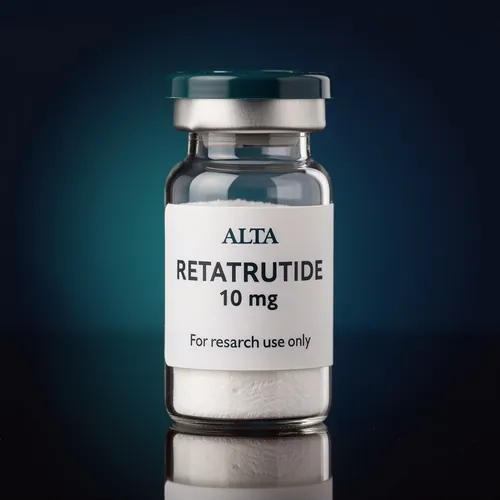
Retatrutide, tirzepatide and semaglutide are the three incretin-class peptides that dominate search interest, and the comparison between them is one of the most-asked questions in this field. Two are licensed medicines available on prescription; one is an investigational compound with no licence anywhere. This article sets out retatrutide vs tirzepatide vs semaglutide on chemistry, receptor pharmacology, regulatory status and the headline results from their pivotal trials, using published figures. It is information about the scientific record. Retatrutide is supplied on this site strictly as a research reagent, and nothing here is guidance on use in people.
Three compounds, three receptor profiles
Semaglutide (Ozempic, Wegovy; Novo Nordisk) is a 31-residue analogue of the gut hormone GLP-1 with a C18 fatty diacid side chain that binds albumin and extends its half-life to about a week. It activates one receptor, GLP-1R.
Tirzepatide (Mounjaro, Zepbound; Eli Lilly) is a 39-residue peptide based on the GIP sequence, engineered to activate both the GIP receptor and the GLP-1 receptor, with a C20 fatty diacid side chain. It is the first licensed dual agonist.
Retatrutide (LY3437943; Eli Lilly, investigational) is also 39 residues with a C20 diacid, engineered to activate three receptors: GLP-1R, GIPR and the glucagon receptor. The glucagon component is the distinguishing feature; glucagon receptor activation increases energy expenditure and hepatic fat oxidation in animal models, which is the rationale for adding it. The trade-off is that glucagon also raises blood glucose, so the balance of the three activities was tuned to keep the GLP-1 and GIP effects dominant.
Regulatory status
Semaglutide and tirzepatide hold marketing authorisations in the UK, EU and US for type 2 diabetes and for weight management, and are prescription-only medicines. Retatrutide holds no marketing authorisation in any country and is in phase 3 trials (the TRIUMPH programme) in obesity, type 2 diabetes, obstructive sleep apnoea and knee osteoarthritis. Every retatrutide vial outside those trials is unlicensed. In the UK it is not a controlled substance and is lawful to possess; supplying it for human use is an offence. Our retatrutide page sets this out in detail.
Trial results
The figures below are from separate trials with different designs, durations and populations, and are not a head-to-head comparison. They are reproduced because they are what the published record says.
Semaglutide, STEP 1 (NEJM 2021): adults with obesity without diabetes, 68 weeks, 2.4 mg weekly. Mean body-weight change minus 14.9% versus minus 2.4% with placebo.
Tirzepatide, SURMOUNT-1 (NEJM 2022): adults with obesity without diabetes, 72 weeks. Mean body-weight change minus 15.0%, minus 19.5% and minus 20.9% at the 5, 10 and 15 mg doses, versus minus 3.1% with placebo.
Retatrutide, phase 2 (NEJM 2023): adults with obesity without diabetes, 48 weeks. Mean body-weight change minus 17.5% at 4 mg, minus 22.8% at 8 mg and minus 24.2% at 12 mg, versus minus 2.1% with placebo, with weight still falling at the end of the study.
The obvious reading, that the triple agonist produced the largest reduction in the shortest time, is the reason for the interest in the compound. The equally important reading is that the retatrutide result comes from a phase 2 study of 338 participants, against phase 3 programmes of several thousand for the two licensed products, and that phase 3 results for retatrutide are still awaited. Trials that look better in phase 2 do not always look as good in phase 3.
Adverse events
All three share the class profile of gastrointestinal effects, nausea, vomiting, diarrhoea and constipation, that are dose-dependent and most frequent during escalation. Retatrutide's phase 2 additionally reported dose-related increases in heart rate and, in a minority of participants, skin sensitivity (dysaesthesia); the glucagon component is thought to contribute to the heart-rate effect. Long-term safety of retatrutide is unknown, which is a large part of what phase 3 exists to establish. For the licensed products the safety information is in their product literature.
What "retatrutide vs Mounjaro" misses
The comparison people search for treats the three as alternatives. They are not. Two are medicines a UK prescriber can issue and a pharmacy can dispense, with a known safety profile and a regulator watching them. The third is a research chemical whose human safety profile is being written in trials that have not finished. That difference matters more than any percentage in the tables above, and it is why we sell retatrutide for laboratory research only under our research use policy, and refuse orders that indicate otherwise.