NAD+ injections have become one of the most searched-for products in the UK longevity market, and the listings are a confusing mix of pens, vials, clinic drips and oral precursors that are not NAD+ at all. This article sorts them out. It explains what NAD+ is, how it differs from NMN and NR, what each injectable format actually contains, where the law sits, and what to check on a listing. It is a description of the market and the published science, not guidance on using anything.
- NAD+ (nicotinamide adenine dinucleotide) is a coenzyme present in every living cell; it carries electrons in energy metabolism and is a substrate for sirtuins, PARPs and CD38.
- NMN and NR are precursors the cell converts into NAD+; they are sold as oral supplements. NAD+ itself is largely broken down in the gut, so NAD+ products for research are solutions or powders, not tablets.
- UK NAD+ injection products come as pre-filled pens (solution in a device), lyophilised vials (powder), and clinic intravenous infusions.
- NAD+ has no marketing authorisation as a medicine in the UK. Vitamin B12 for injection is prescription-only when supplied for human use.
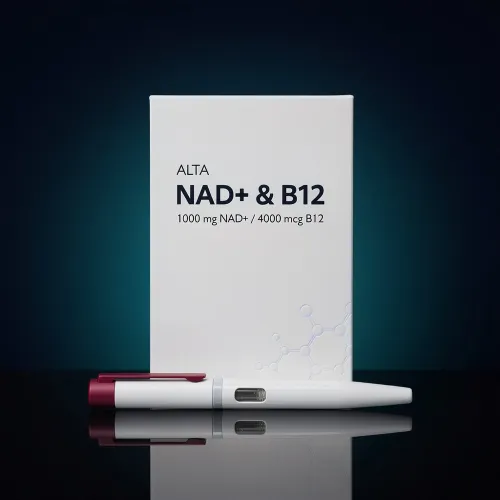
- ALTA PEPTIDES supplies one NAD+ product, the Synedica NAD+ & B12 pen, sealed as received from the manufacturer, for laboratory research only.
What NAD+ is
Nicotinamide adenine dinucleotide is a coenzyme found in every living cell. It cycles between an oxidised form, NAD+, and a reduced form, NADH, as it carries electrons through glycolysis, the citric acid cycle and the mitochondrial electron transport chain, which is to say it sits at the centre of how cells turn nutrients into usable energy. Beyond that redox role it is consumed as a substrate by three enzyme families that have made it central to ageing research: the sirtuins, which regulate gene expression and mitochondrial function; the PARPs, which repair DNA; and CD38, an NAD+-consuming enzyme whose activity rises with age. Tissue NAD+ levels fall with age in rodents and in human samples, and restoring them is the aim of a large research programme. It is not a peptide, although vendors often list it alongside peptides; it is a dinucleotide, and our product page is careful about the distinction.
NAD+ versus NMN and NR
NMN (nicotinamide mononucleotide) and NR (nicotinamide riboside) are precursors. The cell takes them up and converts them to NAD+ through the salvage pathway, and because they survive digestion they are sold as oral supplements, widely and legally. NAD+ itself does not survive the gut in useful amounts: it is cleaved to nicotinamide and other fragments before absorption, which is why NAD+ products intended to deliver the intact molecule are solutions for injection or infusion rather than tablets. In cell-culture and animal work the distinction matters because precursor conversion depends on which transporters and enzymes the tissue expresses, whereas NAD+ supplied directly bypasses those steps. Whether that translates to any difference in people is not established, and none of it is a basis for choosing anything for use in a person.
The formats sold in the UK
Pre-filled pens. A cartridge of NAD+ solution, often combined with vitamin B12 as cobalamin, in a metered injector with a box of disposable needles. Several manufacturers, Synedica among them, sell these to vendors as finished products. The manufacturer decides the concentration and the excipients, prints a batch number, and holds the batch certificate. The buyer receives a sealed device and cannot verify what is inside; traceability rests entirely on the manufacturer's paperwork.
Lyophilised vials. NAD+ as freeze-dried powder, usually 500 mg or 1,000 mg, to be reconstituted in the laboratory. This is the research-reagent format, with the same advantages as any peptide vial: the laboratory controls concentration and diluent, and the lot can be tested independently. NAD+ in solution is unstable, so the vial format also avoids the degradation clock that starts the moment a pen is filled.
Clinic infusions. Intravenous NAD+ offered by private wellness clinics, priced per session. These sit outside the research market entirely and are regulated, to the extent they are, as clinical services; they are mentioned here only because search results mix them in.
Why B12 is paired with NAD+
Vitamin B12 (cobalamin) is the cofactor for methionine synthase, which regenerates methionine from homocysteine and feeds the methylation cycle, and for methylmalonyl-CoA mutase in mitochondrial metabolism. The research interest in pairing the two comes from the overlap between one-carbon metabolism and NAD+ metabolism: the salvage pathway that recycles nicotinamide to NAD+ consumes methyl groups. Manufacturers combine them for that reason. Whether the combination has any additive effect has not been tested in a controlled study, and a combined pen is supplied for research into both compounds, not on the strength of any claim about the pair.
The legal position
NAD+ is not a controlled substance and has no marketing authorisation as a medicine in the UK for any indication. Vitamin B12 for injection is a prescription-only medicine when supplied for human use. A sealed pen supplied as a laboratory reagent, with no claims and no guidance on use in people, sits where every other research product sits; a vendor who markets the same pen as a treatment is placing an unlicensed medicine on the market. Our guide to UK law explains the framework, and our research use policy is why we decline orders that suggest human use.
What to check on a listing
For a pen: the manufacturer's name and batch number on the device and the box, the availability of the batch certificate, and whether the vendor supplies it sealed or has repackaged it. For a vial: a lot-matched certificate of analysis from a named laboratory, which is the same standard as for any peptide and is set out in our certificate guide. For both: UK stock, a registered company, and a listing that describes the product rather than promising outcomes. NAD+ listings are unusually heavy with claims about energy and ageing; treat that language as a mark against the vendor, not for the product.
What ALTA PEPTIDES supplies
We supply the Synedica NAD+ & B12 pen, 1,000 mg NAD+ with 4,000 mcg vitamin B12, boxed with twelve needles, sealed and unopened as received from the manufacturer, with Synedica's batch number on the pen and the batch certificate available on request. It is held in UK stock, dispatched the same working day before 1pm, and supplied for laboratory research only. We do not currently stock NAD+ vials; if that changes, they will appear in Longevity and Cellular alongside MOTS-c and epitalon.
Questions people ask
What is the difference between NAD+ and NMN?
NMN (nicotinamide mononucleotide) is a precursor; the cell converts it to NAD+ through the salvage pathway. NAD+ is the finished coenzyme. Oral NMN and NR products rely on that conversion; NAD+ products supply the molecule directly.
Are NAD+ injections legal in the UK?
NAD+ is not a controlled substance and has no medicines licence. Products are sold as research reagents or, by clinics, as wellness infusions outside the medicines framework. Supplying it for human use with claims is the vendor's legal exposure, and this site makes no such claims.
What is in an NAD+ pen?
A cartridge of NAD+ solution, sometimes combined with vitamin B12 (cobalamin), in a metered injector device with disposable needles. The manufacturer sets the concentration; the buyer cannot verify it.
Does ALTA PEPTIDES sell NAD+ vials?
Not at present. We supply the Synedica NAD+ & B12 pen as a sealed third-party product with the manufacturer's batch certificate on request.