GLP-1 receptor agonists are the most important class of peptide medicine of the last twenty years, and they are also the class with the largest grey market in research chemicals. Understanding what they are makes both facts easier to navigate. This article explains what incretin hormones do, how GLP-1 receptor agonist peptides were developed and engineered, which compounds are licensed medicines in the UK and which are investigational, and where the research-chemical supply of retatrutide fits. It is a science and regulatory explainer, not guidance on use.
Incretins
An incretin is a gut hormone released after a meal that increases insulin secretion in response to glucose. The effect was noticed a century ago: glucose taken by mouth produces a larger insulin response than the same glucose given intravenously, so something in the gut must be signalling to the pancreas. Two peptides account for most of it. Glucose-dependent insulinotropic polypeptide (GIP) is a 42-residue peptide from the upper small intestine. Glucagon-like peptide-1 (GLP-1) is a 30- or 31-residue peptide from the lower gut, cut from the same precursor protein as glucagon.
GLP-1 does several things at once: it stimulates insulin release only when glucose is high, suppresses glucagon, slows gastric emptying, and acts on the brain to reduce appetite. Those combined effects are why a GLP-1 receptor agonist lowers blood glucose without causing hypoglycaemia on its own and also reduces food intake. The catch with the natural hormone is that it is destroyed within about two minutes by the enzyme DPP-4, which makes it useless as a medicine in its native form.
From exenatide to semaglutide
The first practical GLP-1 receptor agonist came from an unlikely place. Exendin-4, a 39-residue peptide in the saliva of the Gila monster, a venomous lizard, was found in the early 1990s to activate the human GLP-1 receptor and, crucially, to resist DPP-4. Its synthetic version, exenatide, was licensed in 2005 as a twice-daily injection for type 2 diabetes: the first incretin mimetic.
The next generation modified human GLP-1 itself. Liraglutide (2009) attached a C16 fatty acid to the peptide so it binds albumin in the blood and is released slowly, extending its action to a day. Semaglutide (2017 for diabetes, 2021 for weight management as Wegovy) swapped one amino acid to block DPP-4 and used a C18 fatty diacid on a longer linker, extending the half-life to about a week. Dulaglutide took a different route, fusing GLP-1 to an antibody fragment. Oral semaglutide, using an absorption enhancer, arrived in 2019. Each step was peptide engineering: change a residue, add a lipid, and a two-minute hormone becomes a weekly medicine.
Dual and triple agonists
Tirzepatide (Mounjaro, 2022) was built on the GIP sequence and engineered to activate both the GIP and GLP-1 receptors, with a C20 fatty diacid. Adding GIP activity produced larger effects on weight than GLP-1 alone in the SURMOUNT trials. Retatrutide, still investigational, adds a third receptor, glucagon, whose activation increases energy expenditure and liver fat oxidation in animal models; its phase 2 and first phase 3 results are covered in our trials article and the comparison. Several other combinations, including amylin co-agonists such as cagrilintide with semaglutide, and oral small-molecule GLP-1 agonists such as orforglipron, are in late development.
Licensing status in the UK
Exenatide, liraglutide, dulaglutide, semaglutide and tirzepatide are licensed prescription-only medicines in the UK, available through the NHS under NICE criteria and privately. They are made by their originators and dispensed by pharmacies; a "compounded" or "research" semaglutide sold online is neither, and the MHRA has issued repeated warnings about counterfeit pens. Retatrutide and the other pipeline compounds are unlicensed everywhere. Our UK law article explains why that distinction determines what any supplier can lawfully do.
Where research supply fits
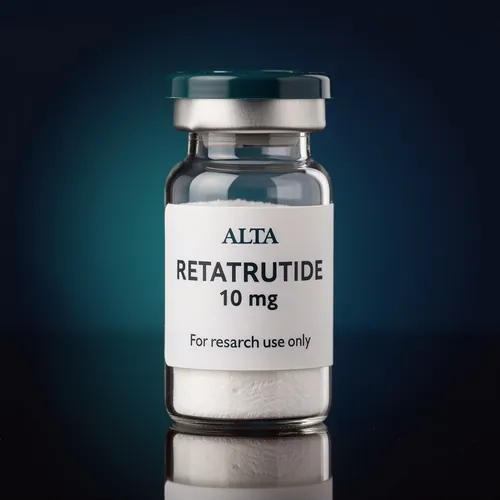
A research-chemical supplier has no role in the licensed products: they are medicines, and supplying them outside the pharmacy system is unlawful. The legitimate research market is in the investigational compounds, where a laboratory studying incretin receptor pharmacology, peptide stability, analytical methods or in-vitro signalling needs a defined, tested reagent. That is the basis on which we supply retatrutide: a lyophilised peptide with per-lot HPLC and mass spectrometry, described only by its chemistry and the published trial record, sold under our research use policy and never for human use.
Class effects worth knowing
For completeness of the scientific record: all GLP-1 receptor agonists share a profile of gastrointestinal adverse events in trials, dose-dependent and most frequent during dose escalation; carry a warning about thyroid C-cell tumours seen in rodents; and are associated in trials with reductions in cardiovascular events for the licensed products with outcomes data. None of this is a description of any research reagent's safety, which has not been established, and none of it is advice.