GHK-Cu is the one research peptide that most people have already met, because it is the copper peptide in a generation of skincare serums. It has also been studied by injection in animal models of lung, liver and nerve injury, and the two literatures are often quoted as if they were one. They are not. The route decides what a study can measure, and a topical result says nothing about a systemic one. This article separates the topical and injectable research, explains how a cosmetic copper peptide serum relates to a research-grade vial, and describes what is on the certificate. It describes the research; it is not guidance on use.
- GHK-Cu is the tripeptide glycine-histidine-lysine complexed with copper(II), first isolated from human plasma by Loren Pickart in 1973.
- Topical studies (creams, serums, dressings) measure skin and wound outcomes in the treated area; injectable studies in animals measure systemic and tissue-level readouts.
- Cosmetic copper peptide serums typically contain GHK-Cu at 0.1 to 3 percent by weight; a research vial is the pure lyophilised complex, 50 mg, reconstituted in the laboratory.
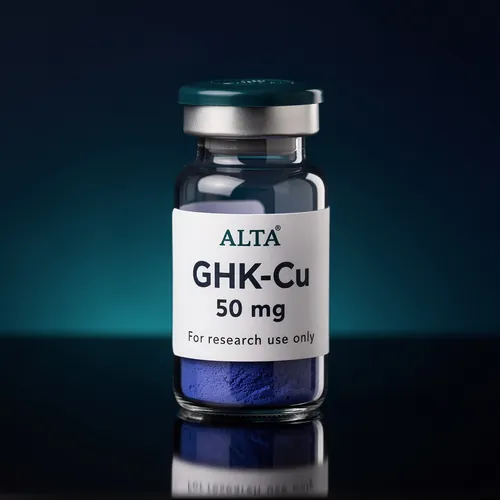
- GHK-Cu is blue in solution because of the copper complex; a colourless copper peptide serum contains very little of it.
- The compound is not a licensed medicine by any route and is supplied here for laboratory research only.
What GHK-Cu is
GHK is the tripeptide glycine-histidine-lysine, a fragment released when larger proteins such as collagen are broken down. It binds copper(II) with high affinity through the histidine imidazole and the terminal amine, and the complex, GHK-Cu, is a distinctive blue. Loren Pickart isolated it from human plasma in 1973 and reported that its concentration falls with age, which set the research direction that has followed since. Our GHK-Cu explainer covers the chemistry and the product page the specification.
The topical research
The largest body of GHK-Cu work is topical, because copper peptides moved into cosmetics in the 1990s and the industry funded studies. The typical design applies a GHK-Cu cream, gel or serum to skin or to a wound and measures the treated area: collagen and elastin synthesis in cultured fibroblasts, skin thickness and elasticity by instrument in volunteers, wound closure rates in animal models and in some small human series, and hair follicle activity in mouse and ex vivo human follicle models. The best-known human studies are small, cosmetic in framing, and report changes in the skin where the product was applied. Wound-dressing work in animals is more robust and is the origin of the tissue-repair reputation. None of it measures anything outside the treated area, because a topical route does not reach anything else in meaningful amounts.
The injectable research
The injectable literature is entirely preclinical. GHK-Cu given by injection or intraperitoneally to rodents has been studied in models of acute lung injury, where it reduced inflammatory markers and tissue damage; in liver fibrosis models; in models of nerve regeneration; and in gene-expression work, where Pickart's group reported that GHK reset the expression of a large set of genes in cultured cells toward a younger pattern. These studies measure systemic or tissue-level readouts that a topical study cannot, and they are the basis for the interest in GHK-Cu beyond skin. There is no controlled human study of injectable GHK-Cu, and the compound is not licensed as a medicine by any route in any country.
Why the route matters
A peptide applied to skin stays largely in the skin: the stratum corneum limits penetration, and what does get through is in the local tissue. That is what makes topical GHK-Cu studiable for skin and wounds and useless for anything else. An injected peptide enters circulation and reaches every tissue, which is why the injectable studies could ask about lung and liver. The two routes are answering different questions, and a claim that pulls a lung-injury result into a skincare context, or a skin-elasticity result into a systemic one, is mixing literatures that do not connect. Research design starts with the route.
Copper peptide serums versus a research vial
A cosmetic copper peptide serum is a formulated product: water, humectants, a preservative system, sometimes a carrier such as hyaluronic acid, and GHK-Cu at a concentration the label almost never states. Industry norms run from 0.1 to about 3 percent by weight, and the colour is the tell: GHK-Cu is blue, so a pale serum contains little of it, and a colourless one may contain GHK without copper. A 30 mL serum at a true 1 percent would hold about 300 mg of GHK-Cu, which is more than most consumers imagine and far more than most products deliver.
A research vial is the other end of the scale in a different sense: 50 mg of the pure lyophilised complex, nothing else, with the purity by HPLC and the identity by mass spectrometry on a lot-matched certificate. The laboratory decides the concentration by choosing how much bacteriostatic water to add; our calculator does the arithmetic and our reconstitution guide the technique. Laboratories studying topical GHK-Cu formulate it into gels and creams themselves from exactly this kind of vial, because that is the only way to know what concentration they are testing.
What is on the certificate, and what is not
Our certificate reports purity by HPLC, identity by mass spectrometry, and net peptide content, which for GHK-Cu accounts for the copper and the counter-ion. It does not report anything about formulation, penetration or effect, because those are not properties of the reagent. A cosmetic product has no certificate at all in this sense; it has a safety assessment, which is a different document answering a different question. Our guide to reading a certificate explains each line.
What ALTA PEPTIDES supplies
GHK-Cu as a sealed 50 mg lyophilised vial at £24.99, tested per lot by an independent UK laboratory with the certificate published, held in UK stock and dispatched the same working day before 1pm; also as part of the GLOW stack with BPC-157 and TB-500. Supplied for laboratory research only, under our research use policy. We sell no serums, creams or finished topical products and give no guidance on making them for use in people.
Questions people ask
Is topical GHK-Cu the same as injectable GHK-Cu?
The molecule is the same. The formulation, concentration and what a study can measure are not: topical work looks at the treated skin or wound, injectable work in animals looks at tissues and systemic markers.
Why is GHK-Cu serum colourless when the research vial is blue?
The copper complex is blue. A serum that is not blue contains either a very low concentration or GHK without copper. Concentration on cosmetic labels is rarely stated.
Can a research vial be used to make a topical formulation?
Laboratories formulate GHK-Cu into gels and creams for topical studies; that is a research activity and the vial is supplied for research. This site gives no guidance on formulating anything for use in people.
How does a 50 mg vial compare with a copper peptide serum?
A 30 mL serum at 1 percent contains about 300 mg of GHK-Cu, in principle; in practice most cosmetic products are far below 1 percent and do not state the figure. The vial is 50 mg of certified material with the purity on the certificate.