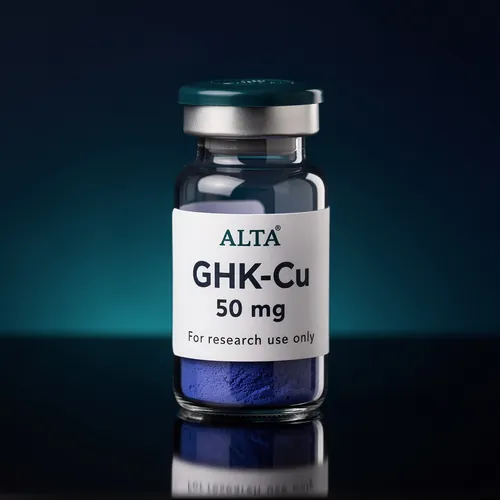
GHK-Cu is the copper complex of a tripeptide, glycyl-L-histidyl-L-lysine, and it is the compound people mean when they say "copper peptide". It is one of the very few peptides in this category that occurs naturally in human plasma at measurable concentration, and one of the few with a substantial literature in human skin, largely because it has been used in cosmetic formulations for thirty years. It is also the reason a vial in our range is blue. This article covers what GHK-Cu is, where it comes from, why the colour, and what the research base looks like. It is a summary for laboratory purposes; we supply the compound as a research reagent only.
Discovery and occurrence
Loren Pickart identified GHK in 1973 while studying why liver tissue from young donors behaved differently in culture from tissue from older donors; a small factor in young plasma turned out to be the tripeptide. Later work established that GHK circulates in plasma at around 200 ng/mL in people in their twenties and falls to roughly 80 ng/mL by age sixty, a decline that has framed much of the subsequent research. The peptide has a high affinity for copper(II) and in the body exists largely as the copper complex, which is how it is supplied for research.
Why it is blue
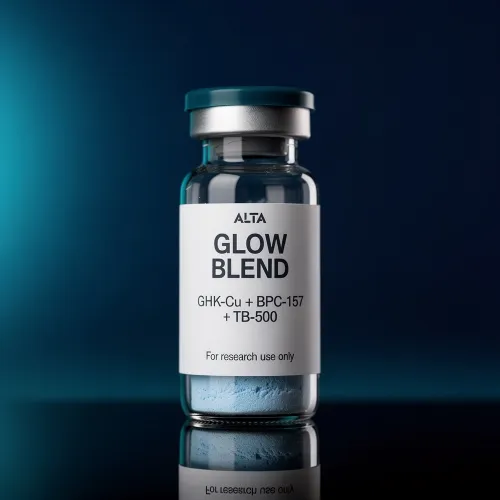
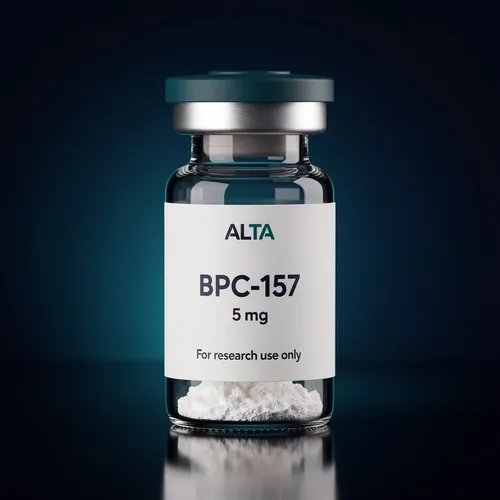
Free GHK is a white powder. Add copper and the histidine imidazole, the terminal amine and the peptide backbone nitrogen coordinate the Cu(II) ion in a square-planar arrangement. Copper(II) in that environment absorbs light in the red and orange part of the spectrum through d-d electronic transitions, so the complex transmits and reflects blue-violet. The intensity of the colour in our GHK-Cu vials is a direct visual indicator that the copper is bound; a solution that has gone green or brown has lost that coordination and should be discarded. The GLOW stack pairs the same GHK-Cu vial with BPC-157 and TB-500 as separate vials, so the blue is undiluted.
What the research reports
The largest body of evidence is in skin. In human fibroblast culture GHK-Cu increases collagen, elastin and glycosaminoglycan synthesis and stimulates the production of decorin, a proteoglycan involved in collagen fibril organisation. In animal wound models it accelerates closure and improves the quality of the repaired tissue, with more organised collagen and better vascularisation. Several small controlled studies of topical GHK-Cu formulations in human skin reported improvements in measured skin density, thickness and wrinkle depth over 12 weeks compared with vehicle; these are the studies that underpin its use in cosmetics.
The more striking finding came from the Broad Institute's Connectivity Map, a database that profiles how compounds change gene expression in human cells. GHK-Cu was found to alter the expression of roughly a third of the genes in the human genome, up-regulating genes associated with tissue repair, antioxidant defence and DNA repair and down-regulating genes associated with inflammation and, notably, a set of genes over-expressed in some cancers. That breadth is unusual for a three-residue peptide and has driven interest in it well beyond dermatology, including in models of lung fibrosis and nerve regeneration. It should be read as a hypothesis-generating screen rather than a demonstrated effect in any tissue.
What is not established
There is no licensed medicinal use of GHK-Cu and no large clinical trial of a systemic formulation. The cosmetic studies are small and industry-sponsored. Mechanism is incompletely understood: the copper delivery, the peptide itself and the complex may each contribute. As with every compound on this site, nothing in the research licenses any claim about what it does when administered to a person.
In the laboratory
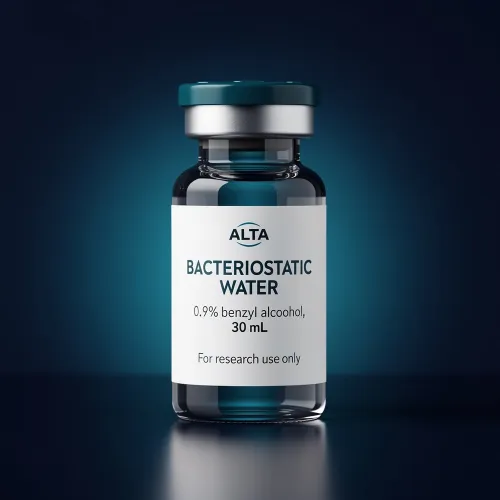
GHK-Cu is supplied as a blue lyophilised powder in 50 mg sealed vials, purity 99% or better by HPLC, copper content by ICP on the certificate. It dissolves almost instantly in bacteriostatic water to a clear blue solution. The complex is light-sensitive; keep both powder and solution in the dark. Molecular formula C14H22CuN6O4 (for the 1:1 complex), mass 401.9 g/mol. Research use only under our research use policy.