KPV is a tripeptide, lysine-proline-valine, and it is the shortest compound on this site by some margin. It is the tail end of alpha-melanocyte-stimulating hormone, the thirteen-residue pituitary peptide better known for darkening pigment, and it was singled out in the 1990s because that tail appeared to carry the hormone's anti-inflammatory activity without its effect on colour. Since then it has been studied mostly in models of gut inflammation. This article explains what KPV is, how it is thought to act, what the research reports, and what the KLOW blend that features it actually is. It describes the science and the reagent; it is not guidance on use.
- KPV is the tripeptide lysine-proline-valine, residues 11 to 13 of alpha-melanocyte-stimulating hormone (alpha-MSH).
- It retains alpha-MSH's anti-inflammatory activity in cell and animal models without the pigmentation activity, which needs the full sequence.
- The most cited work is in mouse colitis models, where KPV reduced inflammatory markers when given orally or by injection.
- Proposed mechanisms are inhibition of NF-kB signalling and uptake into intestinal cells through the PepT1 transporter.
- KLOW is a vendor name for KPV combined with GHK-Cu, BPC-157 and TB-500; it is not a compound. KPV is not a licensed medicine anywhere.
Where KPV comes from
Alpha-MSH is cleaved from the precursor protein pro-opiomelanocortin, the same precursor that yields ACTH and beta-endorphin. Its sequence is Ac-Ser-Tyr-Ser-Met-Glu-His-Phe-Arg-Trp-Gly-Lys-Pro-Val-NH2, and the pigmentation activity depends on the central His-Phe-Arg-Trp motif binding the melanocortin-1 receptor on melanocytes. In the 1980s and 1990s, work led by James Lipton and Anna Catania showed that alpha-MSH also suppressed inflammation in a range of models, and that a fragment as short as the last three residues, Lys-Pro-Val, kept much of that activity. Because KPV lacks the receptor-binding core, it does not act on pigment, which made it an attractive tool for studying the anti-inflammatory arm on its own.
How it is thought to act
Two mechanisms recur in the literature. The first is inhibition of NF-kB, the transcription factor that switches on inflammatory genes: in cultured cells KPV reduced NF-kB activation and the downstream production of cytokines such as IL-6, IL-8 and TNF-alpha in response to inflammatory stimuli. The second is transport. A 2008 study from Didier Merlin's group showed that KPV is taken up by intestinal epithelial cells through PepT1, the transporter that normally carries di- and tripeptides from digested food, and that once inside it dampened the inflammatory response; this is the basis for the oral studies and for the interest in gut models specifically. Neither mechanism requires a melanocortin receptor, which is the point of the fragment.
What the research reports
Colitis models. The most cited work uses chemically induced colitis in mice. KPV given in drinking water or by intraperitoneal injection reduced weight loss, colon shortening, histological damage and inflammatory cytokine levels compared with untreated animals, in dextran sulfate sodium and TNBS models. Later work delivered KPV in nanoparticles targeted to the colon and reported similar findings at much lower amounts of peptide.
Other inflammation models. Smaller bodies of work report reduced inflammatory markers in models of skin inflammation, in a mouse model of allergic airway inflammation, and in cultured cells challenged with bacterial products. There is also older in vitro work on antimicrobial activity against Candida and Staphylococcus, which has not been followed up in animals.
What there is not. There is no controlled human study of KPV for any purpose, no pharmacokinetic data in people, and no safety data beyond the animal models. The research record is a set of consistent preclinical findings in one main model, which is a good reason to study the compound and not a basis for any claim about people.
The KLOW blend
KLOW is a vendor coinage: the GLOW blend of GHK-Cu, BPC-157 and TB-500 with KPV added, the K standing for KPV. It is sold by some vendors as a single mixed vial. We do not sell mixed vials, for the reasons set out in our GLOW versus KLOW article: a blend has no single certificate, cannot have its ratio varied per component in an experiment, and cannot be run one compound at a time as a control. The four components are available separately, and adding KPV to the three GLOW vials in one order qualifies for the automatic stack discount.
Specification and handling
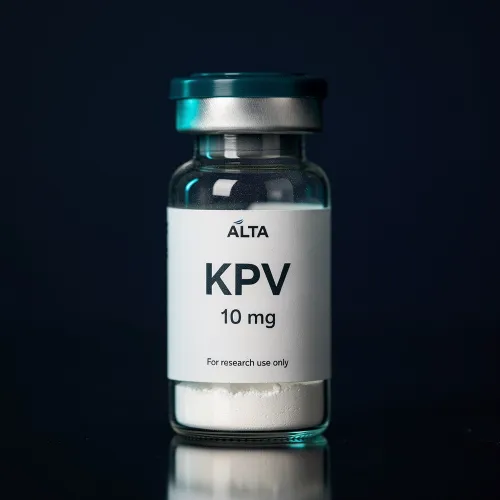
KPV is supplied as a 10 mg lyophilised vial, sequence Lys-Pro-Val, molecular formula C16H30N4O4, molecular weight 342.4 g/mol, purity by HPLC on the lot certificate. It has no oxidisable residues, so it is among the more stable peptides dry, and it reconstitutes readily in bacteriostatic water. Storage is as for any lyophilised peptide: sealed, frozen or refrigerated, out of light, per our storage guide. Our reconstitution guide and calculator cover preparation.
Legal status
KPV is not a controlled substance in the UK and has no marketing authorisation as a medicine anywhere. It is supplied as a laboratory reagent for research use only, under our research use policy, and we decline orders where correspondence suggests any other intent. Our UK law guide explains the framework that applies to it and to every other compound on the site.
Availability
KPV is listed on our product page at £29.99 for a 10 mg vial and will ship from UK stock, tested per lot by an independent UK laboratory, with same-day dispatch before 1pm once the first lot clears testing. If the page shows it as sold out, the lot is in transit or at the laboratory; the certificate is published before the first vial leaves.
Questions people ask
What does KPV stand for?
The single-letter codes of its three amino acids: K for lysine, P for proline, V for valine. It is the C-terminal end of alpha-MSH.
What is the difference between KPV and alpha-MSH?
Alpha-MSH is a 13-residue hormone that both darkens pigment and dampens inflammation. KPV is the last three residues and, in the published models, keeps the anti-inflammatory activity while losing the pigmentation effect.
What is the KLOW peptide?
Not a peptide but a blend: KPV plus GHK-Cu, BPC-157 and TB-500, named by vendors as a variant of the GLOW blend. We supply the components as separate vials rather than a mixture.
Is KPV legal in the UK?
It is not a controlled substance and has no medicines licence. It is supplied as a research reagent for laboratory use only.