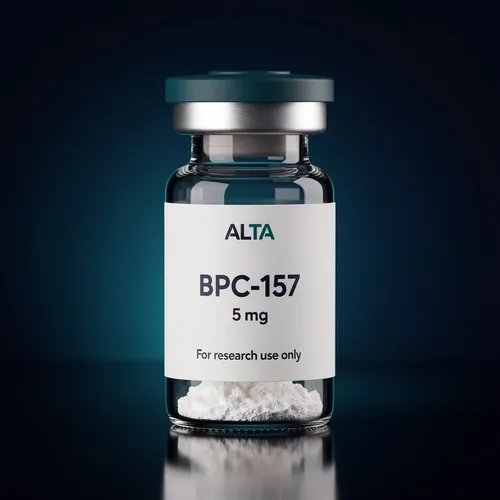
Every peptide we sell arrives as a lyophilised (freeze-dried) powder sealed in a glass vial. Lyophilisation is how peptides survive shipping and storage: with the water removed, the hydrolysis and oxidation reactions that degrade a peptide in solution slow to almost nothing. Before the peptide can be used in any assay it has to be returned to solution, and that step, peptide reconstitution, is where most avoidable losses happen. This guide covers how to reconstitute peptides in a way that protects the material and gives you a solution of known concentration. It is written for laboratory handling only; nothing here is guidance on administration or use in people or animals.
Choosing the diluent
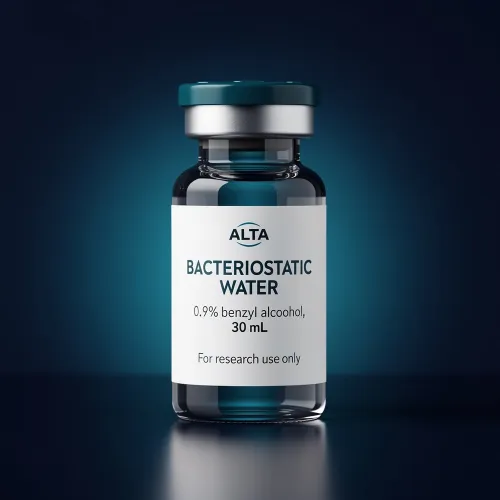
The default diluent for a research peptide that will be used over several sessions is bacteriostatic water: sterile water for injection-grade purity containing 0.9% benzyl alcohol as a preservative. The benzyl alcohol suppresses bacterial growth in the vial between uses, which is why multi-dose laboratory practice standardises on it. Bacteriostatic water for peptides is appropriate for the large majority of compounds in our range: BPC-157, TB-500, GHK-Cu, MOTS-c, epitalon, DSIP, Semax and Selank all dissolve readily in it.
Plain sterile water (no preservative) is used when the solution will be consumed in a single session or when benzyl alcohol would interfere with the assay. Some peptides with poor aqueous solubility, particularly hydrophobic sequences, need a small volume of a co-solvent first (acetic acid for basic peptides, ammonium bicarbonate for acidic ones, or a few percent DMSO) before dilution with water. None of the peptides we currently stock needs this, but it is worth knowing why the option exists.
Do not reconstitute with saline as a first choice. Sodium chloride can promote aggregation of some peptides at high concentration, and it adds nothing that bacteriostatic water does not already provide for storage.
Working out the volume
Concentration is simply mass divided by volume. A 5 mg vial reconstituted with 1 mL gives 5 mg/mL (5,000 µg/mL); with 2 mL it gives 2.5 mg/mL. The volume you choose depends on the concentration your protocol calls for and on how precisely you can measure sub-millilitre volumes with the equipment you have. A more dilute solution is easier to pipette accurately; a more concentrated one keeps the vial headspace small and takes up less cold-storage space.
Our peptide calculator does this arithmetic for you: enter the vial mass and the diluent volume and it returns the concentration per millilitre and per 0.1 mL graduation, so you can see at a glance what a given draw contains. It is arithmetic only; it does not and will not suggest quantities for any purpose.
Two practical points. First, the volume of a lyophilised cake is not zero, but it is small enough to ignore for a research-grade calculation; the powder in a 10 mg vial adds well under 1% to the final volume. Second, note the net peptide content on the certificate of analysis. A vial labelled 10 mg contains 10 mg of lyophilised material, of which typically 80 to 95% is peptide, the balance being counter-ions (usually trifluoroacetate or acetate) and residual water. For precise work, calculate concentration from net peptide content rather than gross mass.
Technique, step by step
1. Equilibrate
Take the vial out of cold storage and let it reach room temperature before you open it, usually 15 to 20 minutes. Opening a cold vial pulls condensation onto the powder, which adds water you have not accounted for and starts hydrolysis early.
2. Clean the stoppers
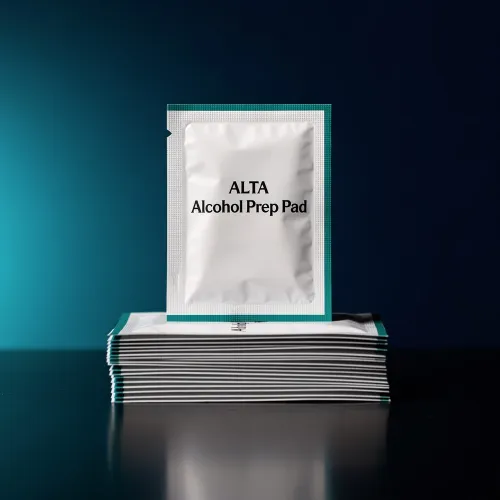
Remove the flip-off cap from the peptide vial and the diluent vial and wipe each rubber stopper with a fresh alcohol prep swab. Let the alcohol flash off; a wet stopper carries alcohol into the vial on the needle.
3. Draw the diluent
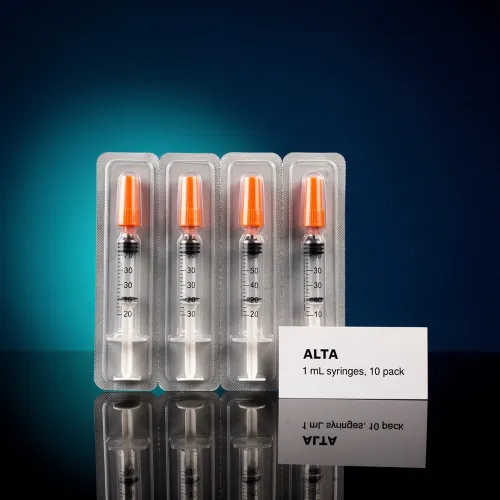
Using a sterile 1 mL syringe, draw the calculated volume of bacteriostatic water. A 1 mL syringe graduated in 0.01 mL steps is the right tool for volumes under 1 mL; for larger volumes use a 3 mL or 5 mL syringe, or a calibrated pipette.
4. Add it slowly, down the wall
Insert the needle through the peptide vial stopper at an angle and let the diluent run down the inside wall of the vial rather than jetting it onto the powder. Lyophilised peptides are fragile; a direct stream can shear longer sequences and foams the solution, and foam means denatured protein at the air interface.
5. Swirl, do not shake
Gently rotate the vial until the cake has dissolved. Most peptides in our range go into solution within a minute; GHK-Cu dissolves into a clear blue solution almost immediately. Do not shake, vortex or sonicate. If a peptide is slow to dissolve, leave it at room temperature for a few minutes and swirl again.
6. Inspect
The solution should be clear and free of particles. Slight opalescence in a concentrated solution is normal for some peptides; visible particulates, cloudiness that does not clear, or a colour change (other than the expected blue of copper peptides) mean the material has aggregated or degraded and should not be used.
7. Label and store
Write the peptide name, concentration, diluent, date of reconstitution and lot number on the vial. Return it to 2 to 8 °C, protected from light. Our storage guide covers how long reconstituted solutions remain usable and when to aliquot and freeze instead.
Common mistakes
Reconstituting the whole vial when only a fraction will be used within the stability window; drawing diluent from a bacteriostatic water vial that has been open for more than 28 days; using a needle that has already touched something else; storing the reconstituted vial in the door of a fridge where the temperature cycles; and, most often, not recording the concentration on the vial so that the next person has to guess. Each of these is avoidable with a few seconds of care.
What this guide is not
This is laboratory handling information for research reagents. It is not, and must not be read as, instruction on preparing anything for human or veterinary use. All products on this site are supplied under our research use policy and are not for consumption, injection or any form of administration.