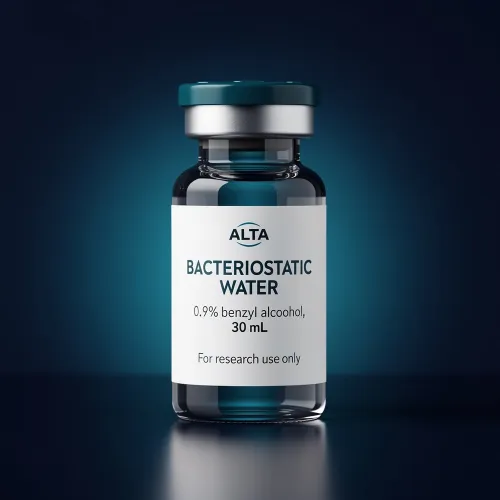
Bacteriostatic water, usually shortened to bac water, is sterile water containing 0.9% benzyl alcohol as a preservative. It is the standard diluent for reconstituting lyophilised research peptides that will be drawn from more than once, and it is the first accessory most laboratories order alongside a vial. This article explains what bacteriostatic water is, how it differs from sterile water for injection, why the 28-day rule exists, which peptides it suits, and what to check when buying bacteriostatic water in the UK. It is laboratory information for research use; nothing here is guidance on human or veterinary use.
What is bacteriostatic water?
Start with the water. Water for injection grade means purified water that meets pharmacopoeial limits for dissolved solids, endotoxin and microbial content, sterilised and filled into vials under aseptic conditions. On its own that is sterile water for injection. Add 0.9% w/v benzyl alcohol and it becomes bacteriostatic water. "Bacteriostatic" means the preservative stops bacteria from multiplying; it does not sterilise a contaminated solution, and it is not bactericidal at that concentration. Its job is to protect a multi-dose vial from the small number of organisms that inevitably enter each time the stopper is punctured.
The product comes in 10 mL and 30 mL glass vials with a rubber stopper and flip-off cap. The vial is not opened; diluent is drawn through the stopper with a sterile syringe. The bacteriostatic water we stock is the 0.9% benzyl alcohol formulation in both sizes.
Bacteriostatic water vs sterile water
The difference is the preservative and what it lets you do. Sterile water for injection has no preservative, so once its stopper is punctured it is a single-use item: whatever is not used immediately should be discarded, because there is nothing to stop contamination growing. Bacteriostatic water can be drawn from repeatedly over a period, which is why it is used for multi-dose reconstitution.
Sterile water is the right choice in two situations. First, when the whole reconstituted vial will be used in one session, so the preservative adds nothing. Second, when benzyl alcohol would interfere with the work: some cell-culture assays are sensitive to it, and a small number of proteins and peptides aggregate or lose activity in its presence at high concentration. For the peptides in our range that is not a practical problem at the concentrations laboratories use, but it is a real consideration in protein work and worth knowing.
Saline (0.9% sodium chloride) is a third option that turns up in forum advice. It is not a preservative solution, it is single-use once punctured like sterile water, and the salt can promote aggregation of some peptides. There is no laboratory reason to prefer it as a reconstitution diluent.
The 28-day rule
Pharmacopoeial guidance for multi-dose vials of bacteriostatic water is to discard the vial 28 days after the stopper is first punctured. Benzyl alcohol at 0.9% suppresses growth for that long under refrigerated or room-temperature storage with reasonable technique; beyond it the guarantee runs out. Write the date of first puncture on the vial. Because a reconstituted peptide inherits its diluent's preservative, this is also where the four-week window for reconstituted peptides comes from, as explained in our storage guide.
Storage and handling
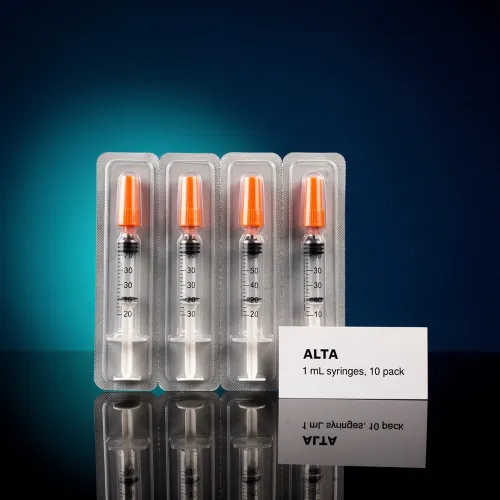
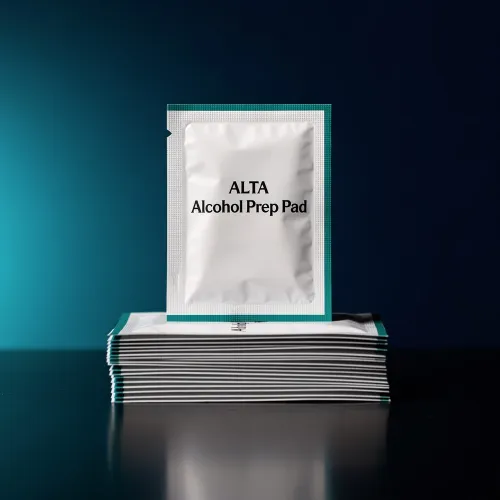
Unopened bacteriostatic water is stored at room temperature, protected from light, and has a shelf life of two to three years from manufacture. After first puncture, refrigeration is sensible but not required. Wipe the stopper with an alcohol swab before each draw, use a new sterile syringe every time, and never return unused liquid to the vial. A vial that has become cloudy, contains particles or has a cracked seal should be discarded.
Benzyl alcohol has a faint sweet, slightly medicinal smell, which is normal. It is also why the product carries a caution against use in neonates in clinical settings; that caution is about a medical context that has nothing to do with laboratory reconstitution, but it is on the label and worth understanding.
Compatibility with peptides
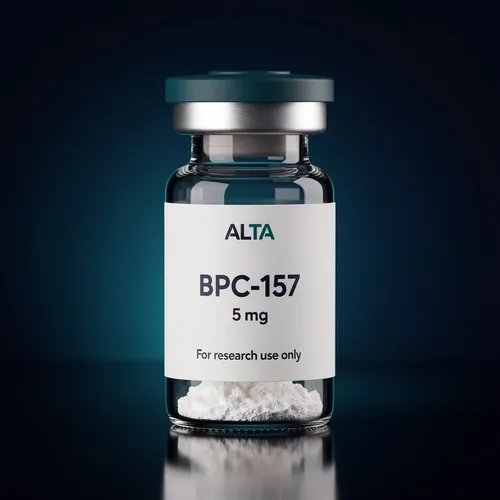
All the peptides we stock reconstitute cleanly in bacteriostatic water: BPC-157, TB-500, GHK-Cu, MOTS-c, epitalon, DSIP, Semax, Selank and retatrutide. Add the water slowly down the wall of the vial and swirl; do not shake. The full procedure, including working out the volume for a target concentration, is in our reconstitution guide and the calculator does the arithmetic.
Buying bacteriostatic water in the UK
Bacteriostatic water UK supply comes either from pharmaceutical wholesalers, who generally sell only to registered healthcare accounts, or from research suppliers like us. What to check: the label should state 0.9% benzyl alcohol and "water for injection" grade with a lot number and expiry date; the vial should be glass with an intact crimp seal and flip-off cap; and the seller should ship it in the UK rather than importing to order, since a vial that has spent weeks in a hot container is not worth having. Ours is UK-stocked, dispatched the same day before 1pm, and priced per vial with free delivery over the site threshold. It is supplied, like everything here, for laboratory research only under our research use policy.