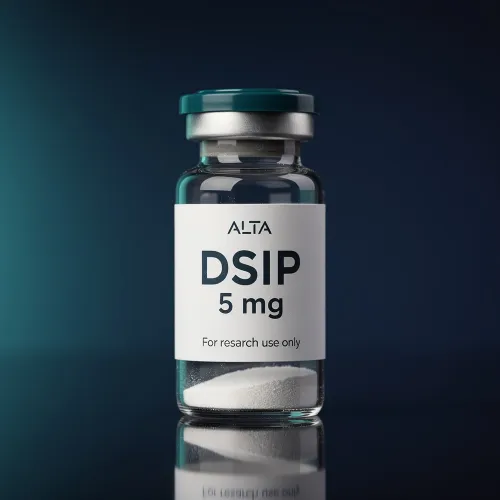
DSIP stands for delta sleep-inducing peptide, and the name is both its claim to fame and its problem. It was coined in 1977 for a small peptide isolated from the blood of rabbits during induced sleep, on the basis of what it appeared to do when given to other rabbits, and it has stuck through decades of research that has been considerably less clear-cut than the name suggests. This article explains what DSIP is chemically, how it was found, what the animal and laboratory studies have reported, why its natural origin is still an open question, and where it stands legally. It is a summary of published research; DSIP is a research reagent with no licensed use anywhere.
Sequence and chemistry
DSIP is a nonapeptide: Trp-Ala-Gly-Gly-Asp-Ala-Ser-Gly-Glu, molecular formula C35H48N10O15, molecular mass 848.8 g/mol. It is acidic, with two carboxylate side chains and a free C-terminal acid, and the N-terminal tryptophan gives it a strong UV absorbance that makes it easy to follow on HPLC. It is water-soluble and, like most short peptides, robust in the vial. In the body it is degraded rapidly by peptidases, with a plasma half-life measured in minutes, which is one of the reasons the early results were hard to reproduce. A phosphorylated form, with the serine at position 7 phosphorylated, occurs alongside it and is more stable.
Discovery
In 1977 Guido Schoenenberger and Marcel Monnier at the University of Basel published the isolation of a peptide from the cerebral venous blood of rabbits whose thalamus was being electrically stimulated to induce sleep. Infused into recipient rabbits, the material increased delta-wave (slow-wave) EEG activity, the signature of deep sleep, and so it was named. The sequence was determined and the peptide synthesised within a few years, and a wave of research followed through the 1980s.
What the research reports
The sleep findings are mixed, which is unusual for a compound named after an effect. Some rabbit and rat studies reproduced increases in slow-wave sleep; others found no effect, effects only at particular times of day, or effects that depended on the animal's baseline state. Reviews from the 1990s onward describe DSIP as a modulator of sleep rather than an inducer, if it affects sleep at all, and note that the original bioassay was not robust.
The more consistent findings are in stress physiology. Several animal studies report that DSIP dampens the corticotropin and corticosterone response to stress, and in-vitro work shows interactions with the hypothalamic-pituitary-adrenal axis. It has also been reported to alter body temperature regulation, to modulate pain thresholds in rodent models, to influence the release of luteinising hormone and somatostatin, and, in older Russian and European studies, to have antioxidant and stress-protective effects in tissue. A handful of small human studies from the 1980s, in chronic insomnia and in withdrawal states, reported modest effects and have not been followed up in modern trials.
The origin problem
Here is the unresolved question. Every peptide hormone with a known function is encoded by a gene, made from a precursor protein and cut out by specific enzymes. No gene for DSIP has been identified in any species. DSIP-like immunoreactivity, meaning material that antibodies raised against DSIP will bind, has been detected in brain, gut and other tissues in many animals, but whether that material is DSIP itself, a fragment of an unrelated protein that happens to share an epitope, or an artefact of the antibodies has never been settled. Some researchers have concluded that DSIP as a distinct endogenous peptide may not exist, and that the 1977 isolate was a fragment of something larger. That does not prevent the synthetic peptide from having activity in assays, but it means claims about DSIP's role in the body should be read cautiously.
Regulatory status
DSIP is not a controlled substance in the UK and has no marketing authorisation anywhere. It is lawful to buy and possess as a research reagent. Because its name describes a physiological effect, it is a compound that sellers are particularly tempted to market for use in people; doing so presents it as a medicine and is unlawful under the Human Medicines Regulations, as set out in our UK law article. We describe its chemistry and research and nothing else.
In the laboratory
DSIP is supplied as a white lyophilised powder in 10 mg sealed vials, 99% or better by HPLC with per-lot mass spectrometry. It dissolves readily in bacteriostatic water; the tryptophan residue is light-sensitive, so keep both powder and solution in the dark. It sits in our sleep category alongside compounds studied for related endpoints, and is supplied for laboratory research only under our research use policy.