A peptide is a short chain of amino acids joined end to end by amide bonds, which in this context are called peptide bonds. That is the whole definition, and everything else about peptides follows from it: their size, their fragility, why the body uses them as signals, and why a laboratory can make them from scratch. This article answers "what are peptides" from first principles, sets out what separates a peptide from a protein, explains what peptide hormones do, and describes how the synthetic research peptides on this site are manufactured. It is chemistry and published science, not guidance on use.
The peptide chain
There are twenty standard amino acids. Each has the same backbone, an amino group at one end and a carboxylic acid at the other, and a different side chain in the middle that gives it its character: glycine has a single hydrogen, lysine a long positively charged arm, tryptophan a bulky aromatic ring. When the acid group of one amino acid condenses with the amino group of the next, a molecule of water leaves and a peptide bond forms. Repeat that and you have a peptide chain, written from the N-terminus (free amine) to the C-terminus (free acid).
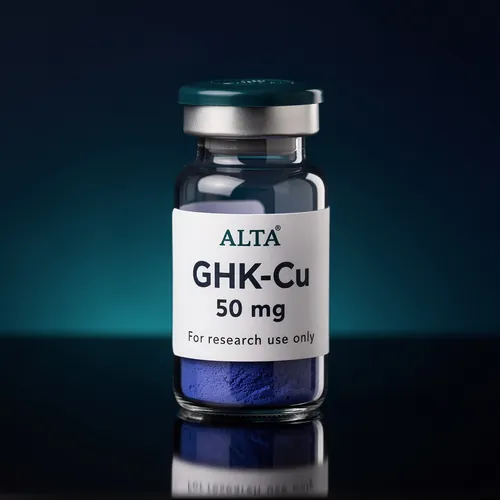
The sequence is the peptide's identity. GHK-Cu is glycine-histidine-lysine; change one residue and it is a different molecule with different properties. Sequence also dictates shape: chains fold according to which side chains attract or repel each other, and short peptides are usually flexible in solution while longer ones settle into stable structures. Two residues make a dipeptide, three a tripeptide, and the general terms are oligopeptide for a handful of residues and polypeptide for longer chains.
Peptide vs protein
The peptide vs protein distinction is one of length and behaviour rather than a sharp chemical line. The convention most biochemists use is that a chain of fewer than about 50 amino acids is a peptide and anything longer is a protein. The reason the convention exists is that beyond roughly that length a chain reliably folds into a stable three-dimensional structure with a defined function, whereas shorter chains tend to act by fitting into a receptor or binding a partner rather than by forming machinery of their own.
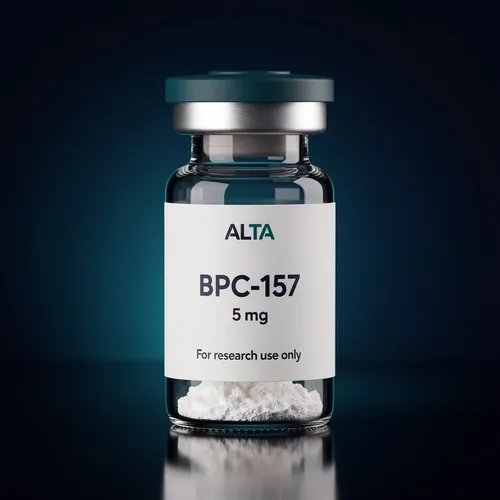
The boundary is fuzzy in practice. Insulin is 51 residues in two chains and is called both a peptide hormone and a small protein. Thymosin beta-4, at 43 residues, is usually called a protein because it folds and has a structural role. BPC-157 at 15 residues, retatrutide at 39 and GHK at 3 are unambiguously peptides. Everything sold on this site is a peptide in this sense: a defined sequence short enough to be made chemically rather than expressed in cells.
What do peptides do?
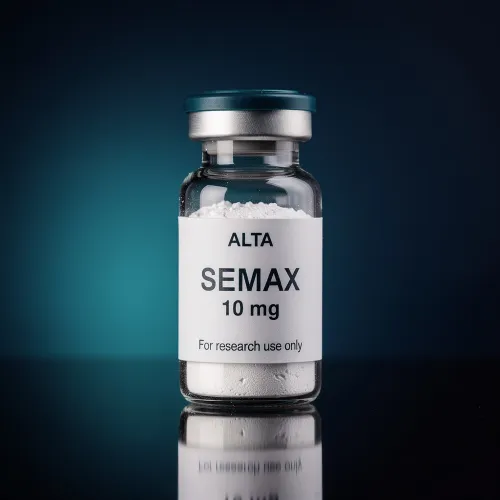
In biology, peptides are mostly messengers. Cells release them to signal to other cells, and the signal is read by a receptor on the target cell's surface that recognises that specific sequence. Because they are small and quickly broken down by peptidases, they make good short-range, short-lived signals. Peptide hormones are the best-known class: insulin and glucagon regulate blood glucose, GLP-1 and GIP are released from the gut after a meal, oxytocin and vasopressin are nine-residue peptides from the pituitary, and ACTH is a 39-residue pituitary peptide whose 4-10 fragment is the basis of Semax. Other peptides are antimicrobial, act as neurotransmitters, or are fragments of larger proteins that have activity of their own, which is the category BPC-157 and TB-500 fall into.
Research peptides are used because those same properties make them tractable tools. A defined sequence can be made in quantity at high purity, its receptor interaction can be studied, and single-residue changes can be tested to map which parts of the chain matter. The question a laboratory asks is not "what do peptides do" in general but what a specific sequence does to a specific readout in a specific model, which is why every product page here summarises the published models rather than making claims.
How peptides are made
Natural peptides are either made directly by the ribosome or cut from larger precursor proteins by enzymes. Synthetic peptides are made chemically, almost always by solid-phase peptide synthesis (SPPS), the method Bruce Merrifield introduced in 1963 and for which he received the Nobel Prize in Chemistry in 1984.
In SPPS the chain is built while anchored to tiny beads of resin. The first amino acid, the one that will become the C-terminus, is attached to the resin. Its amino group is protected by a removable chemical cap, in modern practice the Fmoc group, and its side chain by a second, more robust protecting group. The synthesis then cycles: remove the Fmoc cap with a mild base, wash, add the next protected amino acid with a coupling reagent that activates its acid group so it bonds to the free amine, wash, and repeat. Because the growing chain is tethered to solid beads, excess reagents and by-products are simply washed away at each step, which is what made the method practical for chains of dozens of residues. Automated synthesisers now run these cycles unattended.
When the sequence is complete, a strong acid, usually trifluoroacetic acid (TFA), cleaves the chain from the resin and strips the side-chain protecting groups at the same time. The crude product contains the target peptide plus deletion sequences (where a coupling failed), truncated chains and oxidised variants. It is purified by reversed-phase HPLC, the fractions containing the target are pooled, identity is confirmed by mass spectrometry, and the solution is freeze-dried to give the lyophilised powder that goes into a vial. The TFA used at cleavage is the reason peptides usually arrive as TFA salts and the reason a certificate of analysis should state net peptide content.
Modifications are added during synthesis. Acetylating the N-terminus (as in TB-500's Ac-LKKTETQ) and amidating the C-terminus protect the ends from exopeptidases. Attaching a fatty acid to a lysine side chain, as in semaglutide, tirzepatide and retatrutide, lets the peptide bind albumin in the blood and circulate for days instead of minutes. Adding copper to GHK gives the blue complex.
Why lyophilised, and why research use
A peptide in solution hydrolyses and oxidises; a freeze-dried peptide in a sealed vial is stable for years cold. That is why research peptides are supplied as powder and reconstituted in the laboratory, a process covered in our reconstitution guide. And because a synthetic peptide is a defined chemical with, in most cases, no marketing authorisation as a medicine, it is supplied for laboratory research only, a position our UK law article sets out in detail. Every product on this site is sold under our research use policy.