Semax and Selank are heptapeptides developed at the Institute of Molecular Genetics of the Russian Academy of Sciences, and they are the two peptides most often described as nootropics. They are frequently confused with one another because they share an origin, a length, a C-terminal Pro-Gly-Pro motif and a nasal-spray formulation in their Russian medicinal forms. They are different molecules with different parents and different proposed mechanisms. This article sets out Semax vs Selank as chemistry and published research. It is not a description of effects in people and neither compound is licensed in the UK.
What is Semax?
Semax is Met-Glu-His-Phe-Pro-Gly-Pro, an analogue of the 4-10 fragment of adrenocorticotropic hormone (ACTH). The first four residues are the ACTH(4-7) sequence, which had been studied since the 1970s for effects on attention and learning in animals independent of any hormonal activity; the Pro-Gly-Pro tail was added to protect the peptide from enzymatic breakdown and extend its activity. It was developed in the 1980s and 1990s by Nikolai Myasoedov's group and registered as a medicine in Russia in the 1990s.
The mechanism most consistently reported is an increase in brain-derived neurotrophic factor (BDNF) and its receptor TrkB in the hippocampus of rats, along with modulation of the serotonergic and dopaminergic systems. Rodent studies report improved performance in memory and attention tasks and neuroprotection in models of ischaemia. Gene-expression studies in rat brain show it alters transcription of a large set of genes involved in the immune and vascular systems.
What is Selank?
Selank is Thr-Lys-Pro-Arg-Pro-Gly-Pro, an analogue of tuftsin, a naturally occurring tetrapeptide (Thr-Lys-Pro-Arg) fragment of immunoglobulin G that stimulates phagocytosis. Again the Pro-Gly-Pro tail was added for stability. It was developed by the same institute and registered in Russia in the 2000s as an anxiolytic.
The reported mechanism is different: Selank has been shown to modulate the expression of genes involved in GABAergic transmission and to affect the balance of monoamines, and in rodents it produces anxiolytic-type behaviour in elevated-plus-maze and similar tests without the sedation associated with benzodiazepines. Immunomodulatory effects consistent with its tuftsin parent, including changes in interleukin-6 and interferon expression, have also been reported.
The comparison
Semax derives from a stress hormone fragment and the research emphasises cognition and neuroprotection; Selank derives from an immune peptide and the research emphasises anxiety-type behaviour and immune modulation. Both are said to be stable to peptidases because of the Pro-Gly-Pro tail. Both are studied in rodents by a small number of Russian groups, with a modest number of Russian clinical studies of the licensed nasal products that have not been replicated in Western trials or published in the major English-language journals. Neither is licensed in the UK, the EU or the US, and neither has been through the regulatory review that would establish safety or efficacy to those standards.
Handling differences
Both dissolve readily and both are stable in the vial, but Semax carries a methionine at its N-terminus and methionine sulfoxide is the classic peptide oxidation product, so a Semax solution that has been left warm or in light will show a second peak on HPLC sooner than a Selank solution will. Keep Semax cold and dark from the moment it is reconstituted and use it within the four-week window. Selank has no oxidation-prone residue and is the more forgiving of the two. Neither should be frozen once in solution; aliquot first if a longer hold is needed.
Regulatory status
Neither Semax nor Selank is a controlled substance in the UK. Both are unlicensed medicines here and lawful only as research reagents. Because they are marketed as nootropics elsewhere, the temptation for sellers to describe effects on focus or mood is strong; doing so presents the product as a medicine and is unlawful, which is why our product pages describe chemistry and research and nothing else. See peptides and UK law.
In the laboratory
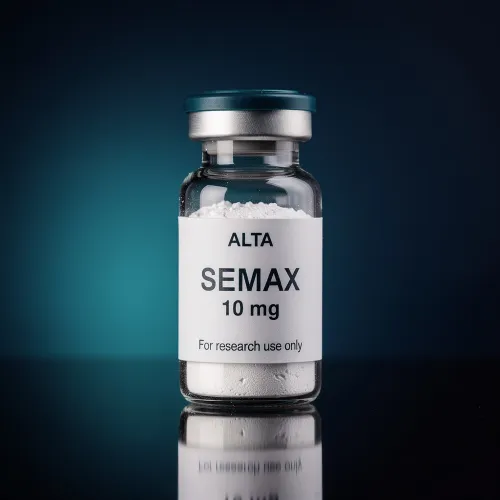
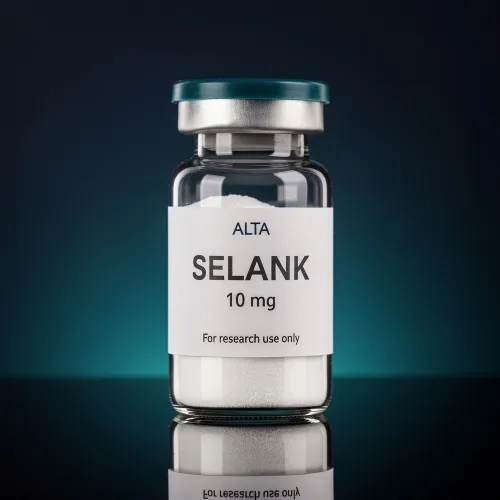
Both are supplied as white lyophilised powders in 10 mg sealed vials, 99% or better HPLC purity with per-lot mass spectrometry. Semax: C37H51N9O10S, mass 813.9 g/mol; note the methionine, which is oxidation-prone, so keep the vial cold and dark. Selank: C33H57N11O9, mass 751.9 g/mol. Both dissolve readily in bacteriostatic water. Research use only, under our research use policy.