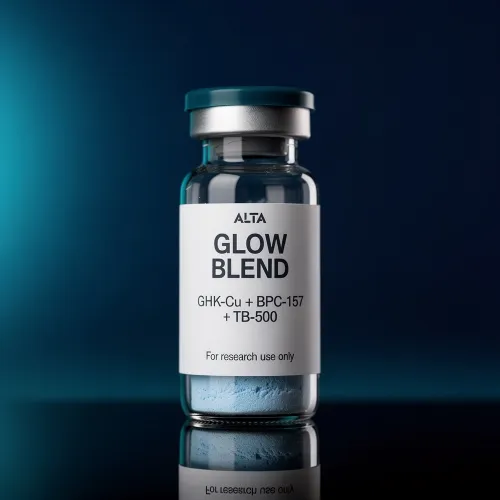
GLOW and KLOW are names for pre-mixed peptide combinations that became popular through social media in 2024 and 2025. Neither is a compound; each is a blend of two or more research peptides lyophilised together in a single vial. GLOW is the three-peptide combination of GHK-Cu, BPC-157 and TB-500. KLOW is GLOW with a fourth peptide, KPV, added. This article explains what is in each blend, what each component peptide is and what its research covers, why the pre-mixed format has trade-offs, and why we supply GLOW as three separate vials and do not stock KLOW. It is a description of research reagents; nothing here is a claim about use in people.
What is in GLOW?
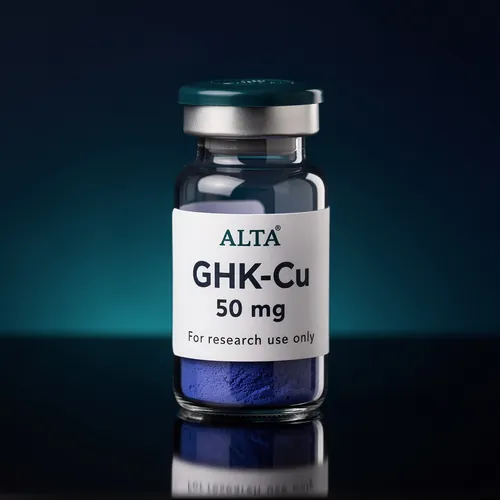
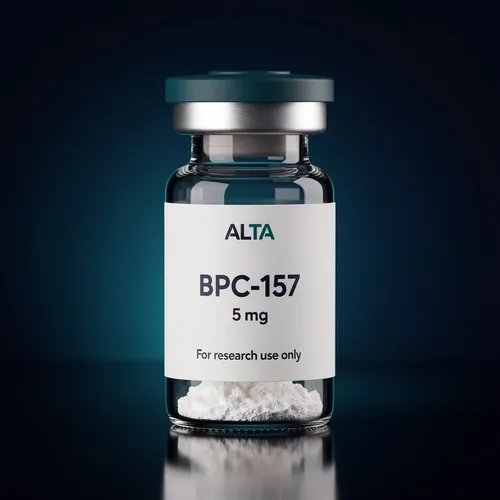
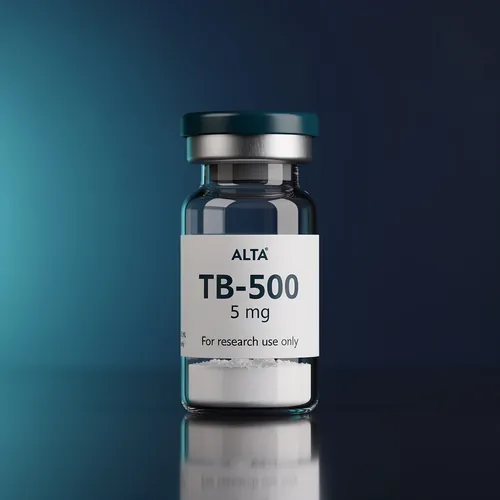
GLOW as sold by most vendors is 50 mg GHK-Cu, 10 mg BPC-157 and 10 mg TB-500 co-lyophilised in one sealed vial. The GLOW stack we sell is the same three peptides as three separate lot-tested vials, GHK-Cu 50 mg, BPC-157 5 mg and TB-500 5 mg, at a bundle price. The name comes from skin: GHK-Cu is the copper peptide with thirty years of cosmetic research behind it, and the combination was marketed as a skin-oriented one.
GHK-Cu is a tripeptide copper complex that occurs naturally in human plasma, declines with age, and in fibroblast culture increases collagen, elastin and glycosaminoglycan synthesis; its gene-expression footprint is unusually broad. Our GHK-Cu article covers it in detail. BPC-157 is a 15-residue gastric fragment studied in several hundred rodent papers on tendon, ligament, muscle and gut repair, acting through angiogenic and nitric oxide signalling. TB-500 is the actin-binding fragment of thymosin beta-4, studied for cell migration in wound models. The rationale for combining them is that the three act on different steps of tissue repair: matrix synthesis, vascular signalling and cell migration.
What is in KLOW, and what is KPV?
KLOW is the same three peptides plus KPV, typically 10 mg. KPV is the tripeptide Lys-Pro-Val, the three C-terminal residues of alpha-melanocyte-stimulating hormone (alpha-MSH), a 13-residue hormone with well-established anti-inflammatory activity. The fragment was identified in the 1990s as retaining much of the parent hormone's anti-inflammatory effect without its pigmentation effect, and it has been studied in cell culture and rodent models of colitis, skin inflammation and infection, where it reduces inflammatory cytokine production (particularly through the NF-kB pathway) and has some direct antimicrobial activity. It has been of interest in inflammatory bowel disease research, including in oral nanoparticle formulations in mice. Like the other three it has no licensed use.
The KPV peptide was added to GLOW on the logic that the three-peptide blend addressed repair but not inflammation. That is a reasonable hypothesis for a research design; it has not been tested as a combination in any published study.
The trade-offs of a blend
A blend is convenient: one vial, one reconstitution, one storage clock. It also has real costs for research. The ratio is fixed, so a laboratory cannot vary one component while holding the others constant, and cannot run each peptide alone as a control against the combination. The four peptides have different stability profiles, and the whole vial is only as stable as its least stable component once in solution. And on the certificate of analysis, a blend is harder to characterise: HPLC shows four main peaks rather than one, and net peptide content has to be reported per component. For serious comparative work, separate vials are better, which is why our Wolverine stack (BPC-157 and TB-500) is supplied as two labelled vials and why we treat GLOW as a convenience product rather than a research tool in its own right.
Why we sell GLOW as separate vials, and not KLOW
We do not stock a co-lyophilised GLOW vial at all, for the reasons above: three separate certificates beat one blended one. On KLOW there are two reasons. First, KPV is not yet in our catalogue as a single compound, and we do not stock a blend containing a peptide we cannot also supply and test on its own. Second, the KLOW name in particular has been marketed almost entirely with claims about effects in people, on gut health and skin, that go well beyond the research, and we are cautious about products whose demand is driven by that marketing. If KPV is added to the range as a tested single-compound vial, a four-vial stack may follow. Until then, the GLOW stack, GHK-Cu, BPC-157 and TB-500 are all available.
Handling
Each vial in the GLOW stack reconstitutes separately in bacteriostatic water; the GHK-Cu vial gives a clear blue solution and is light-sensitive, so keep it dark. Store all three at 2 to 8 °C and use within four weeks of reconstitution. The reconstitution and storage guides apply. Research use only, under our research use policy.