In this article13 sections
A tiny synthetic peptide of four amino acids, made in Russia from a cow pineal-gland extract. In cells it switches on telomerase, the enzyme that rebuilds the caps on chromosomes, and it modestly extended the lives of the longest-lived mice. Most of the research comes from one group; it has never been tested in a human trial.
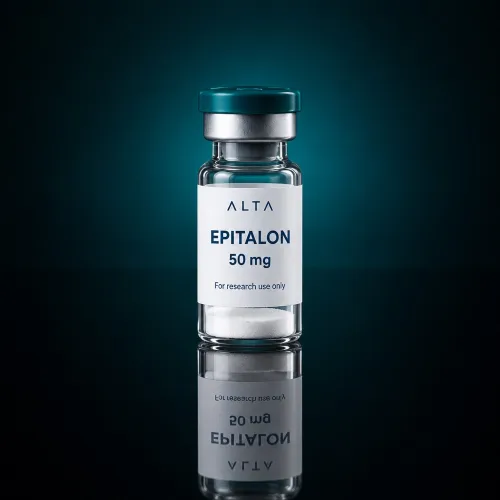
Epitalon, also spelt epithalon or epitalone, is a tiny synthetic peptide of just four amino acids: alanine, glutamic acid, aspartic acid and glycine. It was designed in St Petersburg as a defined version of a cow pineal-gland extract, and it is best known for one claim: that it switches on telomerase, the enzyme that rebuilds the protective caps on our chromosomes. This article explains what epitalon is, what the studies have and have not shown, and how much weight the evidence can bear. It describes published research only; epitalon is not licensed for any use in people, and ALTA PEPTIDES supplies it for laboratory research only.
- Epitalon is a synthetic four-amino-acid peptide, Ala-Glu-Asp-Gly (formula C14H22N4O9, mass 390.35 g/mol), designed from the make-up of epithalamin, a cow pineal-gland extract.
- In 2003 the St Petersburg group reported that it switched on telomerase and lengthened telomeres in cultured human fibroblasts.
- In mice it did not change average lifespan but extended the lifespan of the longest-lived 10% by 13.3% and maximum lifespan by 12.3%, and reduced leukaemia.
- Human data exist only for the crude extract epithalamin, from a small, old study that has never been repeated independently.
- A 2025 study from Brunel University London independently reported telomere lengthening in human cell lines, the first replication outside Russia.
- Epitalon is not a licensed medicine anywhere. It is not named on the WADA list, but as an unapproved substance it falls under WADA's S0 category.
What does epitalon do?
In shortIn human cells in a dish, it switched on the enzyme that rebuilds the caps on chromosomes.
- 01Chromosome caps
Telomeres protect the ends of chromosomes
- 02Shorten
A little every time a cell divides
- 03Telomerase
The enzyme that rebuilds them, usually off
- 04Epitalon
Switched it on in cultured human cells
Khavinson, Bondarev and Butyugov, Bulletin of Experimental Biology and Medicine 2003.
The headline finding is about telomeres, the caps on the ends of chromosomes that shorten each time a cell divides. Telomerase is the enzyme that can rebuild them, and most adult cells keep it switched off. In 2003, Khavinson, Bondarev and Butyugov reported that adding epitalon to cultured human fetal fibroblasts, cells that normally have no telomerase activity, switched on the telomerase catalytic subunit, raised enzyme activity and lengthened telomeres. That paper is the source of almost every claim made about epitalon and ageing.
Does epitalon extend lifespan?
In shortIn mice, a little: the longest-lived lived longer, but the average didn't change.
Same study.
One research group.
Anisimov et al., Biogerontology 2003. Percent change versus untreated mice.
In animals, modestly, and mainly at the extremes. In a 2003 study in Biogerontology, epitalon given to female SHR mice did not change their average lifespan. It did extend the lifespan of the longest-lived 10% of the mice by 13.3% and maximum lifespan by 12.3%, reduced chromosome damage in bone-marrow cells by 17.1%, cut leukaemia about six-fold and slowed the age-related loss of oestrous cycles. Earlier work from the same group reported longer lifespan in fruit flies and slower tumour development in mice bred to develop breast cancer. These are real but small effects, in animal models, from one research network.
What about melatonin and sleep?
In shortIn old monkeys it restored a more youthful melatonin rhythm.
Epitalon came from pineal-gland research, and the pineal gland makes melatonin. In a 2001 study, epitalon raised evening melatonin and normalised the daily rhythm of the stress hormone cortisol in old female rhesus monkeys, while young monkeys were unaffected. That is the basis for its appearance in sleep discussions; our round-up of peptides studied for sleep puts it alongside DSIP.
Has epitalon been tested in people?
In shortNo. The human study people quote used a different product, the crude extract.
No controlled trial of epitalon in people.
The crude extract, not epitalon.
Small, old, not clearly randomised or blinded.
Khavinson and Morozov, Neuro Endocrinology Letters 2003.
Not epitalon itself, in any controlled trial. The human figures that are often quoted come from epithalamin, the crude pineal extract that epitalon was designed to replace. In a 2003 report, Khavinson and Morozov followed 266 older people for six to eight years and reported death rates 1.6 to 1.8 times lower with epithalamin than in controls, and lower still when it was combined with a thymus extract. The study was small, old, not clearly randomised or blinded, and has never been repeated by anyone else, so it cannot show that either extract, let alone epitalon, extends human life.
Has anyone outside Russia repeated the findings?
In shortYes, in 2025, in cells only.
- 1970sEpithalamin
Cow pineal extract in Soviet gerontology.
- LaterEpitalon designed
A defined four-amino-acid copy.
- 2003Telomerase in human cells
St Petersburg group.
- 2003Mouse lifespan
Same network.
- 2025UK replication
Brunel University London, human cell lines.
Sources in this article.
Now, in part. In 2025, a team at Brunel University London and the Royal Brompton Hospital reported in Biogerontology that epitalon lengthened telomeres in normal human cell lines by raising hTERT and telomerase activity, which repeats the 2003 finding independently for the first time. In two cancer cell lines, telomeres also lengthened, but through a different route called ALT (alternative lengthening of telomeres). Other non-Russian laboratory work has reported telomerase stimulation in cow egg-surrounding cells. All of this is in cells, not animals or people.
Is epitalon safe?
In shortUnknown. It has never had a proper safety trial.
Nobody knows, because it has never been through a proper safety trial. There is also a theoretical concern built into the main claim: switching on telomerase is one of the ways cancer cells make themselves immortal, and the 2025 study found telomere lengthening in cancer cell lines too. That does not mean epitalon causes cancer, and the mouse studies reported fewer tumours, but it is a question that has not been studied in people.
Is epitalon legal, and is it banned in sport?
In shortLegal to buy for lab research in the UK. Banned for athletes.
FDA panel backed compounding, July 2026 (not binding).
Under S0, non-approved substances.
From this article.
Epitalon is not a controlled drug in the UK and has no marketing authorisation anywhere. It can be bought and held as a laboratory reagent; supplying it for human use is an offence under the Human Medicines Regulations 2012, as our guide to peptides and UK law explains. In the United States, the FDA's compounding advisory committee recommended epitalon in July 2026 for the list of substances pharmacies may compound, against the FDA's own proposal; that vote is not binding and epitalon remains unapproved. WADA does not name epitalon on its Prohibited List, but as a substance with no approval for human use it falls under the S0 category of non-approved substances, which is banned at all times.
Epitalon vs MOTS-c: how do they compare?
In shortMOTS-c has the stronger research base.
Both are studied for ageing, and both sit in our longevity category, but MOTS-c has a stronger base: a defined gene, a characterised mechanism, work from several groups and an industry phase 1 trial of an analogue. Epitalon's evidence rests mostly on one institute, with independent confirmation so far limited to cells. Our article what is MOTS-c covers it in full.
Everything above is the quick version. The sections below go deeper.
Where epitalon comes from
In shortDesigned in St Petersburg as a defined copy of a pineal-gland extract.
Formula C14H22N4O9, mass 390.35 g/mol.
Epitalon grew out of decades of Soviet and Russian research on peptide "bioregulators" led by Vladimir Khavinson, later at the St Petersburg Institute of Bioregulation and Gerontology, with Vladimir Anisimov leading much of the animal work. The group first used epithalamin, a polypeptide extract of cow pineal gland, and then designed epitalon from the amino-acid make-up of that extract as a defined molecule that could be made synthetically. It is often said to date from the 1980s, but we have not found a primary source for the exact date.
How strong is the evidence?
In shortMostly one research group, plus one independent cell study.
Assessment based on this article.
Almost all of the animal and human work comes from one network in St Petersburg, much of it published in Russian-linked journals, and Khavinson's group also commercialises peptide bioregulators, which is a conflict of interest worth knowing. The human mortality data are for a different product and an old, small study. The mouse lifespan effects are modest and average lifespan did not change. The 2025 Brunel study is the most important development in years because it is independent, but it confirms a cell finding, not an effect in living animals or people.
In the laboratory
In shortSupplied as tested powder in sealed vials. Stable and easy to dissolve.
Epitalon is supplied by ALTA PEPTIDES as a freeze-dried powder in sealed vials, purity 99% or better by with identity confirmed by mass spectrometry for each lot. Formula C14H22N4O9, mass 390.35 g/mol. It is a short, stable, acidic peptide that dissolves readily; our guides to storage and reconstitution cover handling. Research use only, under our research use policy.
Sources
- Khavinson VKh, Bondarev IE, Butyugov AA. Epithalon peptide induces telomerase activity and telomere elongation in human somatic cells. Bulletin of Experimental Biology and Medicine 2003;135:590-592.
- Anisimov VN, Khavinson VKh, Mikhalski AI, Yashin AI. Biogerontology 2003;4(4):193-202: epitalon, survival, chromosome aberrations and tumours in female SHR mice.
- Anisimov VN, et al. Bulletin of Experimental Biology and Medicine 2002: epitalon and mammary tumours in HER-2/neu transgenic mice.
- Khavinson VKh, Izmaylov DM, Obukhova LK, Malinin VV. Mechanisms of Ageing and Development 2000;120:141-149: epitalon and lifespan in Drosophila.
- Goncharova ND, Khavinson VKh, Lapin BA. Bulletin of Experimental Biology and Medicine 2001: epitalon, melatonin and cortisol in old rhesus monkeys.
- Khavinson VKh, Morozov VG. Peptides of pineal gland and thymus prolong human life. Neuro Endocrinology Letters 2003;24(3-4):233-240.
- Al-dulaimi S, Thomas R, Matta S, Roberts T (Brunel University London). Biogerontology 2025: epitalon, telomerase and telomere length in normal and cancer human cell lines (with published correction).
- Araj SK, Brzezik J, Madra-Gackowska K, Szeleszczuk L. Review of epitalon. International Journal of Molecular Sciences 2025;26(6):2691.
- FDA Pharmacy Compounding Advisory Committee, July 2026 meeting briefing; NCPA report, 31 July 2026.
- WADA Prohibited List, section S0 (non-approved substances).
Questions people ask
What does epitalon do?
In cultured human cells it switched on telomerase, the enzyme that rebuilds the protective caps on chromosomes, and lengthened telomeres. In mice it modestly extended the lives of the longest-lived animals and reduced some tumours, and in old monkeys it restored a more youthful melatonin rhythm. None of this has been tested in a controlled human trial of epitalon.
Is epitalon the same as epithalamin?
No. Epithalamin is a crude extract of cow pineal gland used in Soviet and Russian gerontology. Epitalon is a defined synthetic four-amino-acid peptide designed from it. The only human mortality data are for epithalamin, not epitalon.
Has epitalon been tested in humans?
Not in a controlled trial. The human studies usually quoted used epithalamin, the extract, in older people in Russia, and they were small, old and not clearly randomised or blinded.
Is epitalon legal in the UK?
It is not a controlled drug and has no marketing authorisation, so it can be bought and held as a laboratory reagent. Supplying it for human use is an offence under the Human Medicines Regulations 2012. ALTA PEPTIDES sells it for research only.
Information, not advice. This article summarises published research; nothing here is guidance on human or veterinary use. Products are sold under our research use policy.