In this article15 sections
There isn't an approved one: retatrutide is unlicensed everywhere. Lilly's phase 3 TRIUMPH trials assigned once-weekly arms of 4, 9 or 12 mg, each reached from a 2 mg start in steps every four weeks. These are trial arms for Lilly's investigational medicine, not doses for a research vial or for any other use.
There is no approved retatrutide dosage. Retatrutide is an investigational drug: Eli Lilly's once-weekly peptide LY3437943 has no licence from any regulator, so no label sets a dose. What does exist is a public record of the doses each Lilly clinical trial tested: weekly arms of 1 to 12 mg in the trial in obesity, and arms of 4, 9 and 12 mg in the phase 3 TRIUMPH trials, each reached in steps from 2 mg.
- Retatrutide (LY3437943) is not licensed by any regulator, so no approved dose exists. Eli Lilly said in July 2026 that it plans to file for US approval in the first quarter of 2027.
- In Lilly's TRIUMPH trials every retatrutide participant started on the 2 mg dose once weekly and moved up every four weeks; the 12 mg arm went through steps at 2, 4, 6 and 9 mg.
- The TRIUMPH-1 trial (NEJM 2026) assigned 2,339 adults with obesity to once-weekly arms of 4, 9 or 12 mg, or placebo, for 80 weeks; on those arms they lost 17.6%, 23.7% and 25.0% of their starting body weight on average, against 3.9% on placebo.
- In the phase 2 obesity trial (Jastreboff et al., NEJM 2023; 338 adults, 48 weeks), nausea was reported by 18% of the 4 mg arm that started at 2 mg and 36% of the 4 mg arm that started at 4 mg.
- The phase 1b trial (Urva et al., Lancet 2022) measured a half-life of approximately 6 days, which is why later trials gave retatrutide once a week.
- The MHRA has not authorised retatrutide. On 24 July 2026 it warned that products sold online as retatrutide are untested and may not contain it.
One point applies throughout. Trial doses describe Lilly's own investigational medicine, given to monitored participants under a protocol. A research peptide vial is a laboratory reagent with no dose attached. ALTA PEPTIDES supplies retatrutide for laboratory research only and gives no guidance on human use.
Is there an approved retatrutide dosage?
In shortNo. Retatrutide is unlicensed, so every dose on record is a trial arm.
Not licensed by the MHRA or any other regulator.
From single doses in phase 1 to the top weekly arm of TRIUMPH-1.
Once weekly in TRIUMPH-1 and TRIUMPH-2.
A laboratory reagent has no dose attached.
Trial figures: Lilly's TRIUMPH announcements and the papers listed in the sources. Status as of 15 November 2026.
No. Retatrutide has not been approved anywhere, as a weight loss treatment or as any other medicine. Lilly's announcements call it an investigational molecule that cannot legally be sold or marketed for human use. Retatrutide is currently in phase 3, and Lilly said in July 2026 that it plans to file for US approval in the first quarter of 2027.
So there is no official retatrutide dose, no reta dosage on a label and no prescribing information. Retatrutide dosage in clinical trials is the only kind on record, and "reta dose" is shorthand for the same thing. If retatrutide is approved, a label will set its doses; until then, every figure below is a trial arm, assigned by a named clinical trial to its participants.
Retatrutide dosage chart: which doses did each clinical trial use?
In shortFrom 0.1 mg single doses in phase 1 to a 12 mg weekly arm in TRIUMPH-1.
Swipe the table to compare →
| Who took part | Arms (mg) | First dose | Length | |
|---|---|---|---|---|
| Phase 1 single dose | 45 healthy adults | 0.1 to 6, given once | Single dose | One dose |
| Phase 1b | 72 adults, type 2 diabetes | 0.5, 1.5, 3, 6, 12 | 0.5, 1.5 or 3 mg | 12 weeks |
| Phase 2 obesity | 338 adults | 1, 4, 8, 12 | 1, 2 or 4 mg | 48 weeks |
| Phase 2 diabetes | 281 adults, type 2 diabetes | 0.5, 4, 8, 12 | 0.5, 2 or 4 mg | 36 weeks |
| TRANSCEND-T2D-1 | 537 adults, type 2 diabetes | 4, 9, 12 | 2 mg | 40 weeks |
| TRIUMPH-4 | 445 adults, obesity and knee osteoarthritis | 9, 12 | 2 mg | 68 weeks |
| TRIUMPH-1 | 2,339 adults, obesity | 4, 9, 12 | 2 mg | 80 weeks |
| TRIUMPH-2 | 1,152 adults, obesity and type 2 diabetes | 4, 9, 12 | 2 mg | 80 weeks |
| TRIUMPH-3 | 1,949 adults, severe obesity and cardiovascular disease | 9, 12 | 2 mg | 80 weeks |
A chart of trial arms, not a dose for any use. Each row shows what that Lilly trial assigned to its participants, once weekly except in the single-dose study. Sources: Coskun 2022, Urva 2022, Jastreboff 2023, Rosenstock 2023, Lilly announcements 2025 to 2026.
Tap a trial
First-in-human study, NCT03841630. 45 healthy participants each received a single dose of retatrutide or placebo; a 2026 Pharmaceutics review gives the range as 0.1 to 6 mg. Coskun et al. (Cell Metabolism 2022) reported weight reduction lasting to day 43.
Urva et al., Lancet 2022. 72 adults with type 2 diabetes, weekly injections for 12 weeks. Five cohorts: 0.5 mg, 1.5 mg, 3 mg, 3 then 6 mg, and 3, 6, 9 then 12 mg. Half-life measured at approximately 6 days.
Jastreboff et al., NEJM 2023. 338 adults, 48 weeks. Arms: 1 mg; 4 mg (from 2 mg, or from 4 mg); 8 mg (from 2 mg, or from 4 mg); 12 mg (2, 4, 8, then 12 mg); placebo. Steps every 4 weeks. Average weight loss at 48 weeks: 8.7%, 17.1%, 22.8% and 24.2% on the 1, 4, 8 and 12 mg arms, against 2.1% on placebo.
Rosenstock et al., Lancet 2023. 281 adults with type 2 diabetes, outcomes to 36 weeks. Arms: 0.5 mg; 4 mg (from 2 mg, or with no escalation); 8 mg (from 2 mg, or from 4 mg); 12 mg (from 2 mg); dulaglutide 1.5 mg; placebo. HbA1c at 24 weeks fell 2.02 points on the 12 mg arm, against 0.01 on placebo.
NEJM 2026. 2,339 adults with obesity and without diabetes, 80 weeks. Arms: 4 mg (via 2 mg), 9 mg (via 2, 4 and 6 mg), 12 mg (via 2, 4, 6 and 9 mg), placebo; steps every four weeks. Average weight loss: 17.6%, 23.7% and 25.0%, against 3.9% on placebo.
Lancet 2026. 1,152 adults with obesity and type 2 diabetes, 80 weeks. Arms and steps as in TRIUMPH-1: 4 mg, 9 mg, 12 mg, placebo. Average weight loss: 11.9%, 16.8% and 18.8%, against 5.1% on placebo.
Lilly announcement, 23 July 2026. 1,949 adults with severe obesity and cardiovascular disease, 80 weeks. Arms: 9 mg (via 2, 4 and 6 mg), 12 mg (via 2, 4, 6 and 9 mg), placebo. Lilly's efficacy estimate of average weight loss: 21.6% and 22.6%, against 3.2% on placebo.
NEJM, online November 2026. 445 adults with obesity and knee osteoarthritis, 68 weeks. Arms: 9 mg, 12 mg, placebo, on the same steps as TRIUMPH-3. Average weight loss: 20.0% and 23.7%, against 4.6% on placebo.
Lilly announcement, 19 March 2026. 537 adults with type 2 diabetes, 40 weeks. Arms: 4 mg, 9 mg, 12 mg, placebo, from a 2 mg start with steps every four weeks. HbA1c fell 1.7, 2.0 and 1.9 points, against 0.8 on placebo (Lilly's efficacy estimate).
Interactive. Every figure is what the named trial assigned or reported; sources are listed at the end of the article.
How much retatrutide a participant received depended on the trial and the arm. The first phase 1 study gave healthy volunteers single doses of 0.1 to 6 mg, and the phase 1b study reached 12 mg a week. The two phase 2 trials tested weekly arms from 0.5 mg to 12 mg, and the phase 3 TRIUMPH and TRANSCEND-T2D-1 trials settled on three arms: 4 mg, 9 mg and 12 mg.
The table below is a retatrutide dose chart of those arms: each row is one clinical trial and the arms it assigned. As tested, retatrutide is a once-weekly injection: every multi-dose trial listed gave it under the skin (subcutaneously).
What was the starting dose of retatrutide in the trials?
In shortTRIUMPH and TRANSCEND-T2D-1 began at 2 mg; the phase 2 trials also tested a 4 mg start.
In all five phase 3 trials covered here (TRIUMPH-1 to TRIUMPH-4 and TRANSCEND-T2D-1), participants in the active arms started at 2 mg once weekly, according to Lilly's announcements.
Phase 2 compared two starting points. In the phase 2 obesity trial (Jastreboff et al., NEJM 2023), the 4 mg and 8 mg arms were each split in two, one group starting at 2 mg and one at 4 mg; the 12 mg arm started at 2 mg. The phase 2 diabetes trial (Rosenstock et al., Lancet 2023) used the same split.
Retatrutide dose escalation: what dosing schedule did the phase 3 trials follow?
In shortTRIUMPH moved up one step every four weeks: 2, 4, 6, 9, then 12 mg.
- 012 mg
First step for every retatrutide participant in TRIUMPH-1.
- 024 mg
Second step. The 4 mg arm stayed at this step.
- 036 mg
Third step.
- 049 mg
Fourth step. The 9 mg arm stayed at this step.
- 0512 mg
The assigned dose for the top arm, held to week 80.
TRIUMPH-1 protocol as described by Lilly (21 May 2026): once weekly, one step every four weeks. Giblin et al. 2026 describe 16 weeks of escalation and 64 weeks of maintenance. A description of a trial, not guidance.
No label sets a retatrutide dosage schedule; the TRIUMPH trials shared one fixed dose escalation schedule. Lilly describes it the same way each time: participants started at 2 mg once weekly and moved up one step every four weeks until they reached their randomly assigned arm.
In TRIUMPH-1 and TRIUMPH-2, the 4 mg arm took one step (from 2 mg), the 9 mg arm three (2, 4 and 6 mg, then 9 mg) and the 12 mg arm four (2, 4, 6 and 9 mg, then 12 mg). The 12 mg dose, the maximum dose the TRIUMPH trials tested, was reached after 16 weeks of dose increases. TRIUMPH-3 and TRIUMPH-4 tested only the 9 mg and 12 mg arms, on the same steps.
The TRIUMPH design paper (Giblin et al., 2026) describes that escalation period, then 64 weeks of maintenance. In trial language, the retatrutide maintenance dose is the assigned arm: 4, 9 or 12 mg in TRIUMPH-1. The retatrutide titration was blinded and fixed by that protocol.
The phase 2 retatrutide dose schedule was steeper: the top arm of the phase 2 obesity trial went 2, 4, 8, then 12 mg, with steps every 4 weeks (Sanyal et al., Nature Medicine 2024).
How long did the retatrutide trials run?
In shortFrom 12 weeks in phase 1b to 80 weeks in TRIUMPH-1.
Weeks of treatment. Sources: the trial papers and Lilly announcements listed at the end of the article.
The phase 1b study lasted 12 weeks. The phase 2 obesity trial ran for 48 weeks, and the phase 2 diabetes trial measured outcomes to 36 weeks. In phase 3, TRANSCEND-T2D-1 ran for 40 weeks, TRIUMPH-4 for 68 weeks, and TRIUMPH-1, TRIUMPH-2 and TRIUMPH-3 for 80 weeks. A TRIUMPH-1 extension took 532 participants to 104 weeks; none of these trials followed long-term weight loss beyond that.
Length matters when reading results. In the phase 2 trial in obesity, the 12 mg group lost an average of 17.5% by 24 weeks and 24.2% of body weight at 48 weeks: the same arm, measured later, reports a larger number.
Retatrutide dosage for weight loss: what did each arm report?
In shortTRIUMPH-1 reported 17.6%, 23.7% and 25.0% on its 4, 9 and 12 mg arms.
2,339 adults with obesity, counting everyone randomised (treatment-regimen estimand). Jastreboff et al., NEJM 2026. Results reported by one trial, not a forecast.
338 adults, 48 weeks. Jastreboff et al., NEJM 2023.
Higher arms reported more weight loss, with the gap narrowing at the top. In the phase 2 obesity trial (338 adults), participants lost an average of 8.7% of body weight over 48 weeks on the 1 mg arm, 17.1% on the 4 mg dose and 22.8% on the 8 mg dose (two arms each, combined), and 24.2% on the 12 mg retatrutide arm, against 2.1% on placebo.
TRIUMPH-1 (2,339 adults with obesity and without diabetes, 80 weeks) reported 17.6%, 23.7% and 25.0% on its 4, 9 and 12 mg arms, against 3.9% on placebo. Those published figures count everyone randomised, and the TRIUMPH-1 paper reports statistically significant weight loss against placebo on 9 mg and 12 mg (P less than 0.001 for both). Lilly's TRIUMPH-1 announcement also gave an efficacy estimate, which models the result had everyone stayed on treatment: 19.0%, 25.9% and 28.3%, against 2.2%.
In TRIUMPH-4 (445 adults with obesity and knee osteoarthritis), participants lost an average of 20.0% of body weight over 68 weeks on 9 mg and 23.7% on 12 mg, against 4.6% on placebo. For TRIUMPH-3 (1,949 adults with severe obesity and cardiovascular disease, 80 weeks), Lilly's efficacy estimates were 21.6% on 9 mg and 22.6% on 12 mg, against 3.2%.
These are group averages from monitored participants, reported by those trials; they are not a forecast for anyone else. Each is a change in total body weight, not a measure of fat loss alone. Our guide to the phase 3 trials covers the other outcomes.
What retatrutide dose did the type 2 diabetes trials use?
In shortTRANSCEND-T2D-1 and TRIUMPH-2 used 4, 9 and 12 mg arms; the phase 2 diabetes trial used 0.5 to 12 mg.
The same range. The phase 2 diabetes trial (Rosenstock et al., Lancet 2023; 281 adults) compared 0.5 mg, 4 mg, 8 mg and 12 mg arms with placebo and dulaglutide 1.5 mg. At 24 weeks in that trial, HbA1c had fallen by 0.43 points on 0.5 mg and 2.02 points on 12 mg, against 0.01 on placebo.
In phase 3, TRANSCEND-T2D-1 (537 adults, 40 weeks) reported HbA1c reductions of 1.7, 2.0 and 1.9 points on the 4, 9 and 12 mg arms, against 0.8 on placebo, by Lilly's efficacy estimate. TRIUMPH-2 (1,152 adults with obesity and type 2 diabetes, 80 weeks; Lancet 2026) reported average weight loss of 11.9%, 16.8% and 18.8% on those arms, against 5.1%.
Did the starting dose change the side effects of retatrutide?
In shortIn the phase 2 obesity trial, starting at 2 mg instead of 4 mg roughly halved nausea in the 4 mg arms.
Share of participants reporting nausea over the trial, rounded. ClinicalTrials.gov results for NCT04881760, non-serious adverse events table (Jastreboff et al., NEJM 2023).
In phase 2, yes. The phase 2 obesity trial reported that gastrointestinal events were dose-related, mostly mild to moderate, and partially mitigated by the lower starting dose (2 mg rather than 4 mg).
ClinicalTrials.gov results show the size of the difference. In the phase 2 obesity trial, nausea was reported by 6 of 33 participants (18%) in the 4 mg arm that started at 2 mg, and by 12 of 33 (36%) in the 4 mg arm that started at 4 mg. In the same trial's 8 mg arms the figures were 6 of 35 (17%) and 21 of 35 (60%), against 8 of 70 (11%) on placebo.
Side effects still rose with dose in phase 3, where every arm started at 2 mg. In TRIUMPH-1, nausea was reported by 28.6% and 38.4% of the 4 mg and 9 mg arms and by 42.4% of the 12 mg arm, against 14.8% on placebo, and 4.1%, 6.9% and 11.3% stopped because of adverse events, against 4.9%. Our article on retatrutide side effects covers the full picture.
Why once a week? The retatrutide half-life
In shortThe phase 1b study measured a half-life of about 6 days.
The retatrutide weekly dose in every trial follows from how long the molecule stays in the blood after retatrutide is injected. The phase 1b study (Urva et al., Lancet 2022) measured a half-life of approximately 6 days.
That half-life comes from the molecule's design. A 2026 review in Pharmaceutics describes a C20 fatty diacid attached to the peptide, which promotes binding to albumin, a blood protein. The licensed weekly medicines are similar: the UK labels give tirzepatide a half-life of approximately 5 days and semaglutide approximately 1 week.
How do the trial doses compare with Mounjaro and Wegovy?
In shortTwo licensed labels against one set of trial protocols; the milligrams are not comparable.
Swipe the table to compare →
| Retatrutide | Tirzepatide (Mounjaro) | Semaglutide (Wegovy) | |
|---|---|---|---|
| Source of the doses | TRIUMPH-1 protocol | UK SmPC | UK SmPC |
| UK status | Not licensed | Licensed | Licensed |
| First dose | 2 mg | 2.5 mg | 0.25 mg |
| Steps | Every four weeks | At least 4 weeks apart | Over 16 weeks |
| Top of the range | 12 mg arm | 15 mg maximum | 2.4 mg, or 7.2 mg in obesity |
| How often | Once weekly | Once weekly | Once weekly |
| Half-life | About 6 days (phase 1b) | About 5 days | About 1 week |
Milligrams are not comparable between different molecules. Retatrutide column: Lilly's TRIUMPH-1 announcement and Urva et al. 2022. Label columns: Mounjaro and Wegovy SmPCs, emc, 2026.
ClaimThere is an official retatrutide doseTap to check
Retatrutide is not licensed by the MHRA or any other regulator, so no label sets a dose. Every published figure is a trial arm.
Claim12 mg was the only dose Lilly testedTap to check
TRIUMPH-1 and TRIUMPH-2 tested 4 mg, 9 mg and 12 mg arms. The phase 2 obesity trial tested 1, 4, 8 and 12 mg arms.
ClaimTrial participants went straight to their assigned doseTap to check
Every retatrutide participant in the TRIUMPH trials began at 2 mg once weekly and moved up every four weeks, according to Lilly.
ClaimA trial dose tells a laboratory what to do with a research vialTap to check
Trial doses describe Lilly's investigational medicine in monitored participants. A research vial is a reagent with no dose attached, and ALTA gives no guidance on human use.
Interactive. Tap a claim to see what the record says.
Only as facts set side by side. Tirzepatide (Mounjaro) and semaglutide (Wegovy) are licensed medicines: each is a once-weekly weight loss injection with a UK label called a summary of product characteristics (SmPC). Retatrutide has trial protocols and nothing else.
The Mounjaro SmPC sets a starting dose of 2.5 mg once weekly, rising to 5 mg after 4 weeks, with maintenance doses of 5, 10 and 15 mg and a maximum of 15 mg. The Wegovy SmPC starts at 0.25 mg and escalates over 16 weeks to a 2.4 mg maintenance dose, and its September 2026 text allows 7.2 mg for adults with obesity.
Milligrams do not transfer between these molecules, which are three different peptides. Retatrutide activates three hormone receptors (, and glucagon), hence the phase 2 paper's title, "Triple-hormone-receptor agonist retatrutide for obesity". So the 12 mg arm of TRIUMPH-1, the 15 mg on the Mounjaro label and the 2.4 mg on the Wegovy label are not points on one scale.
Our retatrutide vs tirzepatide comparison sets out the trial results.
Is there a licensed retatrutide dose in the UK?
In shortNo. The MHRA has not authorised retatrutide.
Not authorised for use in the UK.
No SmPC exists for retatrutide.
Products sold online as retatrutide are untested.
Lilly's stated plan, July 2026.
MHRA press release, 24 July 2026; Lilly announcement, 23 July 2026.
No. Retatrutide is still unlicensed in the UK: the Medicines and Healthcare products Regulatory Agency (MHRA) has not authorised it for weight management or any other use, so there is no UK label and no retatrutide dosage UK prescribers can use.
In a press release on 24 July 2026, the MHRA warned the public about products sold online as retatrutide. It said retatrutide has not been authorised for use in the UK, that anyone selling it is doing so illegally, and that the products have not been tested for safety, quality or effectiveness and may not contain retatrutide at all.
Our guides to retatrutide in the UK and UK peptide law explain the legal position.
Retatrutide research vials and pens: no dose attached
In shortALTA supplies retatrutide as a laboratory reagent, with no dose attached and no guidance on human use.
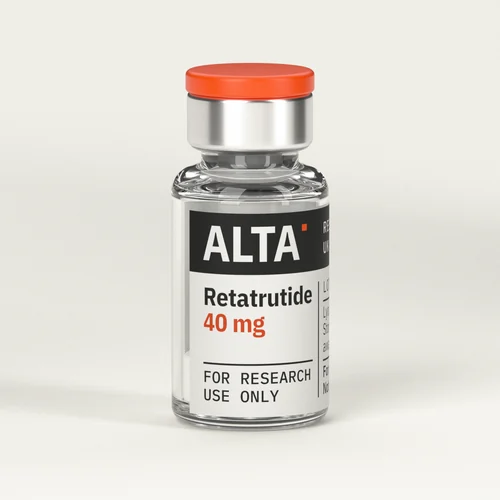
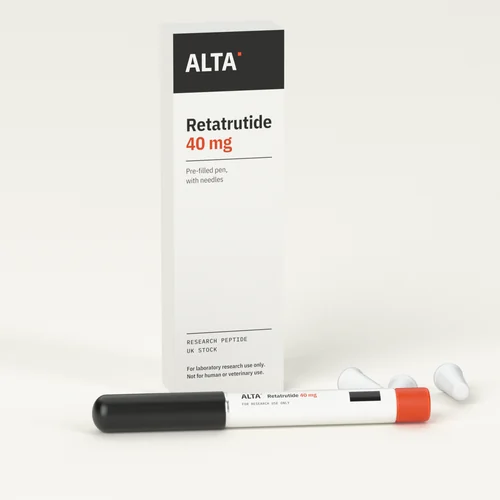
ALTA PEPTIDES stocks retatrutide research vials and a sealed retatrutide pen for laboratory research. Each lot is matched to a published certificate on our certificates page.
None of the trial doses in this article applies to them. Trial doses describe Lilly's own investigational medicine, given to monitored participants. A retatrutide research vial or pen is a laboratory reagent with no dose attached, and ALTA PEPTIDES gives no guidance on human use, as our research use policy sets out.
The trial record gives a laboratory context: the molecule's published human pharmacology. Our retatrutide explainer covers the molecule, and our retatrutide UK page covers stock and testing.
Everything above is the quick version. The sections below go deeper.
Phase 1: the first retatrutide doses in people
In shortA single-dose study in 45 healthy adults, then the 12-week phase 1b study in 72 adults with type 2 diabetes.
The first-in-human study (Coskun et al., Cell Metabolism 2022) enrolled 45 healthy participants, who each received a single dose or placebo. A 2026 review in Pharmaceutics gives that study's range as 0.1 to 6 mg.
The phase 1b study (Urva et al., Lancet 2022) then gave 72 adults with type 2 diabetes weekly injections for 12 weeks. Its five rising phase 1b cohorts received 0.5 mg, 1.5 mg, 3 mg, 3 then 6 mg, or 3, 6, 9 then 12 mg, alongside placebo and dulaglutide 1.5 mg.
Sources
- Jastreboff AM, et al. Retatrutide for obesity: a phase 2 trial. New England Journal of Medicine 2023;389:514-526. Results at ClinicalTrials.gov, NCT04881760.
- Rosenstock J, et al. Retatrutide for people with type 2 diabetes: a phase 2 trial. Lancet 2023;402:529-544.
- Urva S, et al. LY3437943 in people with type 2 diabetes: a phase 1b multiple-ascending dose trial. Lancet 2022;400:1869-1881.
- Coskun T, et al. LY3437943: from discovery to clinical proof of concept. Cell Metabolism 2022;34:1234-1247. ClinicalTrials.gov NCT03841630.
- Jastreboff AM, et al. Retatrutide for treatment of obesity (TRIUMPH-1). New England Journal of Medicine 2026;395:1781-1793.
- Bellido V, et al. Retatrutide in adults with obesity and type 2 diabetes (TRIUMPH-2). Lancet 2026;408:1455-1472.
- Schnitzer TJ, et al. Retatrutide in adults with knee osteoarthritis pain and obesity (TRIUMPH-4). New England Journal of Medicine, online 8 November 2026.
- Giblin K, et al. Rationale and design of the TRIUMPH trials. Diabetes, Obesity and Metabolism 2026;28:83-93.
- Sanyal AJ, et al. Retatrutide for steatotic liver disease: a phase 2a trial. Nature Medicine 2024;30:2037-2048.
- Mateescu DM, et al. Retatrutide as a unimolecular tri-agonist (review). Pharmaceutics 2026;18:1277.
- Eli Lilly and Company press releases: 11 December 2025 (TRIUMPH-4); 19 March 2026 (TRANSCEND-T2D-1); 21 May 2026 (TRIUMPH-1); 23 July 2026 (TRIUMPH-2 and TRIUMPH-3).
- Mounjaro KwikPen SmPC (Eli Lilly, revised 29 August 2026) and Wegovy FlexTouch SmPC (Novo Nordisk, revised September 2026), electronic medicines compendium.
- MHRA. Press release on weight-loss medicines and illegal sellers, gov.uk, 24 July 2026.
Questions people ask
What is the retatrutide dosage?
There is no approved one, because retatrutide is investigational and not licensed anywhere. Eli Lilly's phase 3 TRIUMPH trials assigned participants to once-weekly arms of 4 mg, 9 mg or 12 mg, each reached in steps from 2 mg. Those are trial arms, not doses for any other use.
What was the retatrutide starting dose in trials?
In the phase 3 TRIUMPH and TRANSCEND-T2D-1 protocols, the starting dose was 2 mg once weekly for every participant assigned to retatrutide, according to Lilly. The phase 2 obesity trial compared 2 mg and 4 mg starts and reported that the lower one partially mitigated gastrointestinal events.
What retatrutide dosing schedule did the phase 3 trials use?
Lilly's TRIUMPH announcements describe gradual dose increases from a 2 mg once-weekly start, one step every four weeks: 2, 4, 6, 9, then 12 mg for the top arm. The TRIUMPH design paper describes 16 weeks of escalation, then 64 weeks on the assigned arm.
What is the highest dose of retatrutide tested?
Among the trials covered here, the highest dose tested is 12 mg once weekly: the top arm in the phase 1b study, both phase 2 trials and the phase 3 TRIUMPH and TRANSCEND-T2D-1 trials. In TRIUMPH-1 the retatrutide 12 mg arm reported the largest average weight loss.
Is there an official retatrutide dosage chart?
No. Retatrutide has no approval anywhere, so no label carries one. The chart in this article lists the arms each Lilly clinical trial assigned, and nothing more.
What weight loss results did the 9 mg and 12 mg arms report?
In TRIUMPH-1, average weight loss at 80 weeks was 23.7% on 9 mg and 25.0% on 12 mg. Nausea was reported by 38.4% and 42.4% of those arms, and 6.9% and 11.3% stopped because of adverse events, according to Lilly.
Is retatrutide dosing the same as tirzepatide (Mounjaro) dosing?
No. They are different molecules, so milligrams do not transfer. The UK Mounjaro label starts at 2.5 mg once weekly with a maximum of 15 mg; Lilly's TRIUMPH trials started at 2 mg, with a top arm of 12 mg.
Is retatrutide a licensed weight loss medication?
No. No regulator has licensed it as an injectable weight loss medication or as anything else. Lilly's trials tested retatrutide for weight loss and type 2 diabetes, and the molecule remains investigational.
What was the maintenance dose in the retatrutide trials?
The assigned arm. TRIUMPH-1 set maintenance doses of 4 mg, 9 mg or 12 mg, each held to week 80 once reached; participants assigned to a lower dose stayed on it rather than moving up.
Does ALTA PEPTIDES give retatrutide dosing guidance?
No. ALTA PEPTIDES supplies retatrutide as a laboratory reagent for research only. A research vial or pen has no dose attached, and nothing in this article is guidance on human use.
Information, not advice. This article summarises published research; nothing here is guidance on human or veterinary use. Products are sold under our research use policy.