In this article14 sections
An experimental once-weekly peptide from Eli Lilly that copies three appetite and metabolism hormones at once: GLP-1, GIP and glucagon. In its biggest trial people on the top arm lost 28.3% of their weight on average over 80 weeks. It isn't approved anywhere yet.
Retatrutide, usually shortened to reta, is the most talked-about weight-loss compound since tirzepatide. It is an experimental peptide made by Eli Lilly that copies three of the body's own appetite and metabolism hormones at once, which is why it is often called a triple agonist (and, inaccurately, "GLP-3"). Its trials have reported the largest average weight loss of any drug of its type so far. This article explains, in plain terms, what retatrutide is, how it works, what the trials found, the side effects, and where it stands with regulators. It is an account of published research, not guidance on using any drug. ALTA PEPTIDES supplies retatrutide only as a research peptide for laboratory use.
- Retatrutide (LY3437943) is a single 39-amino-acid peptide made by Eli Lilly that activates three hormone receptors: , and glucagon.
- A C20 fatty acid attached to the chain gives it a half-life of about six days, so it was studied as a once-weekly injection.
- In TRIUMPH-1 (2,339 adults with obesity, 80 weeks), average weight loss was 28.3% on the 12 mg arm against 2.2% on placebo.
- Five phase 3 trials have reported positive results as of October 2026; Lilly plans to file with the US FDA in the first quarter of 2027.
- The most common side effects are nausea, vomiting and diarrhoea; an altered skin sensation called dysaesthesia has appeared consistently in phase 3.
- Retatrutide is not approved by any regulator, including the UK's MHRA, and is legally available as a medicine only inside Lilly's trials.
What is retatrutide?
In shortA Lilly peptide that copies three hormones at once. Not approved yet.
| Hormones copied | Status | |
|---|---|---|
| Semaglutide | GLP-1 | Approved |
| Tirzepatide | GLP-1 + GIP | Approved |
| Retatrutide | GLP-1 + GIP + glucagon | Phase 3 complete, not approved |
Retatrutide is the first of the three to add glucagon.
Retatrutide (development code LY3437943) is a single peptide chain, 39 amino acids long, designed by Eli Lilly to switch on three hormone receptors: GLP-1, GIP and glucagon. Those three hormones normally help control hunger, blood sugar and how the body burns energy. Earlier drugs copied one of them (semaglutide copies GLP-1) or two (tirzepatide copies GLP-1 and GIP). Retatrutide adds the third, glucagon. It was developed as a once-weekly injection for obesity and type 2 diabetes, and is now being tested for knee osteoarthritis, sleep apnoea, fatty liver disease, kidney disease and back pain too. It is not approved anywhere yet.
How does retatrutide work?
In shortTwo hormones cut appetite; the third, glucagon, raises energy burning.
Fuller sooner, slower stomach emptying, insulin after meals.
More insulin release; may soften nausea.
Raises energy use and liver fat burning.
- 01Eat less
GLP-1 and GIP
- 02Burn more
Glucagon
- 03More weight lost
Than eating less alone
Simplified. Coskun et al., Cell Metabolism 2022.
Each of the three hormones it copies does a different job. GLP-1 makes you feel full sooner, slows how fast the stomach empties and helps the pancreas release insulin after a meal. GIP also helps insulin release and appears to make GLP-1's appetite effect stronger while softening some of its nausea. Glucagon is the twist: as well as raising blood sugar, it increases how much energy the body burns and pushes the liver to use up stored fat. On its own glucagon would raise blood sugar, but paired with GLP-1 and GIP that effect is outweighed. The idea behind retatrutide is that eating less (from GLP-1 and GIP) and burning more (from glucagon) together produce more weight loss than eating less alone.
How much weight do people lose on retatrutide?
In shortAbout 28% on average in the biggest trial; less with type 2 diabetes.
Average body-weight loss at the highest dose tested in each trial. Phase 2: Jastreboff et al., NEJM 2023. TRIUMPH-4: Lilly, Dec 2025. TRIUMPH-1: Lilly, 21 May 2026 (efficacy estimand). TRIUMPH-2 and TRIUMPH-3: Lilly, 23 Jul 2026. Topline company figures; full papers pending.
More than with any approved weight-loss drug so far, on the numbers published. In the trial, published in the New England Journal of Medicine in 2023, adults on the 12 mg arm lost 24.2% of their body weight on average after 48 weeks, and had not yet levelled off. The phase 3 results have since confirmed it. In TRIUMPH-1, the largest trial, 2,339 adults with obesity but without diabetes lost 28.3% on average after 80 weeks on the 12 mg arm, against 2.2% on placebo; 45.3% of them lost at least 30% of their weight, and a third reached a normal-weight BMI. People with type 2 diabetes lost less, as they do with every drug in this class: 20.8% in TRIUMPH-2. In people with heart disease and severe obesity it was 22.6% (TRIUMPH-3), and in people with knee osteoarthritis 28.7% after 68 weeks (TRIUMPH-4).
Those headline numbers count only people who kept taking the drug. Counting everyone who started, including those who stopped, the TRIUMPH-1 figure on the top arm was 25.0%. That second figure is the fairer one to compare with other drugs.
Retatrutide vs tirzepatide and semaglutide
In shortMore weight loss on paper, but no head-to-head trial yet.
Treatment-policy (all randomised) figures from separate trials of different lengths; not a head-to-head comparison.
Retatrutide produced more weight loss than either, on the published numbers, but the trials were separate and lasted different lengths of time, so the comparison is rough. Using the same counting method for all three: semaglutide 2.4 mg gave 14.9% at 68 weeks (STEP-1), tirzepatide 15 mg gave 20.9% at 72 weeks (SURMOUNT-1), and retatrutide 12 mg gave 25.0% at 80 weeks (TRIUMPH-1). No head-to-head results against either drug have been published yet. Our retatrutide vs tirzepatide comparison goes through the differences in detail.
What else has retatrutide improved?
In shortBlood sugar, liver fat, knee pain, sleep apnoea and blood pressure.
Points, type 2 diabetes (TRANSCEND-T2D-1).
Relative, 24 weeks (phase 2 substudy).
WOMAC pain vs -40% placebo (TRIUMPH-4).
Breathing interruptions (TRIUMPH-1 sub-study).
mmHg systolic (TRIUMPH-4).
Too few events in TRIUMPH-3; outcomes trial running.
Lilly releases 2025-26; Sanyal et al., Nature Medicine 2024.
Several things that tend to follow weight. In type 2 diabetes, HbA1c (the long-term blood-sugar measure) fell by about 2 percentage points in phase 2 and by up to 2.0 points in the TRANSCEND-T2D-1 phase 3 trial. In a liver substudy of the phase 2 trial, liver fat fell by around 80% in 24 weeks on the higher arms, and most people's livers dropped below the threshold for fatty liver disease. In TRIUMPH-4, knee pain scores fell by about three quarters on retatrutide against about 40% on placebo, and in a TRIUMPH-1 sub-study of people with obstructive sleep apnoea, breathing interruptions during sleep fell by up to 60%. Systolic blood pressure dropped by up to 14 mmHg. The heart-outcome picture is still open: in TRIUMPH-3 the numbers of heart attacks, strokes and related events were similar on retatrutide and placebo, with too few events to draw a conclusion, and a dedicated outcomes trial is under way.
What are the side effects of retatrutide?
In shortMostly nausea and vomiting, plus a new one: tingling skin.
Percent of participants. Lilly, 6 June 2026.
Mostly the same as other drugs in this family, and mostly digestive. In TRIUMPH-1, nausea affected 42.4% on the 12 mg arm against 14.8% on placebo, and vomiting 25.3% against 4.8%; these were most common while the amount was being stepped up every four weeks. One side effect stands out as new: dysaesthesia, an altered or tingling skin sensation, reported in up to 12.5% on the top arm in TRIUMPH-1 and 20.9% in TRIUMPH-4, against around 1% on placebo; Lilly describes it as generally mild and rarely a reason to stop. The phase 2 trial also saw a dose-related rise in heart rate that peaked around 24 weeks and then eased, and more episodes of irregular heart rhythm than placebo. Between about 2% and 18% of people stopped because of side effects across the phase 3 trials, more often at the higher amounts. Some stopped because they felt they had lost too much weight.
Does retatrutide cause muscle loss?
In shortSome, like every drug of its type. Phase 3 muscle data aren't out yet.
Some of the weight lost is , as with every drug of this type, but the full picture isn't published yet. In a body-composition analysis of the phase 2 diabetes trial, roughly two thirds of the weight lost was fat and about a third lean mass, which is similar to tirzepatide and semaglutide. No muscle data from the phase 3 trials have been released. Our article on muscle loss on GLP-1 peptides compares the scan data across the class.
Is retatrutide approved?
In shortNo. US filing is planned for early 2027; the UK comes after.
- 2023Phase 2 published
24.2% average weight loss at 48 weeks in 338 adults, NEJM.
- Dec 2025First phase 3: TRIUMPH-4
28.7% at 68 weeks in adults with obesity and knee osteoarthritis.
- May 2026TRIUMPH-1
28.3% at 80 weeks; 45.3% of people on the top dose lost 30% or more.
- Jul 2026TRIUMPH-2 and TRIUMPH-3
20.8% with type 2 diabetes, 22.6% with heart disease. Five positive phase 3 trials.
- Q1 2027Planned FDA filing
Lilly's stated plan. US review usually takes around a year.
- LaterUK licence, then NICE
MHRA authorisation and a NICE appraisal are separate steps before any NHS use.
Lilly's stated plans; UK steps are separate and come later.
No, not anywhere. Lilly says it is legally available only through its clinical trials. After five positive phase 3 trials, Lilly has said it plans to file in the US in the first quarter of 2027, with filings in other regions to follow. In the UK it is not authorised by the MHRA, so it cannot be sold or supplied as a medicine, and any NHS use would also need a NICE appraisal. Our guide to getting retatrutide in the UK sets out the release timeline and the legal position, and our retatrutide price comparison covers what research vials cost.
Retatrutide vials and pens
In shortSame compound, two formats.
Swipe the table to compare →
| Lyophilised vial | Sealed manufacturer pen | Vendor-filled pen | |
|---|---|---|---|
| What it is | Dry powder, sealed under nitrogen | Solution in an injector, filled by a named manufacturer | Solution the vendor made up and loaded itself |
| Reconstitution | Done by the lab, to its own spec | None needed | Done by the vendor, unchecked |
| Stability | Years cold | Stated shelf life and in-use period | Unknown |
| Traceable to a tested lot | Yes, lot on vial = lot on certificate | To the lot, not the cartridge | No |
| Concentration known | Set by the lab | Set by the manufacturer | Vendor's word only |
| ALTA price, 40 mg | £139.99 (£3.50/mg) | £159.99 Synedica (£4.00/mg) | Not sold |
Same compound; the difference is who made up the solution and whether it can be checked.
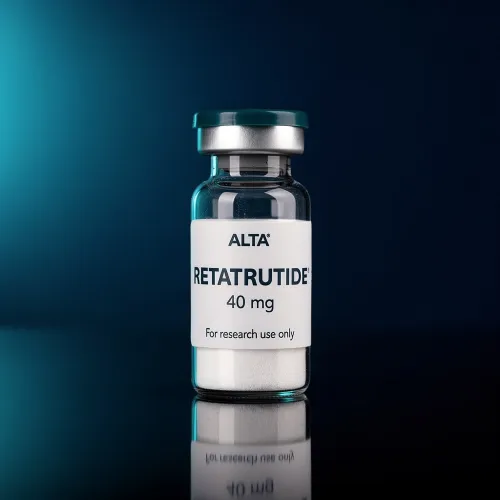
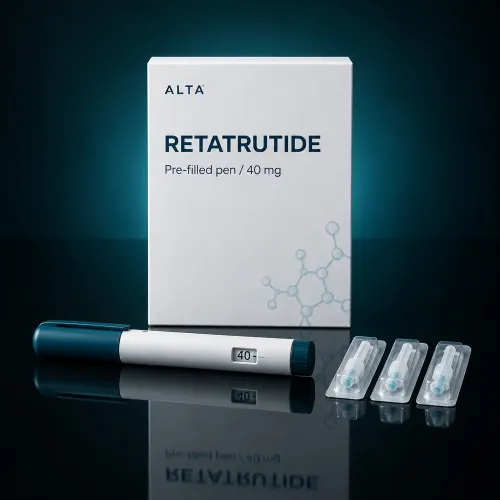
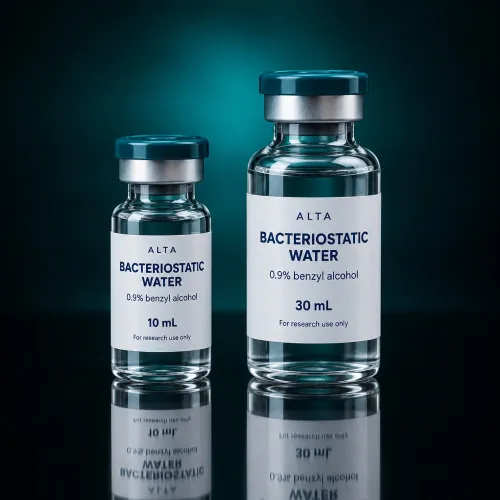
Outside the trials, retatrutide is sold as a research peptide in two forms: a vial of freeze-dried powder, which a laboratory makes up with bacteriostatic water, and a pre-filled pen. They contain the same compound; what differs is who made up the solution and whether that can be checked. Our retatrutide pen vs vial guide explains the difference, and the peptide calculator handles the reconstitution arithmetic for a vial.
What ALTA PEPTIDES supplies
In shortResearch vials and a sealed pen, lot-tested, for laboratory use only.
ALTA PEPTIDES holds retatrutide research vials and the sealed Synedica retatrutide pen in UK stock, each matched to a published certificate for its lot, and the pen lot has its own independent Janoshik test. Everything we sell is a laboratory reagent for research only, under our research use policy: not a medicine, not for human use, and nothing here is advice to use it. Prices, testing and delivery are summarised on our retatrutide UK page.
Everything above is the quick version. The sections below go deeper.
The molecule
In shortThe chemistry: 39 amino acids, a fatty acid tail, a six-day half-life.
Retatrutide is built on a GIP-like peptide backbone of 39 amino acids, modified so that it also activates the GLP-1 and glucagon receptors. In lab tests it is more potent than natural GIP at the GIP receptor and less potent than the natural hormones at the GLP-1 and glucagon receptors, a balance Lilly chose to keep the glucagon effect from pushing blood sugar up. A C20 fatty diacid attached to the chain lets it bind to albumin in the blood, which protects it from breakdown and from being filtered out by the kidneys. That gives a half-life of about six days in people, which is why it was studied once a week, with the amount stepped up gradually (in phase 3, from 2 mg every four weeks to arms of 4, 9 or 12 mg) to limit nausea.
The trials in detail
In shortEvery trial's full figures.
Phase 1b (Urva et al., Lancet 2022): 72 adults with type 2 diabetes over 12 weeks; HbA1c fell up to 1.6 points more than placebo and weight up to 8.96 kg more; heart rate rose in the top groups. Phase 2 obesity (Jastreboff et al., NEJM 2023): 338 adults over 48 weeks; weight change at 48 weeks was -8.7% (1 mg), -17.1% (4 mg), -22.8% (8 mg) and -24.2% (12 mg) against -2.1% on placebo; on 12 mg, 100% lost at least 5% and 83% at least 15%; 16% of the 12 mg group stopped because of side effects. Phase 2 diabetes (Rosenstock et al., Lancet 2023): 281 adults; HbA1c fell 2.02 points at 24 weeks on 12 mg, and weight 16.9% at 36 weeks. Liver substudy (Sanyal et al., Nature Medicine 2024): 98 people with at least 10% liver fat; relative reduction around 82% at 24 weeks on the 8 and 12 mg arms.
Phase 3, as reported by Lilly: TRIUMPH-4 (445 adults with obesity and knee osteoarthritis, 68 weeks, December 2025): -28.7% on 12 mg, -26.4% on 9 mg, -2.1% on placebo. TRANSCEND-T2D-1 (537 adults with type 2 diabetes, 40 weeks, March 2026): HbA1c -2.0 points and weight -16.8% at the top arms. TRIUMPH-1 (2,339 adults with obesity, 80 weeks, May 2026, published in NEJM in September 2026): -19.0%, -25.9% and -28.3% on 4, 9 and 12 mg against -2.2%; -25.0% on 12 mg counting everyone randomised. TRIUMPH-2 (1,152 adults with obesity and type 2 diabetes, 80 weeks, July 2026, published in The Lancet): -20.8% on 12 mg against -4.0%. TRIUMPH-3 (1,949 adults with severe obesity and heart disease, 80 weeks, July 2026): -22.6% on 12 mg against -3.2%. Efficacy-estimand figures unless stated; cross-trial comparisons are not head-to-head.
Sources
- Urva S, et al. LY3437943, a novel triple GIP, GLP-1, and glucagon receptor agonist in people with type 2 diabetes: a phase 1b, multicentre, double-blind, placebo-controlled, randomised, multiple-ascending dose trial. Lancet 2022;400:1869-1881.
- Jastreboff AM, et al. Triple-hormone-receptor agonist retatrutide for obesity: a phase 2 trial. New England Journal of Medicine 2023;389:514-526.
- Rosenstock J, et al. Retatrutide, a GIP, GLP-1 and glucagon receptor agonist, for people with type 2 diabetes: a randomised, double-blind, placebo and active-controlled, parallel-group, phase 2 trial conducted in the USA. Lancet 2023;402:529-544.
- Sanyal AJ, et al. Triple hormone receptor agonist retatrutide for metabolic dysfunction-associated steatotic liver disease: a randomized phase 2a trial. Nature Medicine 2024;30:2037-2048.
- Eli Lilly press releases: TRIUMPH-4 (11 December 2025); TRANSCEND-T2D-1 (19 March 2026); TRIUMPH-1 (21 May and 6 June 2026); TRIUMPH-2 and TRIUMPH-3 (23 July 2026); publications and filing plan (29 September 2026).
- Jastreboff AM, et al. Tirzepatide once weekly for the treatment of obesity (SURMOUNT-1). New England Journal of Medicine 2022;387:205-216.
- Wilding JPH, et al. Once-weekly semaglutide in adults with overweight or obesity (STEP 1). New England Journal of Medicine 2021;384:989-1002.
- Coskun T, et al. LY3437943, a novel triple glucagon, GIP, and GLP-1 receptor agonist for glycemic control and weight loss: from discovery to clinical proof of concept. Cell Metabolism 2022;34:1234-1247.
- Eli Lilly. What to know about retatrutide (lilly.com, updated September 2026).
Questions people ask
What is retatrutide?
Retatrutide is an experimental peptide from Eli Lilly that copies three natural gut and pancreas hormones (GLP-1, GIP and glucagon) at once. It was designed as a once-weekly injection for obesity and type 2 diabetes and has completed several phase 3 trials, but it isn't approved anywhere yet.
What does reta peptide mean?
Reta is simply the short name people use for retatrutide. A 'reta peptide' vial or 'reta pen' refers to the same compound, LY3437943.
How much weight do people lose on retatrutide?
In TRIUMPH-1, adults with obesity on the 12 mg arm lost 28.3% of their body weight on average over 80 weeks, and 45.3% of them lost 30% or more. Counting everyone who started, including those who stopped, the average was 25.0%. People with type 2 diabetes lost less, about 21%.
Is retatrutide stronger than tirzepatide?
On the published numbers it produced more weight loss, but the two have not yet been compared in the same trial. Tirzepatide's SURMOUNT-1 trial reported 20.9% at 72 weeks; retatrutide's TRIUMPH-1 reported 25.0% at 80 weeks on the comparable measure. No head-to-head results have been published.
What are the side effects of retatrutide?
Mostly digestive: nausea (about 42% on the top arm in TRIUMPH-1 against 15% on placebo), vomiting, diarrhoea and constipation, mainly while the amount was being stepped up. A tingling or altered skin sensation called dysaesthesia affected up to about 1 in 8 on the top arm, and phase 2 saw a temporary rise in heart rate.
Is retatrutide approved in the UK?
No. It is not authorised by the MHRA or any other regulator. Lilly plans to file in the US in early 2027, and a UK licence and NICE review would come after that. Our guide to retatrutide in the UK covers the legal position.
Information, not advice. This article summarises published research; nothing here is guidance on human or veterinary use. Products are sold under our research use policy.