In this article16 sections
In Eli Lilly's trials, mostly nausea, diarrhoea, constipation and vomiting, plus an altered skin sensation called dysaesthesia and a rise in heart rate in phase 2. Retatrutide is an investigational weight loss drug: it is unlicensed and no regulator has established its safety. The figures describe Lilly's trial medicine in monitored participants, not products sold online.
Retatrutide side effects have now been reported from two and six phase 3 trials run by Eli Lilly, and most are digestive. In the largest phase 3 trial, TRIUMPH-1 (2,339 adults with obesity, 80 weeks), nausea was reported by 42.4% of people on the 12 mg dose of retatrutide against 14.8% on placebo, and 11.3% stopped treatment because of adverse events. Retatrutide (LY3437943) is not licensed anywhere. Everything below describes Lilly's own investigational medicine in monitored clinical trial participants and says nothing about any product sold online; ALTA PEPTIDES supplies retatrutide for laboratory research only and gives no guidance on human use.
- Retatrutide (LY3437943) is an investigational Eli Lilly medicine, a triple agonist of the receptor, the receptor and the glucagon receptor. As of 15 November 2026 it is not licensed by the MHRA or any other regulator.
- In TRIUMPH-1 (2,339 adults with obesity and no diabetes, 80 weeks), nausea was reported by 28.6%, 38.4% and 42.4% of the 4 mg, 9 mg and 12 mg arms against 14.8% on placebo, according to Lilly's May 2026 release.
- Dysaesthesia, an altered skin sensation, was reported by 12.5% of the 12 mg arm against 0.9% on placebo in TRIUMPH-1, and by 20.9% against 0.7% in TRIUMPH-4 (445 adults with obesity and knee osteoarthritis, 68 weeks).
- Treatment was stopped because of adverse events by 11.3% of the 12 mg arm in TRIUMPH-1 and by 18.2% in TRIUMPH-4, against 4.9% and 4.0% on placebo.
- In the phase 2 trial in obesity (338 adults, 48 weeks), nausea was recorded in 17.1% of the 8 mg group that started at 2 mg and in 60.0% of the 8 mg group that started at 4 mg, according to ClinicalTrials.gov.
- The ClinicalTrials.gov records of the two phase 2 trials (338 and 281 adults) list three cases of acute pancreatitis among participants taking retatrutide and none on placebo.
- On 24 July 2026 the MHRA said retatrutide has not been authorised for use in the UK and that products sold as retatrutide have not been tested and may not contain it.
What are the side effects of retatrutide?
In shortMostly nausea, diarrhoea, constipation and vomiting, plus an altered skin sensation.
Placebo 14.8%. Diarrhoea, constipation and vomiting follow.
Altered skin sensation. Placebo 0.9%.
Because of adverse events. Placebo 4.9%.
Not the MHRA, not the FDA.
TRIUMPH-1: 2,339 adults with obesity, 80 weeks, 12 mg arm against placebo. Eli Lilly release, 21 May 2026.
The side effects of retatrutide reported most often were nausea, diarrhoea, constipation and vomiting, gastrointestinal side effects that were more frequent on the higher dose arms. Dysaesthesia, an altered skin sensation, was reported by up to 20.9% of one group in TRIUMPH-4 (445 adults with obesity and knee osteoarthritis, 68 weeks). Heart rate rose in phase 2, and more people stopped treatment on the higher arms than on placebo.
"Reta side effects" means the same thing: reta is short for retatrutide. Our other guides cover the weight loss results, including the average weight loss Lilly reported, the doses used in each clinical trial, and what retatrutide is.
Is retatrutide safe?
In shortNot established: no regulator has reviewed it, and the long-term effects are unknown.
ClaimRetatrutide has been proven safeTap to check
No regulator has licensed it or reviewed its risks.
ClaimRetatrutide is approved for weight lossTap to check
No regulator has approved it for any use. Lilly has said it plans to file with the FDA in the first quarter of 2027.
ClaimThe side effects are only mildTap to check
The phase 2 authors described digestive events as mostly mild to moderate. But 18.2% of the 12 mg arm in TRIUMPH-4 (445 adults with obesity and knee osteoarthritis, 68 weeks) stopped treatment for adverse events, and that trial's paper reports more serious adverse events on retatrutide than on placebo.
ClaimTrial figures apply to vials and pens sold onlineTap to check
The figures describe Lilly's own medicine in monitored participants. The MHRA said on 24 July 2026 that products sold as retatrutide are untested and may not contain it.
ClaimThe long-term effects are knownTap to check
No main trial ran longer than 80 weeks. The longest reported treatment is 104 weeks, in 532 TRIUMPH-1 participants. The outcomes trial has an estimated completion date of February 2029.
ClaimDysaesthesia only happens with retatrutideTap to check
UK product information lists it for semaglutide (Wegovy: 2.1% against 1.2% on placebo) and for tirzepatide (Mounjaro: uncommon).
Interactive. Tap a claim. Trial papers, Eli Lilly releases, UK product information and the MHRA statement of 24 July 2026.
No one can yet say that it is. Retatrutide safety has not been established by any regulator: it has no licence from the MHRA, the FDA or any other agency. Lilly's own releases caution that there is no guarantee it "will prove to be a safe and effective treatment".
The trials found a pattern Lilly called "generally consistent with trials of other incretin-based therapies" (TRIUMPH-1, 2,339 adults with obesity, 80 weeks). In TRIUMPH-4 (445 adults with obesity or overweight and knee osteoarthritis, 68 weeks), which Lilly describes as a study "comparing the efficacy and safety of retatrutide with placebo", up to 18.2% of one group stopped treatment because of adverse events. That trial's paper states that serious adverse events were more common with retatrutide than with placebo.
The long-term effects are unknown, and all of this concerns side effects in trials of Lilly's manufactured medicine, not products sold online under the same name.
Retatrutide nausea, diarrhoea, vomiting and constipation: the rates
In shortAbout four in ten people on the top arm of the largest trial reported nausea.
Share of participants reporting each event. 2,339 adults with obesity, 80 weeks. Eli Lilly release, 21 May 2026.
Swipe the table to compare →
| People and length | Nausea, 12 mg arm | Nausea, comparator | |
|---|---|---|---|
| Phase 2 obesity | 338 adults, 48 wk | 45.2% | 11.4% placebo |
| TRIUMPH-1 | 2,339 adults, obesity, 80 wk | 42.4% | 14.8% placebo |
| TRIUMPH-4 | 445 adults, obesity and knee osteoarthritis, 68 wk | 43.2% | 10.7% placebo |
| TRIUMPH-2 | 1,152 adults, obesity and type 2 diabetes, 80 wk | 28.0% | 8.0% placebo |
| TRIUMPH-3 | 1,949 adults, severe obesity and heart disease, 80 wk | 22.4% | 5.8% placebo |
| TRANSCEND-T2D-1 | 537 adults, type 2 diabetes, 40 wk | 26.5% | 3.7% placebo |
| TRANSCEND-T2D-2 | 1,298 adults, type 2 diabetes, 80 wk | 23.8% | 21.3% semaglutide 2 mg |
Phase 2: ClinicalTrials.gov NCT04881760 (28 of 62 against 8 of 70). Phase 3: Eli Lilly releases, December 2025 to October 2026. Separate trials, so not a ranking.
TRIUMPH-1, a obesity trial, enrolled 2,339 adults with obesity and no diabetes for 80 weeks, on 4 mg, 9 mg or 12 mg a week or placebo. Lilly's May 2026 release reported retatrutide nausea rates of 28.6%, 38.4% and 42.4% against 14.8% on placebo, and vomiting in 10.6%, 22.8% and 25.3% against 4.8%. Retatrutide constipation rates were 23.8%, 25.9% and 26.1% against 10.9%, and diarrhoea 25.2%, 34.1% and 32.0% against 13.5%.
In TRIUMPH-2 (1,152 adults with obesity and type 2 diabetes, 80 weeks, The Lancet 2026) diarrhoea was the most frequent event, at 27%, 34% and 34% against 13% on placebo, and nausea was reported by 14%, 21% and 28% against 8%. The same paper reported low blood pressure in 1%, 5% and 6% against fewer than 1%. Urinary tract infections were also more frequent in TRIUMPH-1: 7.5%, 8.8% and 8.4% against 5.3%.
Retatrutide dosage in the trials: what did a lower starting dose change?
In shortSide effects came mostly early; in phase 2, groups that started lower reported less nausea.
Share of each 35-person group with the event recorded as a non-serious adverse event. 338 adults in the whole trial, 48 weeks of treatment. ClinicalTrials.gov NCT04881760. This describes a trial design; it is not a suggestion.
Side effects came mostly early, where the reports say. Lilly's 2023 release on the phase 2 obesity trial (338 adults, 48 weeks) said digestive events "usually occurred during the dose escalation period". That trial's paper reported they were "partially mitigated with a lower starting dose (2 mg vs. 4 mg)".
Its ClinicalTrials.gov record shows the gap. Among people assigned to 8 mg, nausea was recorded in 6 of 35 (17.1%) who started at 2 mg and 21 of 35 (60.0%) who started at 4 mg, and vomiting in 2 of 35 against 9 of 35. These are small groups, and the finding describes what a trial protocol did.
The phase 2 type 2 diabetes trial (281 adults, 36 weeks, The Lancet 2023) pointed the same way: its authors reported mild-to-moderate digestive events in 13% of the lowest arm and 50% of the 8 mg group that started at 4 mg, against 13% on placebo.
Retatrutide dysaesthesia and skin sensitivity
In shortAn altered skin sensation, reported by up to one in five on the top arm of one trial.
Share of participants reporting dysaesthesia. TRIUMPH-4: 445 adults; TRIUMPH-1: 2,339; TRIUMPH-2: 1,152; TRIUMPH-3: 1,949. Eli Lilly releases of 11 December 2025, 21 May 2026 and 23 July 2026.
Dysaesthesia is an altered sensation in the skin. The UK product information for semaglutide groups it with burning sensation, allodynia and sensitive skin, which is why searches for retatrutide skin sensitivity and retatrutide dysaesthesia lead to the same finding.
In TRIUMPH-1 (2,339 adults with obesity, 80 weeks) it was reported by 5.1%, 12.3% and 12.5% of the 4 mg, 9 mg and 12 mg arms against 0.9% on placebo. In TRIUMPH-4 (445 adults with obesity and knee osteoarthritis, 68 weeks) it was 8.8% and 20.9% on 9 mg and 12 mg against 0.7%. Lilly described the events as "generally mild to moderate" and said most resolved during treatment.
The phase 2 obesity trial (338 adults, 48 weeks) recorded allodynia, pain from a touch that would not normally hurt, in 4 of 62 people on 12 mg and in no other group. None of the sources establishes a cause.
Retatrutide heart rate findings
In shortHeart rate rose in phase 2, peaking at 24 weeks; the heart-outcome question is still open.
The main source is the phase 2 obesity paper, "Triple-hormone-receptor agonist retatrutide for obesity" (338 adults, 48 weeks). Its published summary reads: "Dose-dependent increases in heart rate peaked at 24 weeks and declined thereafter." The summary gives no size for the rise, and Lilly's phase 3 releases give no heart rate figures.
TRIUMPH-3 (1,949 adults with severe obesity and cardiovascular disease, 80 weeks) counted major cardiovascular events: 44 on its two retatrutide arms combined and 52 on placebo on a five-part measure, a hazard ratio of 0.82 (95% confidence interval 0.55 to 1.22). On a three-part measure it was 27 against 23, a hazard ratio of 1.12 (0.64 to 1.96). Both intervals include 1, so the trial does not show whether retatrutide raises or lowers that risk.
Retatrutide headache, hair loss and muscle loss: what the reports say
In shortSmall phase 2 numbers for headache, no figure for hair loss, one scan study on lean mass.
Retatrutide headache figures exist only for phase 2. In the obesity trial (338 adults, 48 weeks), ClinicalTrials.gov lists headache in 4 of 62 people on 12 mg and 0 of 70 on placebo.
On retatrutide hair loss, the published reports give no figure. It is absent from the phase 2 tables, which list non-serious events reported by at least 5% of any group, and from Lilly's phase 3 releases. The UK product information for tirzepatide and semaglutide lists hair loss at 4.9% and 2.5% of participants in their weight management trials, against 1.0% on placebo.
On retatrutide muscle loss, a body-scan substudy of the phase 2 type 2 diabetes trial (189 participants, 36 weeks, Lancet Diabetes and Endocrinology 2025) concluded that the "proportion of loss to weight loss was similar to other obesity treatments"; our article on muscle loss on GLP-1 peptides compares the scan data. The sources cited here give no bone results.
How many people stopped retatrutide because of side effects?
In shortBetween about 2% and 18%, depending on the trial and the arm.
Swipe the table to compare →
| 4 mg | 9 mg | 12 mg | Comparator | |
|---|---|---|---|---|
| TRIUMPH-1 · 80 wk | 4.1% | 6.9% | 11.3% | 4.9% placebo |
| TRIUMPH-2 · 80 wk | 3.8% | 11.6% | 7.7% | 4.9% placebo |
| TRIUMPH-3 · 80 wk | not tested | 9.8% | 13.5% | 4.8% placebo |
| TRIUMPH-4 · 68 wk | not tested | 12.2% | 18.2% | 4.0% placebo |
| TRANSCEND-T2D-1 · 40 wk | 2.2% | 4.5% | 5.1% | 0.0% placebo |
| TRANSCEND-T2D-2 · 80 wk | not tested | 4.8% | 7.9% | 2.7% semaglutide 2 mg |
Eli Lilly releases: 11 December 2025, 21 May, 6 June, 23 July and 28 October 2026. Trial sizes and populations are given in the text.
More on the 9 mg and 12 mg arms than on the comparator in all six phase 3 trials. In TRIUMPH-1 (2,339 adults with obesity, 80 weeks), 4.1%, 6.9% and 11.3% of the 4 mg, 9 mg and 12 mg arms stopped treatment because of adverse events, against 4.9% on placebo.
TRIUMPH-4 (445 adults with obesity and knee osteoarthritis, 68 weeks) had the highest rates: 12.2% and 18.2% on 9 mg and 12 mg against 4.0% on placebo. Lilly said these rates were "highly correlated with baseline BMI" and included people who stopped for "perceived excessive weight loss". The design paper adds that a permanent dose reduction was permitted for digestive adverse events.
Serious adverse events: retatrutide pancreatitis, gallbladder, heart and deaths
In shortPancreatitis, gallbladder and heart events were recorded; phase 3 rates are mostly unpublished.
Tap a trial
338 adults, 48 weeks. Serious adverse events: 2 of 62 on 12 mg, 3 of 70 on placebo. On the retatrutide arms the record lists two strokes and one case of chest discomfort (1 mg); one drowning and one kidney cancer (4 mg); one case each of cardiac failure, acute kidney injury, acute cholecystitis, serious vomiting and Covid-19 (8 mg); one acute pancreatitis and one QT prolongation (12 mg). On placebo: coronary artery stenosis, bone contusion and raised calcitonin. Source: ClinicalTrials.gov NCT04881760.
281 adults with type 2 diabetes, 36 weeks. Serious adverse events: 2 of 46 on 12 mg, 3 of 45 on placebo. On the retatrutide arms the record lists, among others, two cases of acute pancreatitis (0.5 mg and 8 mg), two of congestive cardiac failure (0.5 mg and 4 mg), one atrial fibrillation and one chronic cholecystitis (8 mg) and one diabetic ketoacidosis (12 mg). No deaths. Source: ClinicalTrials.gov NCT04867785.
2,339 adults with obesity, 80 weeks (New England Journal of Medicine 2026). The paper's abstract and Lilly's releases give no serious adverse event rate. People who had had pancreatitis were excluded from the trial.
1,152 adults with obesity and type 2 diabetes, 80 weeks (The Lancet 2026). Deaths: two on 4 mg, three on 9 mg, one on 12 mg and one on placebo, all judged by investigators to be unrelated to the study drug. Low blood pressure: 1%, 5% and 6% against fewer than 1% on placebo.
1,949 adults with severe obesity and cardiovascular disease, 80 weeks (Lilly release, 23 July 2026). Major cardiovascular events on the five-part measure: 44 on retatrutide and 52 on placebo, hazard ratio 0.82 (95% CI 0.55 to 1.22). On the three-part measure: 27 against 23, hazard ratio 1.12 (0.64 to 1.96). Press release only so far.
445 adults with obesity and knee osteoarthritis, 68 weeks (New England Journal of Medicine 2026). The paper states that serious adverse events were more common with retatrutide than with placebo; its abstract gives no rate. 18.2% of the 12 mg arm stopped treatment for adverse events, against 4.0% on placebo.
537 adults with type 2 diabetes, 40 weeks (The Lancet 2026). Two deaths, both on 4 mg, described as unrelated to the study drug. No severe hypoglycaemia was reported.
Interactive. ClinicalTrials.gov records, journal abstracts and Eli Lilly releases listed in the sources. A serious event recorded during a trial is not necessarily caused by the drug.
The fullest public record is for phase 2. In the obesity trial (338 adults, 48 weeks), ClinicalTrials.gov lists serious adverse events in 2 of 62 people on 12 mg and 3 of 70 on placebo. Events on retatrutide included one case of acute pancreatitis on 12 mg, one of acute cholecystitis (gallbladder inflammation) on 8 mg and two strokes on 1 mg; one participant on 4 mg died, the cause recorded as drowning.
The phase 2 type 2 diabetes trial (281 adults, 36 weeks) recorded two cases of acute pancreatitis on retatrutide and none on placebo. For phase 3, retatrutide pancreatitis and gallbladder rates are not in the abstracts or releases. TRIUMPH-2 (1,152 adults, 80 weeks) reported two, three and one deaths on its three retatrutide arms and one on placebo, all judged by investigators to be unrelated to the study drug.
On the liver, the phase 2 fatty liver substudy (98 participants, 48 weeks, Nature Medicine 2024) reported "no hepatotoxicity signals". It did not include people with advanced fibrosis or cirrhosis.
Retatrutide long term side effects: what is not yet known
In shortNothing is known beyond about two years, or in the people the trials left out.
Longest reported treatment: 104 weeks, in 532 TRIUMPH-1 participants. Potential side effects that take longer to appear have not been measured.
Outcomes trial with a planned 10,000 participants; estimated completion February 2029.
TRIUMPH-1 excluded diabetes, past pancreatitis and a personal or family history of medullary thyroid carcinoma or MEN-2.
TRIUMPH-3 and TRANSCEND-T2D-2: press release only as of 15 November 2026.
Lilly has said it plans to file with the FDA in the first quarter of 2027.
No trial describes them. The MHRA says there is no guarantee they contain retatrutide.
ClinicalTrials.gov NCT05929066 and NCT06383390; Eli Lilly releases of 21 May and 23 July 2026; MHRA, 24 July 2026.
No main trial ran longer than 80 weeks, and the longest retatrutide treatment reported is 104 weeks, in 532 TRIUMPH-1 participants. A cardiovascular and kidney outcomes trial with a planned 10,000 participants has an estimated completion date of February 2029.
The retatrutide trials also left people out: TRIUMPH-1 excluded anyone with diabetes, past pancreatitis, or a personal or family history of medullary thyroid carcinoma or MEN-2. And as of 15 November 2026, TRIUMPH-3 and the head-to-head trial against semaglutide had been reported by press release only. These are the retatrutide risks that no percentage can yet describe.
Is retatrutide available in the UK as a licensed weight loss medication? The MHRA warning
In shortNo. Retatrutide is currently unlicensed, and the MHRA warns that products sold as retatrutide are untested.
- Oct 2025First illicit production site
5,000 unauthorised retatrutide and tirzepatide pens seized, the MHRA says.
- 24 Jul 2026Public warning
Not authorised in the UK; products untested, with no guarantee they contain retatrutide.
- 14 Oct 2026Birmingham raid
Over 12,000 fake retatrutide and tirzepatide pens seized.
GOV.UK press releases of 24 July 2026 and 15 October 2026.
No. Retatrutide has no marketing authorisation from the MHRA, so there is no UK product information and no licensed dose for it. Retatrutide is still in development, and no regulator has approved retatrutide for weight loss or any other use.
On 24 July 2026 the MHRA said retatrutide "has not been authorised for use in the UK, meaning anyone selling this product is doing so illegally", and that such products "haven't been tested for safety, quality or effectiveness and there's no guarantee that they even contain retatrutide". That is a safety point in its own right: a trial figure describes a medicine of known content, and an unlicensed product may not contain what its label says. Our guide to retatrutide UK availability covers the legal position.
Retatrutide for laboratory research: what ALTA supplies
In shortResearch material with a lot certificate; not a medicine, and no guidance on human use.
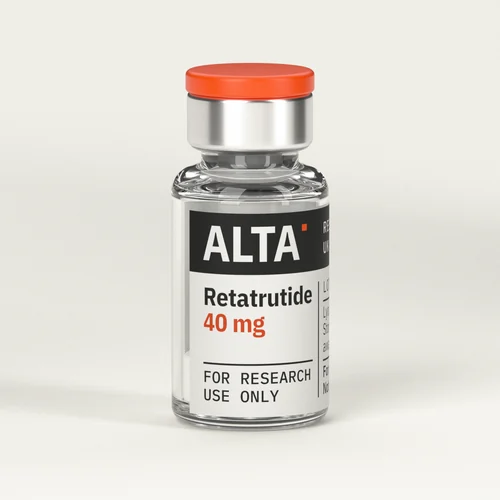
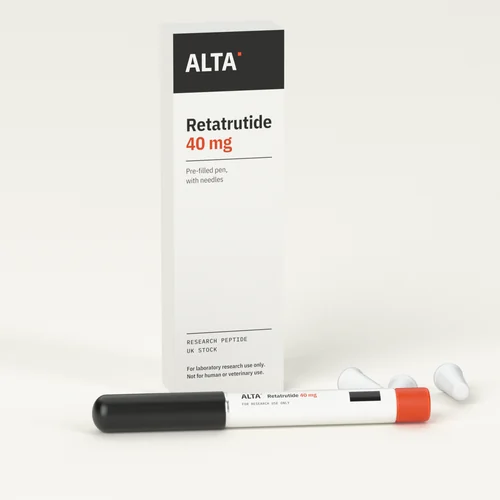
ALTA PEPTIDES supplies retatrutide research vials and a sealed retatrutide pen as laboratory research materials, each lot matched to a published certificate of analysis on our certificates page. A certificate describes the identity and purity of a lot; it is not evidence of safety in people.
The trial data in this article describe Lilly's own investigational medicine in monitored participants and say nothing about any product sold online, including ours. ALTA PEPTIDES supplies retatrutide for laboratory research only, under our research use policy, and gives no guidance on human use.
Everything above is the quick version. The sections below go deeper.
Retatrutide vs tirzepatide and semaglutide: side effects compared
In shortOne head-to-head trial against semaglutide; none yet against tirzepatide.
Swipe the table to compare →
| Retatrutide (unlicensed) | Tirzepatide (Mounjaro) | Semaglutide 2.4 mg (Wegovy) | |
|---|---|---|---|
| Nausea, top dose | 42.4% against 14.8% placebo (TRIUMPH-1, 80 wk) | 28.0% against 8.5% (pooled SURMOUNT-1 and -2) | 43.9% against 16.1% (68 wk) |
| Dysaesthesia | 12.5% against 0.9% (TRIUMPH-1) | Listed as uncommon | 2.1% against 1.2% |
| Heart rate | Rise that peaked at 24 wk in phase 2; no figure in the abstract | Mean rise of 3 beats a minute | Mean rise of 3 beats a minute |
| Hair loss | No figure reported | 4.9% against 1.0% | 2.5% against 1.0% |
| Stopped for adverse events | 11.3% against 4.9% (TRIUMPH-1) | 6.2% against 2.6% (SURMOUNT-1, 15 mg, 72 wk) | 4.5% against 0.8%, gut events only (STEP 1, 68 wk) |
| UK licence | None | Licensed | Licensed |
Retatrutide: Eli Lilly release, 21 May 2026, and Jastreboff et al., NEJM 2023. Tirzepatide: Mounjaro SmPC (revised 29 August 2026) and SURMOUNT-1, NEJM 2022. Semaglutide: Wegovy SmPC (revised September 2026) and STEP 1, NEJM 2021. Separate trials, so not a head-to-head comparison.
Only one head-to-head trial has reported. TRANSCEND-T2D-2 compared retatrutide 9 mg and 12 mg with semaglutide 2 mg (Ozempic) in 1,298 adults with type 2 diabetes over 80 weeks. Lilly's October 2026 release reported nausea in 21.2% and 23.8% against 21.3% on semaglutide, and treatment stopped for adverse events in 4.8% and 7.9% against 2.7%.
No trial comparing Mounjaro and retatrutide has reported; ClinicalTrials.gov lists a study of retatrutide compared with tirzepatide in about 800 adults with obesity. Across separate trials, which is a rough guide only, the UK product information for each licensed weight loss treatment gives top-dose nausea rates of 28.0% against 8.5% on placebo for tirzepatide (Mounjaro, pooled SURMOUNT-1 and SURMOUNT-2) and 43.9% against 16.1% for semaglutide 2.4 mg (Wegovy, 68 weeks).
Dysaesthesia is not unique to retatrutide: the Wegovy product information reports altered skin sensation in 2.1% of people treated with Wegovy against 1.2% on placebo, and the Mounjaro product information lists it as uncommon. Our retatrutide vs tirzepatide comparison covers the difference between retatrutide and tirzepatide, including effects on weight loss.
Retatrutide side effects: the clinical trial programme behind the figures
In shortTwo phase 2 and six phase 3 trials, two of them reported by press release only.
Swipe the table to compare →
| People | Length | Reported in | |
|---|---|---|---|
| Phase 2 obesity | 338 adults | 48 wk | NEJM 2023; ClinicalTrials.gov |
| Phase 2 type 2 diabetes | 281 adults | 36 wk | The Lancet 2023; ClinicalTrials.gov |
| TRIUMPH-1 | 2,339 adults, obesity | 80 wk | NEJM 2026 |
| TRIUMPH-2 | 1,152 adults, obesity and type 2 diabetes | 80 wk | The Lancet 2026 |
| TRIUMPH-3 | 1,949 adults, severe obesity and heart disease | 80 wk | Press release only |
| TRIUMPH-4 | 445 adults, obesity and knee osteoarthritis | 68 wk | NEJM 2026 |
| TRANSCEND-T2D-1 | 537 adults, type 2 diabetes | 40 wk | The Lancet 2026 |
| TRANSCEND-T2D-2 | 1,298 adults, type 2 diabetes | 80 wk | Press release only |
The obesity trials tested whether participants lose weight, measured as percentage change in body weight; the diabetes trials measured blood sugar. Side effects were recorded as safety data. Publication status as found on PubMed on 15 November 2026.
Two phase 2 and six phase 3 trials, set out in the table below. Percentages from Lilly releases are the company's own summaries; where a journal abstract reports the same event, the two agree to within rounding. The phase 2 retatrutide adverse events tables are on ClinicalTrials.gov.
Sources
- Jastreboff AM, et al. Retatrutide for obesity: a phase 2 trial. New England Journal of Medicine 2023;389:514-526. Results: ClinicalTrials.gov NCT04881760.
- Rosenstock J, et al. Retatrutide for people with type 2 diabetes: a phase 2 trial. The Lancet 2023;402:529-544. Results: ClinicalTrials.gov NCT04867785.
- TRIUMPH-1: New England Journal of Medicine 2026;395:1781-1793. TRIUMPH-2: The Lancet 2026;408:1455-1472. TRIUMPH-4: New England Journal of Medicine, online 8 November 2026. TRANSCEND-T2D-1: The Lancet 2026;407:2402-2413.
- Eli Lilly press releases on retatrutide: 26 June 2023 (phase 2), 11 December 2025 (TRIUMPH-4), 21 May and 6 June 2026 (TRIUMPH-1, TRANSCEND-T2D-1), 23 July 2026 (TRIUMPH-2, TRIUMPH-3), 28 October 2026 (TRANSCEND-T2D-2).
- Sanyal AJ, et al. Retatrutide for metabolic dysfunction-associated steatotic liver disease. Nature Medicine 2024;30:2037-2048. Body composition substudy: Lancet Diabetes and Endocrinology 2025;13:674-684.
- Rationale and design of the TRIUMPH registrational clinical trials. Diabetes, Obesity and Metabolism 2026;28:83-93. ClinicalTrials.gov records NCT05929066, NCT06383390 and NCT06662383.
- Mounjaro KwikPen and Wegovy FlexTouch: UK summaries of product characteristics, medicines.org.uk, revised August and September 2026. SURMOUNT-1: New England Journal of Medicine 2022;387:205-216. STEP 1: New England Journal of Medicine 2021;384:989-1002.
- MHRA. No summer shortcut for safe weight loss. GOV.UK, 24 July 2026. MHRA. Counterfeit weight loss pens seized. GOV.UK, 15 October 2026.
Questions people ask
What are the most common side effects of retatrutide?
In Eli Lilly's trials the most frequently reported side effects were nausea, diarrhoea, constipation and vomiting. In TRIUMPH-1 (2,339 adults with obesity, 80 weeks), nausea was reported by 42.4% of the 12 mg arm against 14.8% on placebo, and vomiting by 25.3% against 4.8%.
Is retatrutide safe?
Its safety has not been established. No regulator has weighed the risks and benefits of retatrutide, which is unlicensed everywhere. Trials of up to 80 weeks found frequent digestive side effects, dysaesthesia and more people stopping treatment than on placebo; the long-term effects are unknown.
How does retatrutide work?
Retatrutide is a triple agonist. Where a GLP-1 receptor agonist acts on one hormone receptor, retatrutide targets three: GLP-1, GIP and the glucagon receptor. Eli Lilly is testing it as a once-weekly weight loss injection and in type 2 diabetes.
What is retatrutide dysaesthesia, the altered skin sensation?
It is an altered sensation in the skin, also recorded in trials as sensitive skin or pain from light touch. In TRIUMPH-1 (2,339 adults with obesity, 80 weeks) it was reported by 12.5% of the 12 mg arm against 0.9% on placebo. Lilly described the events as generally mild to moderate, with most resolving during treatment.
Does retatrutide raise heart rate?
The phase 2 obesity trial (338 adults, 48 weeks, New England Journal of Medicine 2023) reported dose-dependent increases in heart rate that peaked at 24 weeks and declined afterwards. Lilly's phase 3 press releases give no heart rate figures.
Does retatrutide cause hair loss?
The published reports give no figure. Hair loss is not in the phase 2 adverse event tables on ClinicalTrials.gov, which list events reported by at least 5% of any group, or in Lilly's phase 3 releases. UK product information for tirzepatide and semaglutide lists it at 4.9% and 2.5% against 1.0% on placebo in their weight management trials.
Has retatrutide caused pancreatitis in trials?
Cases have been recorded. The ClinicalTrials.gov records of the two phase 2 trials (338 and 281 adults) list three cases of acute pancreatitis among people on retatrutide and none on placebo. Phase 3 rates have not appeared in the abstracts or press releases.
How many people stopped retatrutide because of side effects?
In TRIUMPH-1 (2,339 adults with obesity, 80 weeks), 4.1%, 6.9% and 11.3% of the 4 mg, 9 mg and 12 mg arms stopped because of adverse events, against 4.9% on placebo. The highest rate reported was 18.2% on 12 mg in TRIUMPH-4 (445 adults with obesity and knee osteoarthritis, 68 weeks), against 4.0%.
Do the trial figures apply to retatrutide bought online?
No. They describe Eli Lilly's own investigational medicine, given to monitored trial participants. On 24 July 2026 the MHRA said products sold as retatrutide have not been tested for safety, quality or effectiveness and may not contain retatrutide. ALTA PEPTIDES supplies retatrutide for laboratory research only and gives no guidance on human use.
Information, not advice. This article summarises published research; nothing here is guidance on human or veterinary use. Products are sold under our research use policy.