In this article12 sections
An experimental obesity drug from Celltrion and SCOHIA PHARMA, also called SCO-940. One molecule built to switch on four hormone receptors: GLP-1, GIP, glucagon and amylin. In obese rats it beat retatrutide on weight loss at the same dose. It hasn't been tested in people yet.
CT-G32 is the newest name in the race to build stronger obesity drugs. Retatrutide made headlines by copying three hormones at once; CT-G32, from South Korea's Celltrion and Japan's SCOHIA PHARMA, is designed to copy four. Its first results came out in November 2026. They are from rats and monkeys only, so this article separates what has been shown from what has only been claimed.
- CT-G32 is Celltrion's development code; SCOHIA PHARMA calls the same molecule SCO-940. The two companies have worked on it together since 2024.
- It is a quadruple agonist: one molecule designed to activate four hormone receptors, , , glucagon and amylin. The companies describe it as the first of its kind.
- The first results were presented at TIDES Europe in Amsterdam on 3 to 5 November 2026. All of them come from animals.
- In diet-induced obese rats it produced numerically greater weight loss than retatrutide at the same molar dose, with a smaller share of the weight lost coming from . It also lowered obesity-related high insulin.
- In monkeys it stayed in the blood for a long time, which the companies say supports developing it as a once-weekly injection.
- Celltrion plans to file an Investigational New Drug application with the US FDA by February 2027 and to dose the first trial participants in the second quarter of 2027.
- CT-G32 has not been tested in people and is not approved anywhere. ALTA PEPTIDES is adding it as a research compound: price and availability are coming soon.
What is CT-G32?
In shortA Celltrion and SCOHIA molecule that copies four hormones at once. Animal data only.
Celltrion's and SCOHIA's names for one molecule.
One molecule, four hormone receptors.
Rat and monkey studies only.
First human dose planned for Q2 2027.
SCOHIA PHARMA, 3 April and 4 November 2026.
CT-G32 is an experimental drug candidate for obesity and related metabolic diseases. It is a single engineered molecule designed to switch on four hormone receptors: GLP-1, GIP, glucagon and amylin. Celltrion calls it CT-G32; its discovery partner SCOHIA PHARMA calls it SCO-940, so announcements write it as CT-G32/SCO-940. The two companies started working together in 2024, announced the candidate in April 2026 and showed its first data at the TIDES Europe peptide conference in Amsterdam on 3 to 5 November 2026. Based on publicly disclosed programmes, the companies say no other single molecule combines all four of these targets.
What does quadruple agonist mean?
In shortIt switches on four hormone receptors. Retatrutide does three.
Fuller sooner; slower stomach emptying.
More insulin after meals; stronger appetite effect.
Higher energy use; liver burns more fat.
Brainstem fullness signal; slows the stomach.
Swipe the table to compare →
| GLP-1 | GIP | Glucagon | Amylin | |
|---|---|---|---|---|
| Semaglutide | Yes | |||
| Tirzepatide | Yes | Yes | ||
| Retatrutide | Yes | Yes | Yes | |
| CT-G32 | Yes | Yes | Yes | Yes |
Simplified. Each generation adds one hormone.
An agonist is a molecule that switches a receptor on, the way a key turns a lock. Each of the four hormones CT-G32 is built to copy does a different job. GLP-1 makes people feel full sooner and slows how fast the stomach empties. GIP helps the pancreas release insulin after a meal and appears to strengthen GLP-1's effect on appetite. Glucagon raises how much energy the body burns and how fast the liver uses fat. Amylin, a hormone released alongside insulin, adds a separate fullness signal and slows the stomach further. Each new generation of obesity drug has added one more of these: semaglutide copies one, tirzepatide two, retatrutide three and CT-G32 four.
How CT-G32 compares with other obesity drugs
In shortThe only single molecule hitting all four, and the earliest in development.
Swipe the table to compare →
| Hormones | Molecules | Where it stands | |
|---|---|---|---|
| Semaglutide | GLP-1 | 1 | Approved |
| Tirzepatide | GLP-1 + GIP | 1 | Approved |
| CagriSema | GLP-1 + amylin | 2, co-formulated | Filed with FDA, Dec 2025 |
| Amycretin | GLP-1 + amylin | 1 | Phase 3 planned for 2026 |
| Retatrutide | GLP-1 + GIP + glucagon | 1 | Phase 3 complete; US filing early 2027 |
| CT-G32 | GLP-1 + GIP + glucagon + amylin | 1 | Animals only |
Company announcements to November 2026. Statuses change; check the latest filings.
CT-G32 is the only single molecule in the table below that targets all four hormones, and the only one with no human data. Amylin is already being added to GLP-1 drugs in other ways. Novo Nordisk's CagriSema combines two separate molecules, semaglutide (GLP-1) and cagrilintide (amylin), in one injection; it was filed with the US FDA in December 2025. Novo's amycretin puts GLP-1 and amylin activity into one molecule and was due to enter in 2026. Retatrutide, Eli Lilly's triple agonist, has reported results from six phase 3 trials and Lilly plans to file it in the US in early 2027. Our retatrutide explainer covers those results.
What the first CT-G32 results showed
In shortIn obese rats: more weight loss than retatrutide, less lean mass lost.
Obese rats, same molar dose. Percentages not in the press release.
Less of the weight lost was lean mass.
Improved obesity-related high insulin.
Long exposure in monkeys (pharmacokinetics).
SCOHIA PHARMA, 4 November 2026. Animal data only.
Four findings were presented at TIDES Europe. First, laboratory tests measured how strongly CT-G32 switches on each of the four receptors. Second, in rats made obese by a high-fat diet, CT-G32 produced numerically greater weight loss than retatrutide given at the same molar dose (the same number of molecules). Third, a relatively smaller proportion of the weight those rats lost came from lean body mass. Fourth, it reduced the abnormally high insulin levels that come with obesity. Separately, a pharmacokinetic study in monkeys found that CT-G32 stays in the bloodstream for a long time, which the companies say supports developing it as a once-weekly injection.
What the CT-G32 results do not show
In shortNo human data, and the actual numbers haven't been published.
| Shown in animals | Shown in people | |
|---|---|---|
| More weight loss than retatrutide | Rats, one study | No |
| Muscle protected | Lean mass share only | No |
| Works once a week | Monkey blood levels | No |
| Side effects and safety | Toxicology under way | No |
| Actual percentages published | Not in releases | No |
Lean mass includes muscle, bone, organs and water.
Quite a lot, so far. The press releases did not give the actual weight-loss or lean-mass percentages for either drug; Celltrion told Korea Biomedical Review that the detailed numbers were shown only at the conference. "Same molar dose" in rats is not the same as the doses each drug would use in people, so the comparison says little about how the two would compare in a clinic. Lean mass is not the same as muscle: it also includes bone, organs and water. And there are no human data at all, so nothing is known yet about how much weight people might lose, about side effects such as nausea, or about safety. Promising rat results often fail to repeat in people.
When could CT-G32 be available?
In shortFirst human trial planned for mid-2027. Approval would be years away.
- 2024Collaboration starts
SCOHIA leads discovery; Celltrion takes development.
- Apr 2026Candidate announced
SCO-940/CT-G32 named as a first-in-class quadruple agonist.
- May 2026Toxicology begins
252 rats and 48 monkeys, plus PK/PD studies.
- Nov 2026First data
Rat and monkey results at TIDES Europe, Amsterdam.
- Feb 2027Planned US IND
Request to the FDA to begin human trials.
- Q2 2027Planned first human dose
Start of phase 1; years of trials would follow.
Celltrion's stated plans. Approval, if it comes, would be years later.
Not soon. Celltrion started formal toxicology studies in May 2026, in 252 rats and 48 monkeys, to establish safety and starting doses. It plans to submit an Investigational New Drug (IND) application to the US FDA by February 2027, which is the request to begin human trials, and to give the first dose to a trial participant in the second quarter of 2027. Those would be early phase 1 studies. A new obesity drug normally needs several more years of and phase 3 trials before any regulator, including the UK's MHRA, could approve it.
Who is developing CT-G32?
In shortSCOHIA designed it; Celltrion is taking it into trials and to market.
Two companies with different jobs. SCOHIA PHARMA, a drug-discovery company in Fujisawa, Japan, led the design of the molecule and the early animal studies. Celltrion, based in Incheon, South Korea, and best known for biosimilars, is running the studies needed before human trials and will handle clinical development, regulators, manufacturing and sales worldwide. SCOHIA is eligible for milestone payments and single-digit percentage royalties on sales. Beyond obesity, Celltrion has said it is looking at type 2 diabetes and MASH (fatty liver disease with inflammation), and it is separately working on a multi-target oral obesity candidate aimed at an IND in late 2028.
Can you buy CT-G32?
In shortNot yet: coming soon to ALTA as a research compound.
First human trial planned for Q2 2027.
Not approved anywhere, including the UK.
From ALTA PEPTIDES. Register interest on the CT-G32 page.
Price, vial size and lot certificate to be published before release.
Not yet, but it is coming. CT-G32 has not been given to anyone in a trial and is not a licensed medicine anywhere, including the UK. ALTA PEPTIDES is adding CT-G32 as a research compound for laboratory use: price, vial size and release date will be posted on the CT-G32 product page, where you can register to be told first. Its first lot certificate will be published before it goes on sale.
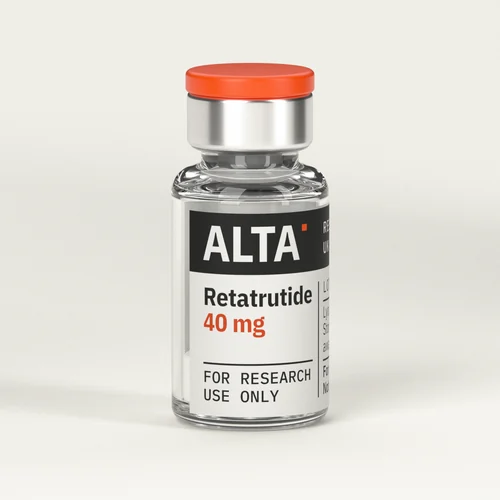
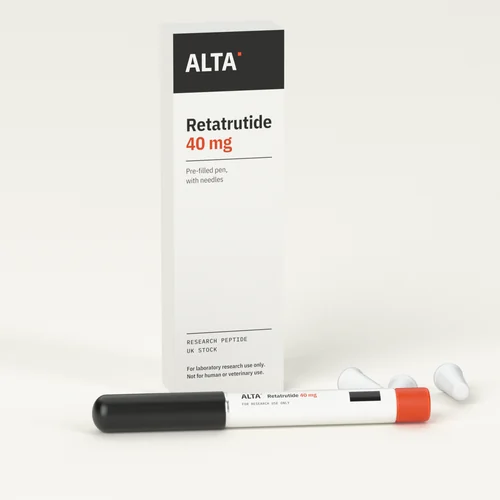
One thing to check with any supplier: the developers have not yet published CT-G32's amino-acid sequence, so a certificate should show identity by mass spectrometry against the structure once it is published. Until CT-G32 is released, the closest compound with a large body of research is retatrutide, the triple agonist it was compared with; we hold retatrutide research vials and a sealed retatrutide pen, each with a published lot certificate, for laboratory research only.
Everything above is the quick version. The sections below go deeper.
Why add amylin?
In shortThe science behind the fourth hormone.
Because it works through a different route. Amylin is made by the same pancreatic beta cells as insulin and released with it after meals. It signals fullness through the brainstem, slows stomach emptying and dampens the glucagon release that follows a meal. An amylin analogue, pramlintide, has been approved in the US for diabetes since 2005, and cagrilintide showed that a long-acting amylin analogue adds weight loss on top of semaglutide. The thinking behind CT-G32 is that adding amylin to GLP-1, GIP and glucagon could deepen appetite suppression through a second pathway, help people who respond weakly to current drugs and keep more lean mass. SCOHIA's own description names those three aims: more weight loss, less variation between individuals and less muscle loss. Whether a four-target molecule delivers them in people, without more side effects, is exactly what the 2027 trials will start to test.
The CT-G32 timeline in detail
In shortEvery date so far, in order.
2024: the Celltrion and SCOHIA collaboration begins. 3 April 2026: SCOHIA announces it has generated SCO-940/CT-G32, with an IND then targeted for the first half of 2027. 29 May 2026: Celltrion starts toxicology studies in 252 rats and 48 monkeys, alongside pharmacokinetic and pharmacodynamic work. 4 November 2026: first preclinical results presented at TIDES Europe in Amsterdam. February 2027: planned IND submission to the US FDA. Second quarter of 2027: planned first dose in a human trial.
Sources
- SCOHIA PHARMA. SCOHIA Announces Generation of Novel Quadruple Agonist SCO-940/CT-G32 for Obesity Through Strategic Collaboration with Celltrion, Inc. Press release, 3 April 2026. scohia.com.
- SCOHIA PHARMA. SCOHIA PHARMA Announces Presentation of First Research Results for Quadruple-Agonist Obesity Drug Candidate SCO-940/CT-G32 at TIDES Europe 2026. Press release, 4 November 2026. scohia.com.
- Kim Yoon-mi. Celltrion's 4-hormone obesity drug beats Lilly's retatrutide on weight loss in rat study. Korea Biomedical Review, 4 November 2026.
- Jung Young-seon. Celltrion unveils promising results for four-target obesity drug. The Korea Herald, 4 November 2026.
- Kim Yi-seul. Celltrion begins toxicology studies of quadruple-acting obesity candidate CT-G32. Korean Pharmaceutical Association News (kpanews.co.kr), 29 May 2026.
- Novo Nordisk. Novo Nordisk files for FDA approval of CagriSema. Press release, 18 December 2025.
- Novo Nordisk. Novo Nordisk to advance subcutaneous and oral amycretin for weight management into phase 3 clinical development. Press release, June 2025.
Questions people ask
What is CT-G32?
CT-G32 is an experimental obesity drug candidate from the South Korean company Celltrion, discovered with Japan's SCOHIA PHARMA. It is one molecule designed to activate four hormone receptors that control appetite, blood sugar and energy use: GLP-1, GIP, glucagon and amylin. It has only been tested in animals so far.
Is CT-G32 the same as SCO-940?
Yes. CT-G32 is Celltrion's development code and SCO-940 is SCOHIA PHARMA's code for the same molecule. Announcements usually write it as CT-G32/SCO-940. People also search for it as CTG32 or CT G32.
What does quadruple agonist mean?
An agonist is a molecule that switches a receptor on. A quadruple agonist switches on four different receptors. Semaglutide acts on one (GLP-1), tirzepatide on two (GLP-1 and GIP) and retatrutide on three (GLP-1, GIP and glucagon). CT-G32 adds a fourth, amylin.
Is CT-G32 better than retatrutide?
Not known. In obese rats it produced more weight loss than retatrutide at the same molar dose, and a smaller share of the weight lost was lean mass. But that is one animal study, the companies' press releases did not give the actual percentages, and results in rats often do not carry over to people. Retatrutide has five completed phase 3 trials in humans; CT-G32 has none.
Does CT-G32 preserve muscle?
In rats, a smaller proportion of the weight lost came from lean body mass than with retatrutide. Lean mass includes muscle, bone, organs and water, so this does not show that CT-G32 protects muscle, and there are no human body-composition data.
When will CT-G32 be available?
Not for years, if ever. Celltrion plans to ask the US FDA for permission to start human trials by February 2027 and to give the first trial dose in the second quarter of 2027. A new obesity drug normally then needs phase 1, 2 and 3 trials before any approval.
Can you buy CT-G32?
Not yet. It has not been tested in people and is not a licensed medicine anywhere. ALTA PEPTIDES is adding CT-G32 as a research compound for laboratory use: price and availability are coming soon, and you can register interest on the CT-G32 product page. The developers have not yet published its amino-acid sequence, so check that any certificate shows identity by mass spectrometry against the published structure once it is available.
Who makes CT-G32?
SCOHIA PHARMA, a Japanese drug-discovery company, led the discovery and early animal work. Celltrion, best known for biosimilars, is running the studies needed to start human trials and will handle clinical development, manufacturing and sales worldwide. SCOHIA is due milestone payments and single-digit royalties.
Has the CT-G32 quadruple agonist shown weight loss in people?
Not yet. For CT-G32, the quadruple agonist weight loss data so far come from rats only: in results presented in November 2026 it produced numerically greater weight loss than retatrutide in diet-induced obese rats given the same molar amount. The first human trial is planned for the second quarter of 2027.
Is CT-G32 a new weight loss peptide?
CT-G32 is a new peptide-based drug candidate for obesity, announced in April 2026. It is sometimes described as a new peptide for weight loss, but that rests on animal studies only: it has not been tested in people, so no weight loss in humans has been shown, and it is not a licensed medicine anywhere.
Information, not advice. This article summarises published research; nothing here is guidance on human or veterinary use. Products are sold under our research use policy.