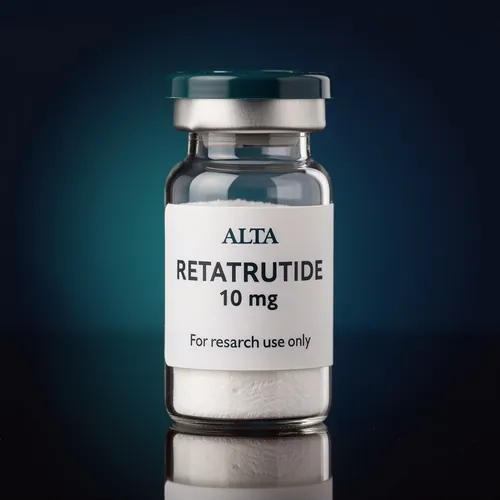
Retatrutide is the most-searched investigational peptide in the UK, and most of the searches are about its trials: what the retatrutide results show, when phase 3 finishes, and when it might be approved. This article sets out the clinical development programme as it stands, what has been published, what is expected and when, and the practical consequence for a research supplier. It is a summary of the public record, and the figures are Eli Lilly's and the trial investigators', not ours. Retatrutide has no marketing authorisation anywhere and is supplied on this site strictly as a research reagent.
The compound
Retatrutide (LY3437943) is Eli Lilly's once-weekly triple agonist of the GLP-1, GIP and glucagon receptors, a 39-residue peptide with a C20 fatty diacid side chain. How it differs from semaglutide and tirzepatide is covered in our comparison article; the product page covers chemistry, sizes and the legal position.
Phase 2: the 2023 results
The phase 2 obesity trial, published in the New England Journal of Medicine in June 2023, randomised 338 adults with obesity or overweight and at least one weight-related condition, without diabetes, to placebo or one of several retatrutide doses for 48 weeks. Mean body-weight change at 48 weeks was minus 17.5% at 4 mg, minus 22.8% at 8 mg and minus 24.2% at 12 mg, against minus 2.1% for placebo, and weight was still falling when the study ended. A parallel phase 2 in type 2 diabetes, published in The Lancet, reported HbA1c reductions of up to about 2 percentage points alongside weight loss. Gastrointestinal adverse events were the most common and were dose-dependent; increases in heart rate and skin sensitivity were also reported. These are the retatrutide results that generated the interest, and they remain the largest published dataset.
Phase 3: the TRIUMPH and TRANSCEND programmes
Lilly began phase 3 in 2023 with a set of trials named TRIUMPH for obesity and TRANSCEND for type 2 diabetes. The obesity trials are TRIUMPH-1 (obesity or overweight with weight-related conditions, around 80 weeks), TRIUMPH-2 (obesity with type 2 diabetes), TRIUMPH-3 (obesity with established cardiovascular disease) and TRIUMPH-4 (obesity with knee osteoarthritis), together with TRIUMPH-OUTCOMES, a long cardiovascular outcomes trial, and studies in obstructive sleep apnoea and chronic kidney disease. Between them they enrol well over ten thousand participants.
The first phase 3 readout was TRIUMPH-4, which Lilly announced in December 2025: adults with obesity and knee osteoarthritis lost a mean of 28.7% of body weight at 68 weeks on the highest dose, against 2.1% on placebo, with substantial improvements in knee pain scores. That figure exceeded the phase 2 result and anything reported for a licensed product. Further TRIUMPH and TRANSCEND readouts are expected through 2026, and the outcomes trial will run for several years beyond that.
Retatrutide release date and approval
There is no retatrutide release date, because there is no approved product. Regulatory submission to the FDA, the EMA and the MHRA normally follows the completion of the core phase 3 trials and takes most of a year to review. On the current timeline the earliest a licence is plausible is 2027, and that assumes the remaining trials read out as expected and no safety signal emerges. Retatrutide FDA approval, EU approval and any retatrutide UK approval would each be separate decisions, and the UK licence would then be followed by a NICE appraisal before NHS availability. Anyone selling retatrutide today with the suggestion that it is an approved medicine, or "the next Mounjaro" available early, is misdescribing it.
What this means for research supply
Until a licence exists, every vial of retatrutide outside Lilly's trials is unlicensed. In the UK it is lawful to possess and to sell as a laboratory reagent, and unlawful to supply for human use; the MHRA has been active against sellers presenting GLP-1-class compounds for weight loss. We list retatrutide on the basis of written legal advice, describe it only in terms of chemistry and the published trial record, and apply our research use policy to every order. When and if a licensed retatrutide product is approved, the research-chemical market for it will likely contract in the same way it has for semaglutide, and this article will be updated.
Reading trial results carefully
Two cautions apply to every number above. Phase 2 results were in a few hundred people over 48 weeks; phase 3 results are in thousands over longer periods, and effects usually look smaller as trials get larger. And weight loss in a trial where participants are monitored, counselled and titrated is not a description of what a compound does in any other setting. Both cautions are part of the scientific record and belong alongside the headline figures.