Does filtering peptides remove bacteria? Yes, provided the filter is a sterilising-grade membrane, which means a 0.22 micron pore size. Bacteria are large enough to be caught by it and so are yeasts and moulds. What a filter does not do is just as important: it does not remove viruses, it does not remove endotoxin, it does not remove chemical impurities, and it can quietly remove some of the peptide. This article explains what sterile filtration is, when laboratories use it, why it is not a substitute for a tested lot or for bacteriostatic water, and what the certificate of analysis covers that a filter cannot. It describes laboratory practice; it is not guidance on preparing anything for use in people.
- A 0.22 micron (0.2 micron) membrane filter is the laboratory standard for sterilising a solution: it retains bacteria and fungi by size.
- Filtration does not remove viruses (too small), endotoxin (a dissolved bacterial by-product) or any chemical impurity.
- Peptides can adsorb to filter membranes; low-binding PES or PVDF membranes are used to limit loss, and the first few drops are discarded.
- Bacteriostatic water stops bacteria growing in a solution; it does not sterilise a solution that is already contaminated. The two measures do different jobs.
- Endotoxin is measured on the certificate of analysis for the lot, because filtration cannot remove it afterwards.
What a sterilising filter does
A membrane filter is a thin sheet of polymer with pores of a controlled size. At 0.22 microns the pores are smaller than any bacterium: E. coli is about 0.5 by 2 microns, Staphylococcus about 1 micron, and even the smallest free-living bacteria are above the cut-off. Pushing a solution through the membrane with a syringe therefore leaves the organisms on the upstream side and delivers a solution free of viable bacteria and fungi on the downstream side. The 0.22 micron figure is the pharmacopoeial standard for a sterilising filter; the 0.45 micron filters sold alongside them are clarifying filters that remove particulates and most, but not all, bacteria, and are not sterilising-grade.
What it does not remove
Viruses. At 20 to 300 nanometres, viruses pass a 0.22 micron membrane freely. Virus removal needs nanofiltration at 20 nanometres or below, which is a manufacturing operation, not a syringe filter.
Endotoxin. Lipopolysaccharide from the outer membrane of Gram-negative bacteria is shed into anything they have grown in and stays behind when the cells are removed. It is a dissolved molecule, it passes any filter, and it is heat-stable enough to survive autoclaving. It is the reason a solution can be sterile and still pyrogenic. Endotoxin is controlled by aseptic manufacture and measured on the lot, which is why it appears on our certificate of analysis as a limulus amoebocyte lysate result.
Chemical impurities. Residual solvents, truncated sequences, oxidised variants and the counter-ion all pass through. Purity is a property of the lot, established by HPLC at the laboratory, and no downstream step changes it.
What it can take away
Peptides stick to surfaces, and filter membranes are a lot of surface. Nylon and cellulose membranes bind protein strongly; polyethersulfone (PES) and polyvinylidene fluoride (PVDF) are the low-binding choices and are what a laboratory reaches for. Even so, the first fraction through a fresh membrane is depleted while the surface saturates, so the first few drops are discarded, and for a small volume of a dilute solution the loss can be a measurable fraction of the total. Hydrophobic peptides and those at low concentration are worst affected. A laboratory that filters a peptide solution and needs to know the concentration afterwards measures it, rather than assuming nothing was lost.
Filtration versus bacteriostatic water
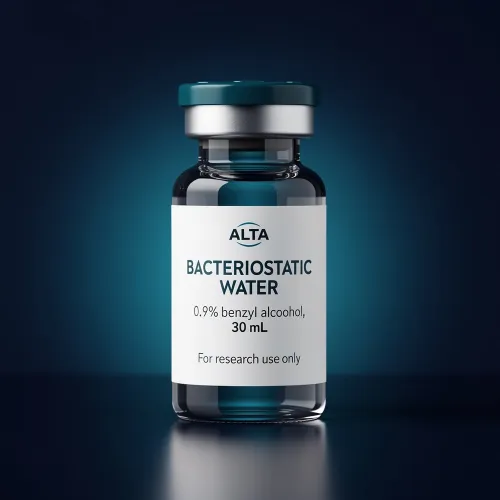
The two are often confused and they do different jobs. Bacteriostatic water contains 0.9 percent benzyl alcohol, which stops bacteria that get into a reconstituted vial from multiplying over the days or weeks the solution is in use; it is a preservative, and it does nothing about organisms already present in numbers, nor about endotoxin. A sterilising filter removes organisms present at the moment of filtering and does nothing about what gets in afterwards. In practice a sealed lyophilised vial from a tested lot has been filled aseptically, the bacteriostatic water is itself sterile, and the reconstituted solution is refrigerated and used within its stability window, so for short-term laboratory use neither step is added; the risk is handled upstream. Our bacteriostatic water article explains the diluent and our reconstitution guide the aseptic technique that matters more than either.
When laboratories filter
Sterile filtration is used when a solution has been prepared from non-sterile components, when it has been open or handled at length, when it is going into cell culture where a single organism would ruin the experiment, and when a protocol specifies it. It is done with a syringe and a 0.22 micron PES or PVDF syringe filter into a sterile receiving vial, in a laminar-flow hood where one is available. It is not a way of rescuing a solution that has gone cloudy, which indicates either aggregation of the peptide or a contamination that has already released endotoxin.
What the certificate covers
For every lot ALTA PEPTIDES ships, the certificate from an independent UK laboratory reports identity by mass spectrometry, purity by HPLC, residual solvents, and endotoxin by LAL assay, and it is published before the vial leaves. Those are the properties a filter cannot change, and they are the reason a tested lot is the starting point rather than an optional extra. Sterility of the sealed vial comes from aseptic filling; what happens after the stopper is pierced is in the laboratory's hands. Our bacteriostatic water, syringes and swabs are the consumables for that stage.
Questions people ask
Does filtering peptides remove bacteria?
Yes, if the filter is a 0.22 micron sterilising-grade membrane. Bacteria are roughly 0.5 to 5 microns and cannot pass. Coarser filters, such as 0.45 micron, are clarifying filters and let some bacteria through.
Does filtering remove endotoxin?
No. Endotoxin is lipopolysaccharide shed from bacterial cell walls, dissolved in the solution, and far smaller than the membrane pores. It is tested for on the lot certificate and controlled in manufacture, not removed by filtering.
Does filtering reduce the peptide?
It can. Peptides adsorb to some membranes, especially nylon and cellulose. Laboratories use low-protein-binding PES or PVDF filters and discard the first drops to saturate the membrane.
Is filtering needed if I use bacteriostatic water?
They do different things. Bacteriostatic water prevents growth after reconstitution. Filtration removes organisms already present. A sealed lyophilised vial from a tested lot is manufactured aseptically and the diluent is sterile, so many laboratories do neither for short-term use.