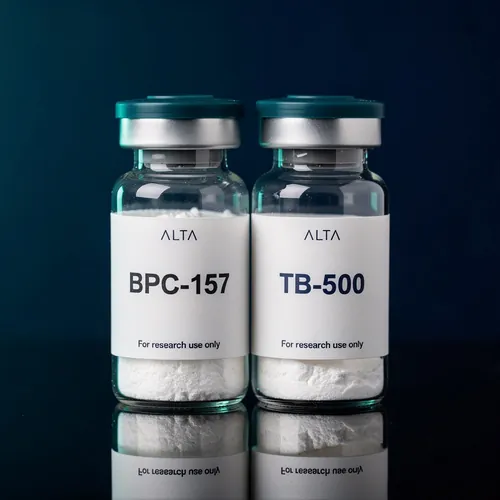
The Wolverine stack is not a compound, a product or anything with a regulatory definition. It is forum slang for BPC-157 and TB-500 bought together, named for the comic-book character whose defining trait is rapid healing, and it stuck because the two peptides dominate the preclinical literature on tendon, ligament and muscle repair. This article explains what each one is, why researchers study them as a pair, what the difference is between a blended vial and two separate vials, what the stack costs, and where the law sits. It describes the research and the reagents; it is not guidance on using them.
- The Wolverine stack is BPC-157 (a 15-residue gastric peptide fragment) plus TB-500 (a 43-residue fragment of thymosin beta-4). The name is forum slang, not a compound.
- Both have large preclinical literatures in tendon, ligament, muscle and wound models; the mechanisms proposed differ, which is why they are studied together.
- Vendors sell it either as a single blended vial or as two vials. A blend has one certificate for a mixture; two vials have one certificate each.
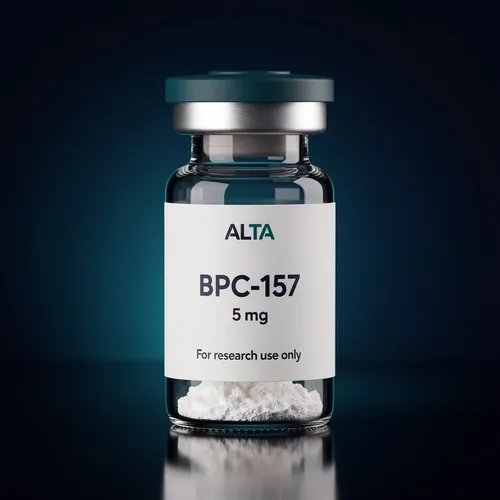
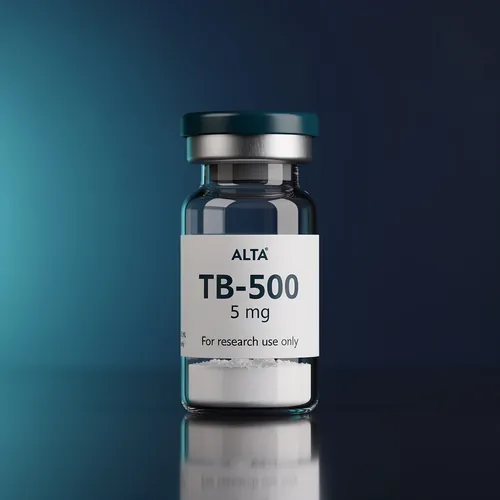
- ALTA PEPTIDES supplies the stack as two separate 5 mg vials for £37.99, or the vials individually with the automatic stack discount.
- Neither compound is a licensed medicine; BPC-157 is on the WADA prohibited list. Supplied for laboratory research only.
The two compounds
BPC-157 is a 15-residue fragment of a protective protein found in human gastric juice, described by Predrag Sikiric's group in Zagreb. Its literature, almost all from that group, reports accelerated healing of transected tendons and ligaments in rats, faster recovery from crush injury to muscle, closure of skin wounds, and protection of the gut lining, with angiogenesis and nitric-oxide signalling as the proposed mechanisms. It is unusual among peptides in surviving gastric acid. Our BPC-157 explainer covers the detail.
TB-500 is the name given to a synthetic fragment of thymosin beta-4, a 43-residue protein present in nearly every cell, whose main job is to sequester actin monomers and so regulate the cytoskeleton. Thymosin beta-4 and its active fragment, the actin-binding sequence LKKTETQ, have been studied in models of dermal wound healing, corneal injury, and cardiac repair after infarction, with cell migration and reduced inflammation as the proposed mechanisms. Our TB-500 explainer and our comparison of the two set out how they differ.
Why the research pairs them
The two peptides are proposed to act through different mechanisms on the same kind of injury. BPC-157's literature emphasises blood supply: new vessel growth at the injury site and nitric-oxide-mediated effects on vascular tone. TB-500's emphasises cell movement: actin regulation lets cells migrate into a wound and lay down new tissue. A tendon healing model that measures both vascularisation and cellular infiltration has a reason to test both compounds, alone and together, and a handful of rodent studies have done exactly that and reported additive findings. The pairing is therefore a research design choice with a rationale, not a marketing invention, even if the name is. What does not exist is any controlled human study of either compound, alone or together.
Blend vial versus two vials
Vendors sell the stack two ways. A blended vial contains both peptides freeze-dried together in a fixed ratio, usually 5 mg of each, under one label. Two vials are simply BPC-157 and TB-500 sold as a pair. For research the difference matters. A blend has one certificate of analysis for a mixture, so purity and identity are reported for two co-eluting peptides rather than for each on its own; the ratio is fixed by the vendor and cannot be varied; and an experiment cannot run either compound alone as a control from the same lot. Two vials keep each compound on its own certificate, its own lot number and its own storage clock, and let the researcher decide the ratio. That is why ALTA PEPTIDES supplies the stack as two separate vials and why the product page says so; our article on blends makes the same argument for the GLOW stack.
Price
The Wolverine stack on this site is a 5 mg vial of BPC-157 and a 5 mg vial of TB-500 for £37.99, against £17.99 and £24.99 bought separately, which is £3.80 per milligram across the pair. Buying the two vials individually instead triggers the automatic 10 percent stack discount for two distinct compounds, and adding a third, GHK-Cu for example, raises it to 15 percent; the pre-priced stack is excluded from the discount because it is already reduced. Prices include VAT, and delivery is £4.95 or free over £100. UK vendors selling blended 10 mg vials in September 2026 ranged from about £35 to £55.
Handling
Both are lyophilised and reconstituted with bacteriostatic water in the laboratory; the two vials are prepared separately, which is the point. BPC-157 has no oxidisable residues and is robust; TB-500 has a methionine and is stored more carefully once in solution. Our reconstitution guide, storage guide and calculator cover preparation, and each product page carries the storage specification for its compound.
Legal and anti-doping status
Neither BPC-157 nor TB-500 is a controlled substance in the UK, and neither has a marketing authorisation as a medicine anywhere. Both are supplied as research reagents for laboratory use only, under our research use policy, and we decline orders that suggest any other use. BPC-157 is named on the WADA prohibited list under S0, non-approved substances, and TB-500 falls under the same section; a tested athlete would fail for either. Our UK law guide explains the framework.
What ALTA PEPTIDES supplies
The Wolverine stack as two sealed 5 mg lyophilised vials, each tested per lot by an independent UK laboratory with its own certificate published, held in UK stock and dispatched the same working day before 1pm. Also available as BPC-157 and TB-500 individually, and with GHK-Cu as the GLOW stack.
Questions people ask
What is in the Wolverine stack?
BPC-157 and TB-500. Some vendors' blends add a third compound; ours is the two, as separate 5 mg vials.
Why is it called the Wolverine stack?
Forum shorthand referring to the comic-book character who heals rapidly, applied to the two peptides most studied in tissue-repair models. It is a nickname, not a product name with any regulatory meaning.
Is a blended vial better than two vials?
For research, no. A blend fixes the ratio, has a single certificate for a mixture rather than for each compound, and cannot be run one compound at a time as a control. Two vials keep every variable separate.
Does the Wolverine stack count towards the stack discount?
The pre-priced stack product does not, because it is already discounted. Buying BPC-157 and TB-500 as individual vials does, and adding a third compound raises the discount.