Almost every research peptide has to be injected in a study because the stomach destroys it in minutes. BPC-157 is the exception that makes people search for BPC-157 capsules, oral BPC-157 and BPC-157 nasal sprays: it was isolated from gastric juice, it is stable in acid, and the research includes oral studies alongside injectable ones. This article explains why it survives digestion, what the oral and injectable literatures each report, what the capsule and spray products on the market actually are, and how a lyophilised research vial differs from all of them. It describes the science and the products; it is not guidance on using anything.
- BPC-157 is a 15-residue fragment of a protein found in human gastric juice; the published work reports it is stable in gastric acid for more than 24 hours.
- Because it survives digestion, rodent studies have given it orally (in drinking water or by gavage) as well as by injection, and report activity by both routes.
- Most peptides are destroyed in the stomach within minutes, which is why almost every other research peptide is injectable-only.
- Capsule, tablet and nasal spray products are formulated goods sold for human use without a licence; a lyophilised vial is a research reagent.
- Oral bioavailability of BPC-157 in humans has not been measured. There is no controlled human study by any route.
Why BPC-157 survives the stomach
BPC-157 is a 15-residue sequence, Gly-Glu-Pro-Pro-Pro-Gly-Lys-Pro-Ala-Asp-Asp-Ala-Gly-Leu-Val, originally described by Predrag Sikiric's group in Zagreb as a fragment of a protective protein in human gastric juice. Two features explain its stability. The sequence is rich in proline, and proline's ring structure resists the proteases pepsin, trypsin and chymotrypsin, which prefer to cut next to aromatic or basic residues that BPC-157 has few of. And it has no methionine, cysteine or tryptophan, the residues that oxidise. The original papers report that it is stable in human gastric juice for more than 24 hours, against minutes for a typical peptide, and that stability is the reason the Zagreb group could study it orally from the start. Our BPC-157 explainer covers the background.
What the injectable studies report
The bulk of the literature uses intraperitoneal or intramuscular injection in rats. The consistent findings are accelerated healing of transected Achilles tendon and medial collateral ligament, improved recovery in crushed muscle, faster closure of skin wounds, and protection of the gut lining against NSAID and alcohol damage, with angiogenesis and nitric-oxide signalling as the proposed mechanisms. The models are well described and the effect sizes are large, and nearly all of the work comes from one group, which is the main caveat the field itself raises.
What the oral studies report
A substantial subset of the same group's work gave BPC-157 in drinking water or by gavage. In gut models, oral and injected BPC-157 produced similar findings, which is not surprising for a compound acting where it is delivered. More notable are the reports that oral BPC-157 also improved outcomes in tendon and muscle injury models, which implies systemic absorption from the gut; the group has published on this directly. What is missing is pharmacokinetics: no study has measured how much of an oral amount reaches the blood, in rats or in anyone else, so the oral literature shows an effect in a model without showing the exposure that produced it. That gap is why "oral bioavailability of BPC-157" has no number attached in any review.
Capsules, tablets and sprays
Because the oral studies exist, a market in BPC-157 capsules and tablets has grown, and nasal sprays have followed. These are formulated products: a capsule contains the peptide, or is claimed to, with fillers and no certificate for the finished good; a spray is BPC-157 in saline with the stability limits of any peptide in solution, which is to say weeks. Almost none state the amount of peptide per unit in a way that has been verified, and a product presented for a person to swallow or inhale is, whatever the label says, an unlicensed medicine placed on the market by the vendor. The research-use framework that makes reagent vials legal to sell does not cover a capsule, and a vendor selling both is trading on two different footings. Our UK law guide sets out the distinction.
What a research vial is
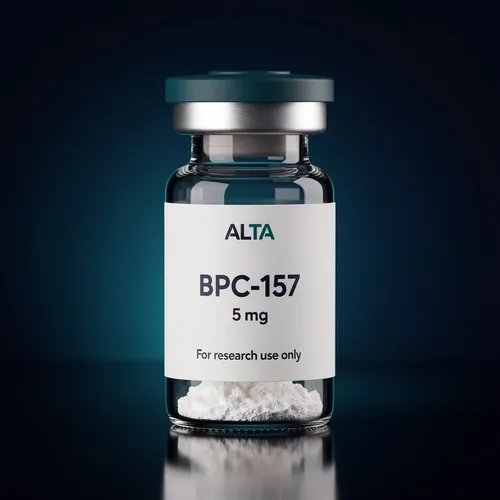
A lyophilised vial is the compound as it left purification: 5 mg of freeze-dried powder, sealed, with purity by HPLC and identity by mass spectrometry on a certificate matched to the lot. A laboratory reconstitutes it with bacteriostatic water to a known concentration and can then study it by any route the design calls for, including the oral models above, with the concentration and the amount under control and documented. That control is what the research is for and what a capsule cannot offer. Our reconstitution guide, storage guide and calculator cover preparation and handling.
BPC-157 and TB-500
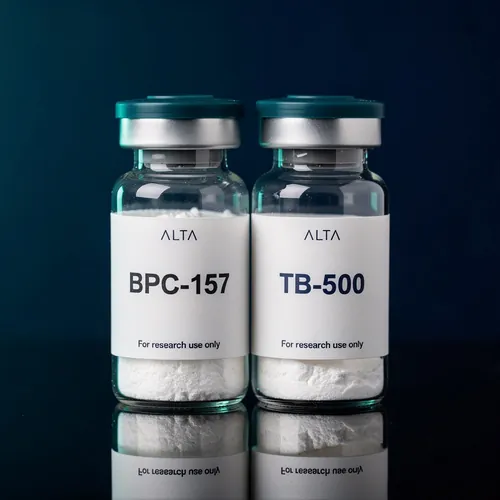
The two are frequently studied together in tendon and muscle models and sold together as the Wolverine stack. TB-500 does not share BPC-157's acid stability; it is a 43-residue fragment with ordinary peptide fragility, so the oral question does not arise for it and the combination is studied by injection. Our BPC-157 versus TB-500 article compares them.
What ALTA PEPTIDES supplies
BPC-157 as a sealed 5 mg lyophilised vial at £17.99, tested per lot by an independent UK laboratory with the certificate published, held in UK stock and dispatched the same working day before 1pm. No capsules, tablets or sprays, and no guidance on any route of use in people. Supplied for laboratory research only under our research use policy.
Questions people ask
Does BPC-157 work orally?
In rodent models, oral BPC-157 produced findings comparable to injected BPC-157 in gut and some musculoskeletal studies. Nothing has been measured in people, and this site makes no claim about what works in people.
Why do other peptides not survive the stomach?
Gastric acid and the proteases pepsin, trypsin and chymotrypsin cut peptide bonds. BPC-157's sequence, rich in proline and with no obvious cleavage sites, resists them; most peptides do not.
Are BPC-157 capsules the same as a BPC-157 vial?
No. A capsule is a formulated product, usually with an undeclared amount of peptide and no lot certificate, sold for consumption. A vial is certified lyophilised powder for laboratory reconstitution.
What is a BPC-157 nasal spray?
BPC-157 dissolved in a saline base in a spray bottle, a format some vendors sell. It is a solution with the stability limits of any solution and, as a product presented for human use, an unlicensed medicine.