In this article12 sections
A small ring-shaped peptide, also called bremelanotide, that works on melanocortin receptors in the brain rather than on blood flow. In the US it is approved as Vyleesi for low sexual desire in premenopausal women, after two trials found small but real improvements. Nausea is common. It is not licensed in the UK.
PT-141, also called bremelanotide, is a small, ring-shaped peptide that works in the brain rather than on blood flow. That makes it different from drugs like sildenafil (Viagra), and it led to a US-approved medicine for low sexual desire in women that is used as needed rather than daily. This article explains what PT-141 is, how it was developed, what the trials found, its side effects and where it stands in the UK. It describes published research only; there is no licensed use in the UK, and ALTA PEPTIDES supplies PT-141 for laboratory research only.
- PT-141 is the development code for bremelanotide, a cyclic seven-amino-acid peptide (Ac-Nle-cyclo[Asp-His-D-Phe-Arg-Trp-Lys]-OH), an analogue of the natural hormone alpha-MSH, closely related to Melanotan II.
- It is a melanocortin receptor agonist. The US label says it binds MC1R and MC4R most strongly at relevant concentrations, and that how it improves sexual desire is unknown.
- The FDA approved it as Vyleesi on 21 June 2019 for acquired, generalised hypoactive sexual desire disorder (HSDD) in premenopausal women. It is not licensed in the UK or the EU.
- Two 24-week trials (RECONNECT) randomised 1,267 women; bremelanotide produced small but statistically significant gains in desire and falls in distress compared with placebo.
- On the US label, 40% of users had nausea; blood pressure rose briefly after each dose, and about 1% developed darker patches of skin.
What does PT-141 do?
In shortIt acts on the brain's melanocortin receptors, not on blood flow like Viagra.
| PT-141 (bremelanotide) | Sildenafil, tadalafil | |
|---|---|---|
| Acts on | Melanocortin receptors in the brain | Blood vessels (PDE5 enzyme) |
| Aimed at | Desire | Erection, once aroused |
| Approved for | Women with HSDD, US only | Men with erectile dysfunction, UK and worldwide |
| Main side effect | Nausea | Headache, flushing |
Vyleesi US prescribing information, 2019; this article.
PT-141 switches on melanocortin receptors, a family of five receptors (MC1R to MC5R) that respond to the body's own melanocyte-stimulating hormones. These receptors do very different jobs depending on where they sit: MC1R in skin controls pigment, while MC4R in the brain is involved in appetite and sexual function. The US prescribing information describes bremelanotide as a non-selective melanocortin receptor agonist that binds MC1R and MC4R most strongly at the concentrations that matter, and states plainly that how it improves sexual desire in women is unknown. Animal work points to the hypothalamus, a brain region that coordinates hormones and motivation.
The key contrast is with PDE5 inhibitors such as sildenafil and tadalafil, which act on blood vessels and need sexual arousal to start with. PT-141 was developed on the idea that a brain-acting drug could affect desire itself.
Is PT-141 the same as bremelanotide and Vyleesi?
In shortYes: same drug, three names.
Yes. PT-141 was the code name used by Palatin Technologies during development. Bremelanotide is the drug's official name, and Vyleesi is the brand name of the approved US product, a single-use autoinjector. The rights have changed hands: AMAG Pharmaceuticals licensed it from Palatin and launched it, the licence ended in 2020 and the rights returned to Palatin, and in December 2023 Palatin sold its worldwide rights to Cosette Pharmaceuticals.
What did the trials show?
In shortSmall but real improvements in desire and distress, in women with diagnosed low desire.
Premenopausal, with HSDD.
Two identical trials.
Small, statistically significant.
Small, statistically significant.
Kingsberg et al., Obstetrics & Gynecology 2019. Integrated results of studies 301 and 302.
The approval rests on two identical phase 3 trials, together called RECONNECT, published in Obstetrics & Gynecology in 2019. They randomised 1,267 premenopausal women with hypoactive sexual desire disorder (persistent low desire that causes distress) to bremelanotide or placebo, used as needed, for 24 weeks. On the two main measures, women on bremelanotide reported a small but statistically significant rise in desire and a fall in distress about it compared with placebo; the combined improvements were 0.35 points on the desire score and 0.33 points on the distress score. A 52-week open-label extension, in which everyone received the drug, found no new safety problems.
In plain terms: a real effect, on average a modest one, in a specific, carefully diagnosed group.
What are the side effects of PT-141?
In shortNausea for 4 in 10 users, plus flushing, headache and a short rise in blood pressure.
Peaks 2 to 4 hours after a dose, usually normal within 12.
Uncontrolled hypertension, known cardiovascular disease.
Vyleesi US prescribing information, 2019. Share of users.
Nausea is the main one. On the Vyleesi label, 40% of users reported nausea, 13% needed medicine to treat it, and 8% stopped because of it. Flushing and headache were also common; in the long extension study, drug-related nausea, flushing and headache were reported by 40.4%, 20.6% and 12.0% of participants. Blood pressure rose briefly after each dose, by up to 6 mmHg systolic and 3 mmHg diastolic, peaking two to four hours later and usually back to normal within 12 hours, while heart rate fell slightly. About 1% of users developed focal hyperpigmentation, darker patches on the face, gums or breasts, more often with darker skin and with daily use; because MC1R controls skin pigment, that effect is expected from the mechanism. The label rules out use with uncontrolled high blood pressure or known heart disease.
Does PT-141 work in men?
In shortEarly studies said yes, but it was never approved for men.
It was first studied in men. In a 2004 trial published in the International Journal of Impotence Research, an intranasal form produced erectile responses in healthy men and in men with mild to moderate erectile dysfunction; flushing and nausea were the commonest side effects. Further small studies looked at men who had not responded well to sildenafil and at using it alongside sildenafil. Development of the nasal spray stopped after increases in blood pressure were seen, and when Palatin restarted with an injection, it focused on women. PT-141 has never been approved for men anywhere.
Is PT-141 legal in the UK?
In shortNot a controlled drug and not licensed here. Research use only.
Not authorised by the MHRA.
Never authorised by the EMA.
Vyleesi, women with HSDD.
From this article.
PT-141 is not a controlled drug in the UK. Vyleesi has no marketing authorisation from the MHRA, and bremelanotide has never been authorised by the European Medicines Agency, so it cannot be prescribed as a licensed medicine here. It can be bought and held as a laboratory reagent; supplying it for human use is an offence under the Human Medicines Regulations 2012, and our guide to peptides and UK law explains why. The MHRA has taken a similar line with Melanotan tanning injections, warning that they are unlicensed and that their safety and quality are not guaranteed.
PT-141 vs Melanotan II: what is the difference?
In shortClose relatives; only bremelanotide went through trials and approval.
They are close relatives. Melanotan II was made at the University of Arizona as a tanning agent, a stable version of alpha-MSH; volunteers noticed sexual side effects, and a small 1998 study in men with psychogenic erectile dysfunction reported erections. PT-141 came out of that work as a related cyclic peptide intended to keep the effect on sexual function while being developed as a medicine. Both act on several melanocortin receptors, so both can darken skin. The difference that matters most is regulatory: bremelanotide went through controlled trials and approval in the US, while Melanotan II never has, and the MHRA has warned against its use.
Everything above is the quick version. The sections below go deeper.
Where PT-141 comes from
In shortIt grew out of tanning research at the University of Arizona.
- 1980sStable alpha-MSH analogues
University of Arizona tanning research; Melanotan II.
- 1998Effect in men reported
Small study in erectile dysfunction.
- 2000sPT-141 nasal spray
Palatin; stopped after blood-pressure rises.
- 2019Vyleesi approved
US, injection, women with HSDD.
- 2023Rights sold to Cosette
Worldwide.
Sources in this article.
The story starts with alpha-MSH, a 13-amino-acid hormone that tans skin by acting on MC1R. In the 1980s and 1990s, researchers at the University of Arizona made more stable, ring-shaped versions; Melanotan II was one, and its unexpected effects on sexual function led Palatin Technologies to develop bremelanotide. Early work used a nasal spray. After blood-pressure increases were reported in the late 2000s, Palatin moved to an injection given under the skin, ran the RECONNECT trials, and won US approval in June 2019.
How melanocortin receptors work
In shortOne hormone family, five receptors: skin colour, stress, appetite and sex drive.
Why PT-141 can darken skin.
Responds to ACTH.
Brain.
Brain; also setmelanotide's target.
Overview; Vyleesi label and Imcivree EPAR.
The melanocortin system links several body functions through one family of hormones and five receptors. MC1R in skin and hair cells controls the switch to dark pigment. MC2R responds to ACTH and drives cortisol release. MC3R and MC4R in the brain help regulate energy balance and appetite; MC4R is also the receptor most linked with sexual function. This is why drugs aimed at this system can have wide effects. Another MC4R drug, setmelanotide (Imcivree), is approved in the EU and recommended by NICE for rare genetic forms of obesity, showing how the same receptor family is used for quite different medical purposes.
In the laboratory
In shortSupplied as tested powder in sealed vials. Keep it frozen and dark.
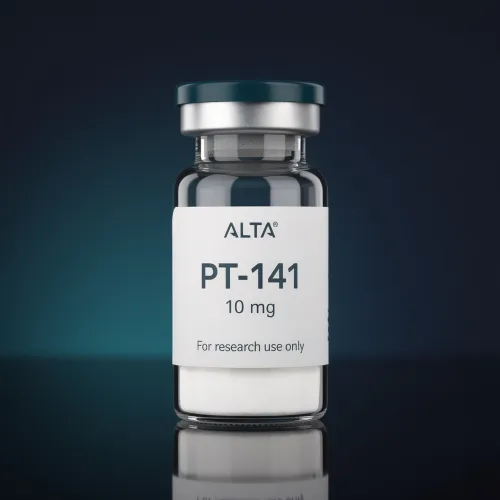
PT-141 is supplied by ALTA PEPTIDES as a freeze-dried powder in sealed vials, purity 99% or better by , with the certificate for each lot published. Formula C50H68N14O10, mass about 1025.2 g/mol, CAS 189691-06-3. Store sealed vials at -20 °C away from light; our guides to storage and reconstitution cover handling, and the peptide calculator does the solution arithmetic. Research use only, under our research use policy.
Sources
- Kingsberg SA, Clayton AH, Portman D, et al. Bremelanotide for the treatment of hypoactive sexual desire disorder: two randomized phase 3 trials. Obstetrics & Gynecology 2019;134(5):899-908. PMID 31599840.
- Simon JA, Kingsberg SA, Portman D, et al. Long-term safety and efficacy of bremelanotide for hypoactive sexual desire disorder. Obstetrics & Gynecology 2019;134(5):909-917. PMID 31599847.
- US Food and Drug Administration. VYLEESI (bremelanotide injection) prescribing information, 2019 (NDA 210557), and approval package, 21 June 2019.
- Diamond LE, Earle DC, Rosen RC, et al. Double-blind, placebo-controlled evaluation of the safety, pharmacokinetic properties and pharmacodynamic effects of intranasal PT-141, a melanocortin receptor agonist, in healthy males and patients with mild-to-moderate erectile dysfunction. International Journal of Impotence Research 2004;16:51-59. PMID 14963471.
- Diamond LE, et al. Co-administration of low doses of intranasal PT-141 and sildenafil to men with erectile dysfunction. Urology 2005. PMID 15833522.
- Wessells H, Fuciarelli K, Hansen J, et al. Synthetic melanotropic peptide initiates erections in men with psychogenic erectile dysfunction. Journal of Urology 1998;160:389-393. PMID 9679884.
- Palatin Technologies. Form 8-K, December 2023: sale of Vyleesi worldwide rights to Cosette Pharmaceuticals.
- European Medicines Agency. Imcivree (setmelanotide) EPAR overview.
Questions people ask
Is PT-141 the same as bremelanotide?
Yes. PT-141 was Palatin Technologies' development code; bremelanotide is the drug's official name, and Vyleesi is the brand name of the approved US product, an autoinjector pen.
Does PT-141 work for men?
Small studies in the early 2000s, including one in men with erectile dysfunction, reported erectile responses with an intranasal form. It has never been approved for men anywhere, and development in men did not continue.
What are the side effects of PT-141?
In the trials behind Vyleesi the most common were nausea, flushing and headache. The label also lists a short-lived rise in blood pressure after each dose and darkening of patches of skin in about 1% of users.
Is PT-141 legal in the UK?
It is not a controlled drug, and it has no UK marketing authorisation, so it can be bought and held as a laboratory reagent. Supplying it for human use is an offence under the Human Medicines Regulations 2012. ALTA PEPTIDES sells it for research only.
Information, not advice. This article summarises published research; nothing here is guidance on human or veterinary use. Products are sold under our research use policy.