In this article19 sections
Two unlicensed research peptides that make the body release more of its own growth hormone, through two different receptors. CJC-1295 is a long-acting copy of the brain's GHRH signal; ipamorelin copies ghrelin. Human data is thin: one pharmacology study for CJC-1295, one failed phase 2 trial for ipamorelin, and a trial halted after a death in 2006.
Search for CJC-1295 and ipamorelin and you will find them sold together, almost always as a pair. The pairing has a real scientific logic: the two peptides push on the same hormone system through different doors. What the sales pages leave out is how little human data exists for either, and that the only trial of CJC-1295 was halted in 2006 after a participant died.
- CJC-1295 is a 29-amino-acid analogue of growth hormone-releasing hormone (GHRH) from the Canadian company ConjuChem. The version with DAC carries a maleimidopropionyl group that bonds to cysteine-34 of albumin, which is what makes it last for days.
- In two randomised, placebo-controlled trials in healthy adults aged 21 to 61, CJC-1295 raised plasma growth hormone 2 to 10 fold for 6 days or more and IGF-1 by 1.5 to 3 fold for 9 to 11 days, with an estimated half-life of 5.8 to 8.1 days (Teichman et al., JCEM, 2006).
- ConjuChem stopped its phase 2 trial of CJC-1295 (then DAC:GRF) on 17 July 2006, after a participant in Argentina had a fatal heart attack hours after his eleventh weekly injection. It then terminated the study, which had enrolled 192 adults.
- Ipamorelin is a five-amino-acid growth hormone secretagogue first described by Raun and colleagues at Novo Nordisk in 1998. It acts on the ghrelin receptor, not the GHRH receptor.
- Novo Nordisk licensed ipamorelin to Sapphire Therapeutics in 2006; Helsinn acquired Sapphire in 2009 and tested the peptide in surgical patients.
- In the phase 2 ipamorelin trial in 117 adults after bowel resection, median time to a first tolerated meal was 25.3 hours against 32.6 on placebo, not statistically significant (p = 0.15; Beck et al., 2014).
- Neither CJC-1295 nor ipamorelin is licensed as a medicine by the MHRA, the US FDA or the European Medicines Agency.
- WADA's 2026 Prohibited List names CJC-1295 and sermorelin as GHRH analogues and ipamorelin as a growth hormone secretagogue, in category S2, prohibited at all times.
What are CJC-1295 and ipamorelin?
In shortTwo unlicensed peptides that ask the body to release more of its own growth hormone.
29 amino acids, built by ConjuChem. Acts on the GHRH receptor. Also written CJC 1295 or CJC1295.
5 amino acids, built by Novo Nordisk in 1998. Acts on the ghrelin receptor.
One pharmacology study each; none of the pair together.
No MHRA, FDA or EMA authorisation for either.
Structures and development history from the sources listed in this article.
CJC-1295 is a laboratory-made version of growth hormone-releasing hormone, or GHRH: the signal your hypothalamus sends to the pituitary telling it to release growth hormone. The natural hormone is broken down within minutes; CJC-1295, built by ConjuChem in Montreal, was engineered to survive for days. People also search for it as CJC 1295 or CJC1295.
Ipamorelin is a different kind of molecule: a chain of just five amino acids that acts on the ghrelin receptor. Ghrelin is best known as the hunger hormone, but it also triggers growth hormone release through its own pituitary receptor. Compounds that do this are called growth hormone secretagogues. Ipamorelin was designed at Novo Nordisk and first published in 1998. Both are peptides, short chains of amino acids; our introduction to peptides covers the chemistry.
How does the growth hormone axis work?
In shortAn accelerator (GHRH), a brake (somatostatin) and a second accelerator (ghrelin) set each pulse.
- 01Hypothalamus
Releases GHRH, the accelerator, and somatostatin, the brake
- 02Stomach
Releases ghrelin, a second accelerator on its own receptor
- 03Pituitary
Adds the signals up and fires a growth hormone pulse
- 04Liver
Converts the pulse into IGF-1, the steadier marker
- 05Feedback
IGF-1 turns the hypothalamus and pituitary back down
Standard endocrine physiology, as described in this section.
Tap a hormone or compound in the growth hormone axis
Growth hormone-releasing hormone, 44 amino acids, made in the hypothalamus. It switches on GHRH receptors on pituitary cells, which make and release growth hormone in pulses. The natural hormone is broken down within minutes by the enzyme DPP-4, which is the problem every GHRH analogue is built to solve. Sermorelin (the first 29 residues), tesamorelin (all 44, chemically protected) and CJC-1295 (29 residues, four substitutions) are all attempts at the same fix.
A 28-amino-acid hormone released mainly by the stomach, best known for driving hunger. It also acts on its own receptor in the pituitary, where it amplifies the growth hormone pulse that GHRH triggers. Compounds that copy it are called growth hormone secretagogues: ipamorelin, ibutamoren (MK-677), macimorelin and anamorelin all work this way. WADA calls ghrelin itself lenomorelin and prohibits it.
The brake. Also made in the hypothalamus, it blocks growth hormone release and sets the gaps between pulses. Nothing in this article touches it, which is one reason a GHRH analogue cannot force the system past its ceiling: the brake stays connected. It is also why these compounds keep the natural pulsed rhythm, while injecting growth hormone itself does not.
A 191-amino-acid protein from the pituitary. Recombinant human growth hormone is a licensed medicine in the UK and worldwide for defined conditions. Injecting it bypasses the hypothalamus and pituitary entirely, which removes the feedback loop. That is the mechanistic difference between a secretagogue or GHRH analogue and the hormone itself.
Insulin-like growth factor 1, made mostly by the liver in response to growth hormone. Because growth hormone comes in pulses and disappears within minutes, trials measure IGF-1 instead: it is stable through the day and reflects the total signal. In the 2006 CJC-1295 trials IGF-1 rose 1.5 to 3 fold and stayed above baseline for up to 28 days after repeat injections.
Interactive. Physiology as described in this section; CJC-1295 figures from Teichman et al., JCEM 2006; WADA naming from the 2026 Prohibited List.
Growth hormone is not released in a steady trickle. It comes out in pulses, mostly at night, and each pulse is set by a push and pull between three signals.
GHRH is the accelerator. Somatostatin is the brake. Ghrelin is a second accelerator working through its own receptor, which makes the GHRH pulse bigger. Growth hormone then travels to the liver, which makes IGF-1, and IGF-1 feeds back to turn the system down again. That loop is why researchers measure IGF-1 as well as growth hormone: it is the steadier number. A GHRH analogue or a secretagogue therefore works only if the pituitary still has hormone to release. Injecting growth hormone itself bypasses all of that.
Why are CJC-1295 and ipamorelin paired in research?
In shortThey hit two different receptors that feed the same output. No human trial has tested the pair.
Because they hit two different receptors that converge on the same output. In animal and cell work, a GHRH agonist and a ghrelin-receptor agonist together produce a bigger growth hormone pulse than either alone: one raises how much hormone the cell makes and releases, the other amplifies the release signal.
What does not exist is a human trial of the two together. No published randomised study has given CJC-1295 and ipamorelin to people in combination. Every claim about the pair rests on the two single-compound datasets below, plus animal data on the principle.
CJC-1295 vs ipamorelin vs tesamorelin vs sermorelin
In shortFour related compounds, and only tesamorelin has phase 3 data and a current approval.
Swipe the table to compare →
| CJC-1295 | Ipamorelin | Tesamorelin | Sermorelin | |
|---|---|---|---|---|
| What it is | Modified GHRH (1-29) analogue, with or without DAC | 5-amino-acid ghrelin-receptor agonist | Full 44-amino-acid GHRH, protected | GHRH (1-29) |
| Receptor | GHRH receptor | Ghrelin receptor | GHRH receptor | GHRH receptor |
| Furthest human stage | Phase 2, terminated 2006 | Phase 2, endpoint missed | Phase 3, published | Approved, then withdrawn |
| Licensed now | Nowhere | Nowhere | US only, as Egrifta | Discontinued 2008 |
| UK licence | None | None | None | None |
| WADA 2026 | S2, named | S2, named | S2, named | S2, named |
Development stages from the sources in this article; WADA status from the 2026 Prohibited List, section S2.2.4.
Assessment based on the published record described in this article. Tesamorelin is the only one of the four with a current approval anywhere.
Four compounds get mentioned in the same breath, at very different points on the evidence ladder. Sermorelin is GHRH(1-29), the first 29 amino acids of the natural hormone, approved in the United States in the 1990s and discontinued for commercial reasons in 2008. Tesamorelin is the full 44-amino-acid chain with a chemical group added to protect it, approved by the FDA in 2010 as Egrifta and backed by trials. CJC-1295 is a modified 29-amino-acid analogue whose development stopped in 2006. Ipamorelin is not a GHRH analogue at all. Only tesamorelin has real human outcome data; our tesamorelin explainer goes through those trials.
What did the CJC-1295 human trials show?
In shortGrowth hormone up 2 to 10 fold for 6 days or more in healthy adults. Hormone levels only, no outcomes.
Teichman et al., Journal of Clinical Endocrinology and Metabolism, 2006. Two randomised, placebo-controlled trials in healthy adults aged 21 to 61. Half-life reported as a 5.8 to 8.1 day range; the bar shows the midpoint. IGF-1 bar shows the upper end of the 9 to 11 day range.
Growth hormone and IGF-1 in blood, plus pharmacokinetics.
No serious adverse reactions over 28 and 49 days.
No fat, muscle or weight outcomes.
Longest trial ran 49 days.
Scope of Teichman et al., JCEM 2006.
One published study carries almost all the weight: Teichman and colleagues, in the Journal of Clinical Endocrinology and Metabolism in 2006, reported two randomised, placebo-controlled, double-blind ascending-dose trials in healthy adults aged 21 to 61, lasting 28 and 49 days.
After a single injection, plasma growth hormone rose 2 to 10 fold for 6 days or more and IGF-1 rose 1.5 to 3 fold for 9 to 11 days. The estimated half-life was 5.8 to 8.1 days. After repeat injections IGF-1 stayed above baseline for up to 28 days, a cumulative effect. No serious adverse reactions were reported. A 2006 abstract from Ionescu and colleagues added that growth hormone was still released in pulses during continuous stimulation.
Note what these cjc-1295 results are: hormone measurements in healthy volunteers over weeks. No trial has shown that CJC-1295 changes body fat, muscle, recovery or sleep in people.
What did the ipamorelin human trials show?
In shortA phase 2 trial after bowel surgery missed its target: 25.3 hours against 32.6 on placebo.
Adults having small or large bowel resection.
p = 0.15; other efficacy measures also failed to separate.
Any treatment-emergent event, up to 7 days.
Any treatment-emergent event, same period.
Beck et al., International Journal of Colorectal Disease, 29(12):1527 to 1534, 2014; ClinicalTrials.gov NCT00672074.
Ipamorelin went further into development than CJC-1295, but not for anything to do with body composition. Novo Nordisk licensed it to Sapphire Therapeutics in 2006; Helsinn acquired Sapphire in 2009 and tested it for postoperative ileus, the sluggish bowel that follows abdominal surgery. Ghrelin-receptor agonists speed up gut movement, so the idea was sound.
The phase 2 trial, by Beck and colleagues in 2014, was multicentre, double-blind and placebo-controlled in 117 adults having bowel resection. Median time to a first tolerated meal was 25.3 hours with ipamorelin and 32.6 hours with placebo: not statistically significant (p = 0.15), and the other efficacy measures did not separate either. Side effects of any kind were reported in 87.5% of the ipamorelin group against 94.8% of the placebo group. A larger second phase 2 study was completed with no published results, and public databases list the programme as having no further development reported.
Why is neither one licensed?
In shortCJC-1295's only phase 2 trial was terminated; ipamorelin's phase 2 did not beat placebo.
For two different reasons, and neither is a conspiracy. CJC-1295 stopped because its only phase 2 trial was terminated in 2006 after a death, the company's share price halved, and nobody picked the molecule back up: no phase 3 programme, no further published human work.
Ipamorelin stopped because it did not work well enough. Missing a primary endpoint in phase 2 is the ordinary way drug development ends.
Are CJC-1295 and ipamorelin legal in the UK?
In shortNot controlled drugs, but not licensed either, so they are lawful only as laboratory reagents.
Neither appears in the schedules of the Misuse of Drugs Act 1971, so neither is a controlled drug and holding them as laboratory reagents is not a criminal offence. Neither has a marketing authorisation from the MHRA, so no doctor here can prescribe them and no pharmacy can dispense them. Supplying an unlicensed medicinal product for human use is an offence under the Human Medicines Regulations 2012, which is why a legitimate UK supplier sells these as research reagents and gives no guidance about people. Searches for cjc-1295 ipamorelin, cjc-1295 uk and ipamorelin uk mostly land on vendors; that does not change the licensing position. This is a summary, not legal advice.
Are CJC-1295 and ipamorelin banned in sport?
In shortYes. Both are named in WADA category S2 and prohibited at all times.
Swipe the table to compare →
| Section | Named examples | Status | |
|---|---|---|---|
| GHRH and analogues | S2.2.4 | CJC-1293, CJC-1295, sermorelin, tesamorelin | Prohibited at all times |
| GH secretagogues | S2.2.4 | Anamorelin, capromorelin, ibutamoren (MK-677), ipamorelin, lenomorelin, macimorelin, tabimorelin | Prohibited at all times |
| GH-releasing peptides | S2.2.4 | Alexamorelin, hexarelin, GHRP-1 to GHRP-6 | Prohibited at all times |
| Growth hormone itself | S2.2.3 | Somapacitan, somatrogon, AOD-9604, hGH 176-191 | Prohibited at all times |
WADA World Anti-Doping Code International Standard: Prohibited List 2026, in force 1 January 2026. Everything in S2 is a non-specified substance.
Yes, and explicitly by name. WADA's 2026 Prohibited List, in force from 1 January 2026, covers growth hormone releasing factors in section S2.2.4. GHRH and its analogues are named with the examples CJC-1293, CJC-1295, sermorelin and tesamorelin. Growth hormone secretagogues and their mimetics are named with anamorelin, ibutamoren (MK-677), ipamorelin, lenomorelin (ghrelin) and macimorelin. GH-releasing peptides follow, including GHRP-6. Everything in S2 is prohibited at all times and is non-specified, which carries the heavier sanction range.
What are the risks of unregulated CJC-1295 and ipamorelin products?
In shortYou cannot tell which molecule is in the vial, or how pure it is, without a lot-matched certificate.
A listing that just says CJC-1295 could be either of two chemically different molecules.
Purity by HPLC and identity by mass spectrometry, with the lot number from your vial.
A certificate with the issuing laboratory blanked out is not a certificate.
Any human-use guidance is a sign of supply for human use, which is an offence.
There are no human outcome data for either compound to claim.
A blend of two peptides has one certificate for a mixture, so neither is separately verified.
From the risks described in this section and the characterisation problems any unlicensed peptide raises.
ClaimCJC-1295 and ipamorelin are proven to work together in humansTap to check
No published randomised trial has given the two to people in combination. The pairing rationale comes from receptor biology and animal work. Every human number quoted for the pair actually belongs to one compound studied alone.
ClaimCJC-1295 lasts about a week in the bodyTap to check
Teichman et al. estimated the half-life at 5.8 to 8.1 days in healthy adults, and that study used the version with DAC, which bonds to albumin. The form sold as CJC-1295 without DAC is modified GRF (1-29) and has no published human half-life at all.
ClaimIpamorelin failed its trial because of safety problemsTap to check
It was described as well tolerated over up to seven days, with fewer treatment-emergent events than placebo (87.5% against 94.8%). It stopped because the primary endpoint, time to a first tolerated meal, was not significantly better than placebo (p = 0.15).
ClaimA trial participant died and CJC-1295 was proven to be the causeTap to check
A participant in the 2006 phase 2 trial died of a heart attack hours after his eleventh weekly injection, and ConjuChem halted and then terminated the study. The attending physician's most likely explanation was undiagnosed coronary artery disease with plaque rupture. No regulator or publication has established causation, and one event cannot.
ClaimThese are growth hormone, so they must be as well understood as growth hormoneTap to check
Recombinant human growth hormone is a licensed medicine with decades of trial data. These are signals that ask the pituitary to release its own, which keeps the natural pulses and the IGF-1 feedback loop, and their own human datasets amount to two small studies.
ClaimTesamorelin is just another name for CJC-1295Tap to check
Tesamorelin is the full 44-amino-acid GHRH chain with a trans-3-hexenoyl group added, approved by the FDA as Egrifta in November 2010. CJC-1295 is a 29-residue analogue with four substitutions and, in the DAC form, an albumin anchor. Same receptor, different molecules, very different evidence.
Interactive. Each verdict is sourced from the studies and documents listed at the end of this article.
Because no licensed product exists, everything sold under these names is made and tested outside any medicines regulator. Two problems follow. The first is identity: "CJC-1295" is sold in two chemically different forms, discussed below, and vendors are not consistent about which is in the vial. Someone who cannot tell which molecule they have cannot interpret a result from it.
The second is purity. A powder can contain synthesis by-products, residual solvents, the wrong counter-ion or bacterial endotoxin, none of them visible. The only defence is a from a named laboratory with a lot number matching the vial: see reading a certificate and buying research peptides in the UK.
Everything above is the quick version. The sections below go deeper.
What is CJC-1295 with DAC, and what is CJC-1295 without DAC?
In shortWith DAC it sticks to albumin and lasts days. Without DAC it is a different, short-acting peptide.
| CJC-1295 with DAC | CJC-1295 without DAC | |
|---|---|---|
| Correct name | CJC-1295 (DAC) | Modified GRF (1-29) |
| Chain | 29 residues plus a lysine carrying a maleimidopropionyl group | 29 residues, nothing added |
| Binds albumin | Yes, to cysteine-34, a stable bond | No |
| Human half-life | 5.8 to 8.1 days (Teichman 2006) | Not published |
| Which form was trialled | This one, in both published studies | Neither trial used it |
Structure from the chemistry described in this section; human figures from Teichman et al., JCEM 2006. The two names are used interchangeably in the literature, which is the root of the confusion.
This is the most confused point in the topic. CJC-1295 as ConjuChem built it is a 29-amino-acid GHRH analogue with four substitutions that protect it from the enzyme DPP-4, plus an extra lysine carrying a maleimidopropionyl group. DAC stands for Drug Affinity Complex. That maleimide group reacts with the free thiol on cysteine-34 of albumin, forming a stable bond, so the peptide circulates attached to the most abundant protein in blood. That is why its half-life runs to days rather than minutes. Both Teichman trials used this form.
"CJC-1295 without DAC" is not a variant of CJC-1295 at all. It is the 29-amino-acid peptide on its own, correctly called modified GRF (1-29). Without the albumin anchor it behaves like a short-acting GHRH analogue, closer to sermorelin, and no human pharmacokinetic study of it has been published. The two names are used interchangeably in the literature, so a label saying CJC-1295 may mean either.
What happened in the halted CJC-1295 trial?
In shortA participant died of a heart attack in July 2006 and the study was stopped, then terminated.
- Dec 2005Phase 2 opens
International, randomised, placebo-controlled, double-blind, in HIV-related visceral obesity.
- Jun 2006Enrolment completes
192 adults across North and South America. Weekly injections for 12 weeks, then 6 weeks of follow-up.
- 13 Jul 2006Eleventh weekly injection
A participant at an Argentine site receives it, then reports chest discomfort about two hours later.
- 13 Jul 2006Death
An ECG confirms an acute myocardial infarction; he dies about an hour later.
- 17 Jul 2006Trial halted
ConjuChem stops dosing across the study pending investigation. Its share price halves.
- 9 Aug 2006Findings published
The company reports no prior cardiotoxic signal; the attending physician's most likely explanation is asymptomatic coronary artery disease with plaque rupture.
- 2006Study terminated
The phase 2 trial is terminated and no further human development of CJC-1295 has been reported.
aidsmap, July 2006; Pharmaceutical Business Review, 9 August 2006; ClinicalTrials.gov NCT00267527.
ConjuChem ran a randomised, placebo-controlled, double-blind phase 2 trial of CJC-1295 (DAC:GRF) in HIV-related visceral obesity, which finished enrolling 192 patients in June 2006. Participants received weekly injections for 12 weeks, then a six-week follow-up.
One participant at a site in Argentina received his eleventh weekly injection on 13 July 2006. About two hours later he complained of chest discomfort, an ECG confirmed an acute myocardial infarction, and he died roughly an hour after that. ConjuChem halted the study on 17 July and published its findings in early August, stating that no cardiotoxic effect had been seen in any previous study and that the attending physician's most likely explanation was asymptomatic coronary artery disease with plaque rupture. The study was terminated.
No regulator or published paper has established a causal link, and one event in one participant cannot. What it does establish is that the compound's clinical record ends with a terminated trial, not a clean safety file.
CJC 1295 ipamorelin dosage: the amounts given in the published human studies
No dose of the combination has been established, because no published study has given the two together. What exists is one dataset for each, and both set the amount by body weight. Both are injectable peptides.
For CJC-1295, the trials by Teichman and colleagues (JCEM 2006) injected it under the skin of healthy adult volunteers as single ascending doses, then as two or three weekly or biweekly doses, and the authors concluded it was relatively well tolerated, particularly at doses of 30 or 60 micrograms per kg. A 2006 follow-up study by Ionescu and Frohman gave healthy male volunteers aged 20 to 40 a single injection of 60 or 90 micrograms per kg.
Ipamorelin was given intravenously. In the phase 2 ileus trial (Beck et al., 2014), patients received infusions of 0.03 mg/kg twice daily from the first day after surgery for up to seven days. A larger phase 2 trial, NCT01280344, enrolled 320 adults in arms of 0.03 mg/kg twice daily, 0.06 mg/kg twice daily and 0.06 mg/kg three times daily, and was completed with no results posted. A 1999 study in Pharmaceutical Research (Gobburu et al.) infused ipamorelin over 15 minutes into groups of eight healthy male volunteers and measured a terminal half-life of 2 hours.
Ipamorelin benefits: what the trials measured
Ipamorelin is a synthetic pentapeptide that mimics ghrelin at the growth hormone secretagogue receptor. The 1998 Novo Nordisk paper that introduced it (Raun et al., European Journal of Endocrinology) tested selectivity, not benefit to a person. In rat pituitary cells it released growth hormone with potency and efficacy similar to GHRP-6, and in swine none of the secretagogues tested changed FSH, LH, prolactin or TSH. The older GHRPs, GHRP-6 and GHRP-2, raised ACTH and cortisol; ipamorelin did not, even at more than 200 times the dose that gave half-maximal growth hormone release. Hence the paper's title, the first selective growth hormone secretagogue.
In human volunteers, ipamorelin produced a single episode of growth hormone release peaking at 0.67 hours. Ionescu and Frohman reported trough growth hormone 7.5-fold higher a week after one CJC-1295 injection, mean growth hormone up 46% and IGF-1 up 45%, with the natural pulses preserved. No controlled human trial of either compound has measured muscle mass, fat loss, body-composition outcomes or sleep quality, and neither is FDA-approved.
CJC 1295 ipamorelin side effects: what the trials and the FDA report
Teichman and colleagues reported no serious adverse reactions over studies lasting 28 and 49 days, and the ipamorelin trial recorded fewer treatment-emergent events than placebo. The FDA's list of bulk drug substances that may present significant safety risks includes both compounds.
For CJC-1295 the entry states that the agency has identified serious adverse events including increased heart rate and systemic vasodilatory reaction, and that available clinical data are limited. For ipamorelin acetate it states that a study published in the literature identified serious adverse events including death when ipamorelin was given intravenously for improving gastric motility. Both entries note a possible immunogenicity risk from aggregation or peptide-related impurities.
There is no long-term human safety data for either compound, and none at all for the pair. These figures describe the cited studies and documents, not any product.
Two synthetic peptides, two receptors: selectivity and the IGF-1 findings
Both compounds are synthetic peptides, and each one binds a different pituitary receptor. CJC-1295 is a synthetic analogue of growth hormone-releasing hormone and acts at the GHRH receptor. Ipamorelin is a synthetic pentapeptide, Aib-His-D-2-Nal-D-Phe-Lys-NH2, and the 1998 Novo Nordisk paper used GHRP and GHRH antagonists to show that it stimulates growth hormone release through a GHRP-like receptor rather than the GHRH one.
That receptor difference is what the hormonal selectivity work turned on. In conscious swine, none of the growth-hormone secretagogues tested changed plasma FSH, LH, prolactin or TSH. GHRP-6 and GHRP-2 raised ACTH and cortisol; ipamorelin did not, at doses more than 200 times the ED50 for growth hormone release. Cortisol and prolactin are the two hormones usually raised against this class, and in that animal work ipamorelin left both alone.
The IGF-1 research on CJC-1295 is human but narrow. In the 2006 trials by Teichman and colleagues, a single subcutaneous injection in healthy adults raised mean plasma IGF-1 1.5 to 3 fold for 9 to 11 days. In the 2006 study by Ionescu and Frohman, healthy men sampled every 20 minutes overnight a week after one injection showed mean growth hormone 46% higher and IGF-1 45% higher, with the frequency and magnitude of natural growth hormone pulses unaltered. Both studies measured how far the compound could stimulate the axis, not what that did for anyone.
Related compounds you can research
In shortALTA does not stock either one. Tesamorelin is the evidenced compound on the same pathway.
ALTA PEPTIDES does not stock CJC-1295 or ipamorelin. We are not going to sell a compound whose identity cannot be pinned down from its own name and whose clinical file ends where this one does.
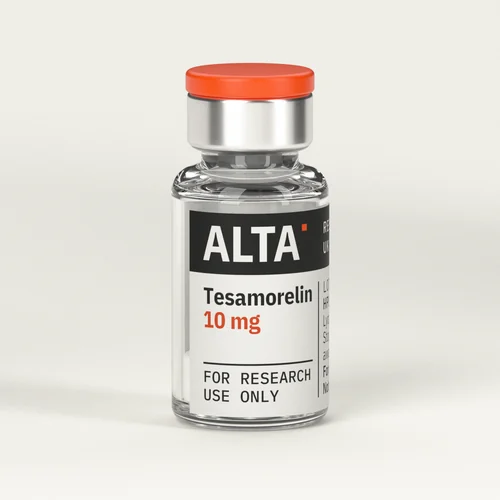
The closest compound we do hold is tesamorelin, on exactly the same pathway as CJC-1295, the GHRH receptor, and the best-evidenced molecule on it: a synthetic copy of the full 44-amino-acid GHRH chain, approved by the FDA as Egrifta in November 2010, with phase 3 trials in the New England Journal of Medicine and a liver-fat trial in Lancet HIV. Tesamorelin is supplied as a sealed 10 mg vial at £59.99, each lot published with its certificate of analysis, from UK stock, for laboratory research only. It is not licensed in the UK and we make no claims for it: the results in our tesamorelin article belong to those trials, not to this reagent.
Sources
- Teichman SL, Neale A, Lawrence B, et al. Prolonged stimulation of GH and IGF-I secretion by CJC-1295, a long-acting analog of GH-releasing hormone, in healthy adults. Journal of Clinical Endocrinology and Metabolism, 91(3):799 to 805, 2006.
- Raun K, Hansen BS, Johansen NL, et al. Ipamorelin, the first selective growth hormone secretagogue. European Journal of Endocrinology, 139(5):552 to 561, 1998.
- Beck DE, Sweeney WB, McCarter MD, et al. Proof-of-concept study of the ghrelin mimetic ipamorelin for postoperative ileus after bowel resection. International Journal of Colorectal Disease, 29(12):1527 to 1534, 2014. NCT00672074.
- Lipodystrophy study halted after patient death. aidsmap, July 2006.
- ConjuChem reveals findings of patient death investigation. Pharmaceutical Business Review, 9 August 2006.
- ClinicalTrials.gov. CJC 1295 in HIV Patients With Visceral Obesity. NCT00267527 (terminated).
- World Anti-Doping Agency. Prohibited List 2026, section S2.2.4.
- Falutz J et al. Metabolic effects of a growth hormone-releasing factor in patients with HIV. New England Journal of Medicine, 357:2359 to 2370, 2007.
Questions people ask
What is CJC-1295?
CJC-1295 is a laboratory-made copy of growth hormone-releasing hormone, the hypothalamic signal that tells the pituitary gland to release growth hormone. ConjuChem in Montreal built it as a long-acting version that could be given weekly rather than daily. It has been studied in a small number of human trials and is not licensed anywhere.
What is ipamorelin?
Ipamorelin is a chain of five amino acids designed at Novo Nordisk and first published in 1998. It acts on the ghrelin receptor, and the 1998 paper called it the first selective growth hormone secretagogue: in the animal work it released growth hormone without raising ACTH, cortisol or prolactin the way earlier compounds did.
Did someone die in a CJC-1295 trial?
Yes. ConjuChem halted its phase 2 trial in HIV-related visceral obesity on 17 July 2006 after a participant at an Argentine site had a fatal heart attack hours after his eleventh weekly injection. The attending physician's most likely explanation was undiagnosed coronary artery disease with a ruptured plaque, and the company said it had seen no cardiotoxic signal earlier. The trial was terminated.
What are the side effects of ipamorelin?
In the phase 2 trial in surgical patients, side effects of any kind were reported in 87.5% of the ipamorelin group and 94.8% of the placebo group, so it was described as well tolerated over up to seven days in hospital. Beyond that there is no long-term human safety data, which is the honest answer on ipamorelin side effects.
Is CJC-1295 or ipamorelin approved anywhere?
No. Neither has a marketing authorisation from the MHRA, the FDA or the European Medicines Agency. CJC-1295 development stopped after the 2006 trial was terminated, and ipamorelin missed its primary endpoint in phase 2 with no further development reported since.
Are CJC-1295 and ipamorelin legal in the UK?
Neither is a controlled drug under the Misuse of Drugs Act, so holding them as laboratory reagents is not an offence. Supplying an unlicensed product for human use is an offence under the Human Medicines Regulations 2012. That is a summary rather than legal advice; our guide to peptide law in the UK covers it properly.
Are CJC-1295 and ipamorelin banned in sport?
Yes, both at all times under category S2 of the WADA Prohibited List. The 2026 list names CJC-1295 and CJC-1293 among GHRH analogues, alongside sermorelin and tesamorelin, and names ipamorelin among growth hormone secretagogues alongside ibutamoren (MK-677). GHRP-6 appears in the same section.
Does ALTA sell CJC-1295 or ipamorelin?
No. ALTA PEPTIDES does not stock either. The best-evidenced compound on the same GHRH pathway is tesamorelin, an approved medicine in the United States with published phase 3 trials behind it, and that is what we supply for laboratory research.
What is the ipamorelin peptide?
Ipamorelin is a five-amino-acid growth hormone secretagogue first described by researchers at Novo Nordisk in 1998. It acts on the ghrelin receptor, not the GHRH receptor that CJC-1295 targets. It is not licensed as a medicine anywhere.
What CJC 1295 ipamorelin benefits do the published studies report?
None for the pair: no controlled human trials have given the two compounds together, so every number quoted for the combination belongs to one of them studied alone. CJC-1295 raised growth hormone and IGF-1 in healthy adults for days. Ipamorelin released growth hormone in volunteers and missed the endpoint in its one efficacy trial. Although the two are often paired in listings, no study has measured body composition, recovery or sleep.
Does ipamorelin reduce belly fat?
No published human trial has measured it. The only controlled human trial of ipamorelin measured time to a first tolerated meal after bowel surgery, not fat or weight, and it missed that endpoint. The growth hormone studies measured hormone levels in blood.
Is ipamorelin FDA-approved?
No. Ipamorelin is not approved by the FDA, the MHRA or the European Medicines Agency, and nor is CJC-1295. The FDA has placed both on its list of bulk drug substances that may present significant safety risks for pharmacy compounding.
What does ipamorelin bind to?
A GHRP-like receptor on pituitary cells, now known as the ghrelin receptor, not the GHRH receptor that CJC-1295 binds. Raun and colleagues established this in 1998 using GHRP and GHRH antagonists in primary rat pituitary cells, where ipamorelin released growth hormone with potency and efficacy similar to GHRP-6.
Does ipamorelin affect cortisol and prolactin?
In conscious swine it did not. The 1998 Novo Nordisk study reported that none of the secretagogues tested changed FSH, LH, prolactin or TSH, and that while GHRP-6 and GHRP-2 raised ACTH and cortisol, ipamorelin did not do so at doses more than 200 times the ED50 for growth hormone release. That is animal data; no equivalent human hormonal panel has been published. This describes the cited study and is not medical advice.
What IGF-1 figures do the CJC-1295 studies report?
Teichman and colleagues reported mean plasma IGF-1 1.5 to 3 fold above baseline for 9 to 11 days after one subcutaneous injection in healthy adults, and above baseline for up to 28 days after several doses. Ionescu and Frohman reported IGF-1 45% higher one week after a single injection in healthy men aged 20 to 40.
Information, not advice. This article summarises published research; nothing here is guidance on human or veterinary use. Products are sold under our research use policy.