In this article16 sections
A synthetic small molecule, not a peptide, that switches on the three oestrogen-related receptors (ERRs) and so copies part of what endurance training does to muscle. In mice it increased running time by 70% and caused 12% body weight loss in obese animals, without any change in appetite. No human trial has reported results.
SLU-PP-332 is the compound behind a lot of "exercise in a pill" headlines. It is a synthetic molecule that switches on receptors your muscles use during endurance training. In mice it produced longer running times and real fat loss, with no change in appetite or activity. Everything published is from cells and animals, and the people who made it said it needs redesigning before anyone tests it in a person.
- SLU-PP-332 is a synthetic small molecule, not a peptide. Its name comes from Saint Louis University, where Thomas Burris's laboratory designed it; Burris later moved to the University of Florida.
- It is a pan-ERR agonist: it switches on all three oestrogen-related receptors (ERR alpha, beta and gamma), most strongly ERR alpha. ERRs control genes for mitochondria and fat burning in muscle, heart and brain.
- In Billon et al., ACS Chemical Biology, April 2023, normal-weight mice given the compound ran 70% longer and 45% further than untreated mice and gained more fatigue-resistant type IIa muscle fibres.
- In obese mice (Billon et al., Journal of Pharmacology and Experimental Therapeutics, online September 2023), treated animals gained 10 times less fat and lost 12% of their body weight in a month, while eating the same amount of food.
- In mice with heart failure from pressure overload, SLU-PP-332 and a second compound, SLU-PP-915, improved ejection fraction, reduced scarring and improved survival (Xu, Billon et al., Circulation 2024;149:227 to 250).
- No human trial of SLU-PP-332 has reported results. The University of Florida said in 2023 that the next steps were to redesign it as a pill rather than an injection, then test it in more animal models.
- Bahaa Elgendy of Washington University in St Louis, a co-author on the chemistry, co-founded a start-up called Pelagos Pharmaceuticals to develop newer ERR agonists. We could not verify any public licensing agreement covering SLU-PP-332 itself.
- A January 2026 paper in Rapid Communications in Mass Spectrometry mapped nine metabolites of SLU-PP-332 so that sports testing laboratories could detect its use.
What is SLU-PP-332?
In shortA synthetic molecule from Saint Louis University that copies part of what training does to muscle.
Not a peptide. No amino-acid chain.
ERR alpha, beta and gamma at once.
Burris later moved to the University of Florida.
Cells, mice and rat heart cells.
Billon et al., ACS Chemical Biology 2023; University of Florida news release, September 2023.
An experimental small molecule, also written SLU PP 332. The "SLU" is Saint Louis University, where Thomas Burris and colleagues designed it with teams at Washington University in St Louis; Burris is now a professor of pharmacy at the University of Florida, which is why the 2023 press coverage came from Florida.
It belongs to a class people have chased for almost twenty years: exercise mimetics, compounds that switch on some of the gene programmes endurance training switches on. As the laboratory that built it put it, the compound tells skeletal muscle to make the same changes it would make during endurance training. It does not replace exercise, and the researchers said so.
Is SLU-PP-332 a peptide?
In shortNo. It is a small molecule, which changes how you check whether a product is real.
No, and this is the commonest mistake made about it. Plenty of pages, including vendor listings, sell the "slu-pp-332 peptide". A peptide is a chain of amino acids whose identity can be confirmed by mass spectrometry against a published sequence. SLU-PP-332 has no amino-acid chain at all.
That has a practical edge: the tests that prove a peptide is what it claims to be are not the tests that prove a small molecule is. Our guide on how to read a certificate of analysis covers what a real peptide certificate contains, and what peptides are covers the chemistry.
How does SLU-PP-332 work?
In shortIt switches on the ERR receptors, which turn up genes for mitochondria and fat burning.
- 01SLU-PP-332 enters the cell
A small molecule, so it passes the membrane without a transporter.
- 02It binds the ERRs
Nuclear receptors ERR alpha, beta and gamma. Strongest at ERR alpha.
- 03The ERRs sit on DNA
They switch up genes for mitochondria and fatty acid handling.
- 04Muscle shifts fuel
Whole-body metabolism turns towards burning fatty acids.
- 05Measured effect in mice
More type IIa oxidative fibres; longer time to exhaustion.
Simplified from Billon et al., ACS Chemical Biology 2023. ERRs are not oestrogen receptors.
Through the oestrogen-related receptors, or ERRs. Despite the name they are not oestrogen receptors and have nothing to do with oestrogen. They are nuclear receptors: proteins inside the cell that bind DNA and turn sets of genes up or down. There are three, ERR alpha, beta and gamma, busiest in the tissues that burn the most energy: muscle, heart and brain.
When you train, ERR activity rises and the genes they control build more mitochondria and shift muscle towards burning fatty acids. ERRs were an obvious drug target for years, and an obviously hard one, because they lack an easy pocket for a molecule to sit in. SLU-PP-332 is a pan-ERR agonist: it switches on all three, most strongly ERR alpha. In mice, Burris said, whole-body metabolism turns towards using fatty acids, as it does in fasting or exercise. The animals simply use more energy living.
What did the mouse studies show?
In shortMice ran 70% longer and 45% further; obese mice lost 12% of their body weight.
Obese mice gained a tenth of the fat untreated mice did.
The animals did not eat less.
They did not move around more either.
The fatigue-resistant, oxidative kind.
University of Florida news release, 25 September 2023, reporting Billon et al. 2023 in ACS Chemical Biology and in J Pharmacol Exp Ther. Mouse data only.
Two papers carry most of the weight, both from the same group. Billon and colleagues, in ACS Chemical Biology in April 2023, tested exercise capacity in normal-weight mice: treated animals ran 70% longer and 45% further than untreated mice and gained more type IIa muscle fibres, the oxidative, fatigue-resistant kind endurance training builds. The effect depended on ERR alpha specifically.
The second paper, in the Journal of Pharmacology and Experimental Therapeutics in September 2023, used diet-induced obese mice and ob/ob mice. Over a month, treated obese animals gained 10 times less fat and lost 12% of their body weight, with energy expenditure and fatty acid oxidation up and food intake unchanged. The paper reports improved insulin sensitivity, although one outlet that read the full text called the glucose tolerance and insulin findings mixed.
A third strand came in Circulation in January 2024: in mice with heart failure from pressure overload, SLU-PP-332 and a structurally different pan-ERR agonist, SLU-PP-915, both improved ejection fraction, reduced fibrosis and improved survival, with ERR gamma the main mediator.
What SLU-PP-332 has not shown
In shortNo human results, no safety profile, and no proof it works taken by mouth.
ClaimSLU-PP-332 is a peptideTap to check
It is a small synthetic organic molecule. Peptides are chains of amino acids; this has none. The error matters, because the laboratory tests that confirm a peptide's identity are not the ones that confirm a small molecule's.
ClaimIt replaces exerciseTap to check
Even the scientists working on this class say so plainly. In mice the compound reproduced part of the muscle gene programme of endurance training. It did not reproduce the cardiovascular, skeletal, cognitive or mood effects of exercising, and none of that was measured.
ClaimIt causes 12% weight lossTap to check
That figure is real and comes from the 2023 Journal of Pharmacology and Experimental Therapeutics paper: obese mice lost 12% of body weight over a month and gained 10 times less fat than untreated animals. It is a mouse figure. No human weight data of any kind have been published.
ClaimIt is safe, with no side effectsTap to check
The University of Florida said in September 2023 that no severe side effects had appeared so far, and that testing for side effects in more animal models was the next step before human trials. That is a statement about early animal work, not a safety profile.
ClaimIt works as a tablet or capsuleTap to check
The animal studies used injection. The stated plan was to redesign the molecule so it could be given as a pill, and a later paper on the related compound SLU-PP-915 describes SLU-PP-332 as lacking oral bioavailability.
ClaimERR agonists improved heart failure in animalsTap to check
In Circulation in January 2024, SLU-PP-332 and SLU-PP-915 both improved ejection fraction, reduced fibrosis and improved survival in mice with pressure-overload heart failure, with ERR gamma as the main mediator. Mouse models of heart failure, not patients.
Verdicts drawn from the primary papers and the University of Florida release named in the sources.
Anyone searching slu-pp-332 benefits research, or slu-pp-332 exercise mimetic, is asking one question: what has been shown? This is the other half of the answer. No human trial has reported results, and no human pharmacokinetic data are published, so nobody has shown how a human body absorbs, processes or clears it. The animal studies used injection, and the University of Florida's stated next step was to refine the structure into a pill, then test for side effects in more animal models before any human study. A later paper on SLU-PP-915 describes SLU-PP-332 as lacking oral bioavailability.
Safety is open. "No severe side effects so far" in mouse work is not a safety profile. ERRs regulate metabolism in heart and brain as well as muscle, and long-term animal toxicology for this compound has not been published.
SLU-PP-332 vs other exercise mimetics: AICAR, cardarine and MOTS-c
In shortThree came before it. None was approved, and cardarine was dropped over cancers in rodents.
Swipe the table to compare →
| Target | Type | Best animal result | Where it ended up | |
|---|---|---|---|---|
| AICAR | AMPK | Small molecule | 44% better running endurance in sedentary mice (Cell, 2008) | Never approved; WADA banned |
| GW501516 (cardarine) | PPAR delta | Small molecule | Endurance gains with training (Cell, 2008) | Dropped: cancers in rodents |
| MOTS-c | AMPK | 16-amino-acid peptide | Resisted diet-induced obesity; better physical capacity in old mice | Analogue reached phase 1, then dropped |
| SLU-PP-332 | ERR alpha, beta, gamma | Small molecule | 70% longer running time; 12% weight loss in obese mice | Preclinical; no human results |
Narkar et al., Cell 2008; Health Canada advisory 2013; Lee et al., Cell Metabolism 2015; Billon et al. 2023. No exercise mimetic has ever been approved.
This is the fourth serious attempt at the idea, and the fate of the first three is the reason to be careful. The comparisons people look for, slu-pp-332 vs cardarine and slu-pp-332 vs mots-c, are really questions about what happened to the earlier ones.
AICAR activates AMPK, the cell's energy sensor. In the 2008 Cell paper by Narkar and colleagues that coined the phrase exercise mimetics, four weeks of AICAR improved running endurance in sedentary mice by 44%. It was never approved and has been on the WADA Prohibited List for years.
GW501516, known as cardarine, was the other compound in that paper: a PPAR delta agonist from GlaxoSmithKline. Development stopped in the 2000s after long-term animal studies found cancers developing rapidly in multiple organs in mice and rats. Health Canada issued a public advisory in 2013 and WADA an unusual safety warning the same year, aimed at athletes buying it on the black market. Cardarine gw501516 is still sold online today, which tells you how little the evidence record constrains this market.
MOTS-c is the peptide member: a 16-amino-acid peptide encoded inside mitochondrial DNA, discovered in 2015, which activates AMPK mostly in skeletal muscle. It is the only one of the four your own body makes, and exercise raises it in human muscle and blood. Our article on what MOTS-c is covers that evidence, including the only human trial, which was of a different analogue and was dropped.
Is SLU-PP-332 legal in the UK?
In shortNot a controlled drug, but no MHRA licence, and treat it as banned in sport.
Not scheduled under the Misuse of Drugs Act 1971.
No marketing authorisation anywhere in the world.
That makes it an unlicensed medicine under the 2012 Regulations.
WADA S4 covers metabolic modulators; tests are being built.
Human Medicines Regulations 2012; WADA Prohibited List S4; Moller et al., Rapid Commun Mass Spectrom 2026.
It is not a controlled drug under the Misuse of Drugs Act 1971, and it holds no marketing authorisation from the MHRA or any other regulator. A marketing authorisation is the licence a medicine needs before it can be sold or supplied for human use in the UK; without one, supplying SLU-PP-332 for human use makes it an unlicensed medicine, an offence under the Human Medicines Regulations 2012. Our article on whether peptides are legal in the UK sets out that framework. This describes the law; it is not legal advice.
Under anti-doping rules, treat it as prohibited. WADA's section S4 covers hormone and metabolic modulators and is banned at all times, and two anti-doping laboratories published metabolite maps of SLU-PP-332 in 2026 so that testing laboratories can catch its use.
Can you buy SLU-PP-332?
In shortProducts exist under the name; verifying what is in them is the problem.
The animal studies injected it. Capsules and tablets are not the thing the papers describe, and a later paper says the molecule lacks oral bioavailability.
One testing laboratory states plainly that its targeted method confirms identity and amount but does not screen for related compounds, contaminants or undeclared substances.
Vendor figures we found ranged from 97.81% on a batch printout to 99+% in marketing copy, with no common reference standard behind them.
Many sellers state the product is not for human use while supplying it in capsules. Both statements cannot be meant seriously.
Pages selling the slu-pp-332 peptide are describing a small molecule. Expect the paperwork to be equally approximate.
Observations from vendor listings and testing-laboratory method descriptions, November 2026. ALTA PEPTIDES does not stock SLU-PP-332.
Products exist under the name, which is not the same thing. Searches for slu-pp-332 uk mostly land on shops selling capsules, tablets and powders, which runs into the problem above: the molecule the papers describe was injected into animals, so an oral tablet is not what those papers studied.
Verification is the deeper issue. One testing laboratory openly notes that its targeted method confirms identity and amount but does not screen for related compounds, contaminants or undeclared substances. Vendor purity claims we found ranged from 97.81% on a batch printout to "99+%" in marketing copy, and many sellers state the product is not for human use while packaging it in capsules. ALTA PEPTIDES does not stock SLU-PP-332.
Where SLU-PP-332 fits with ALTA's research peptides
In shortMOTS-c is the peptide version of the same idea, with a sequence you can check.
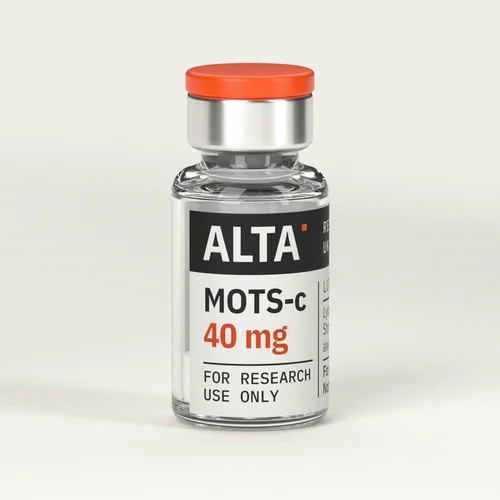
If the ERR pathway is what interests you, the honest adjacent compound in our catalogue is MOTS-c, and the link is scientific rather than marketing. SLU-PP-332 works through the ERRs; MOTS-c works through AMPK, the energy sensor sitting immediately upstream of the same mitochondrial gene programme, as AICAR does. The difference is chemistry and evidence: MOTS-c is a defined 16-amino-acid sequence your mitochondria make themselves, so a vial can be checked against a published sequence by mass spectrometry. MOTS-c is supplied as a 40 mg vial at £74.99 with a published lot certificate, for laboratory research only.
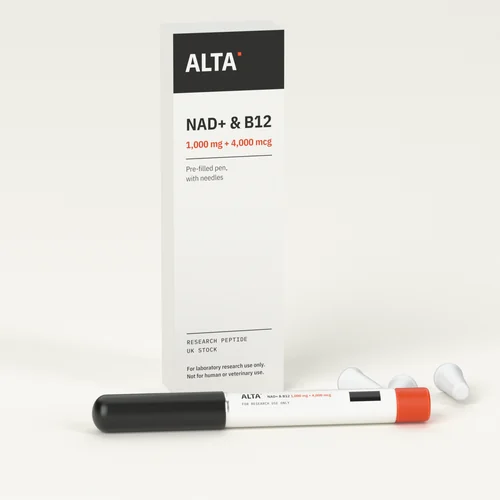
The other related product is the NAD+ and B12 pen at £119.99. NAD+ is not a peptide and not an exercise mimetic: it is the coenzyme that carries electrons through the reactions the ERRs build the machinery for. See NAD+ injections in the UK for what is in each format, and MOTS-c and epitalon for the two peptides most often researched together here. Neither product treats anything, and both are sold for laboratory research only.
Everything above is the quick version. The sections below go deeper.
Who is developing SLU-PP-332?
In shortAcademic laboratories in St Louis and Florida, with a start-up for the newer compounds.
- 2008The idea gets its name
Narkar et al. publish AMPK and PPAR delta Agonists Are Exercise Mimetics in Cell.
- Apr 2023First results
ACS Chemical Biology: 70% longer running time, 45% further, more type IIa fibres.
- Sep 2023Obese mice
J Pharmacol Exp Ther: 12% weight loss, 10 times less fat gain, no change in food intake.
- Jan 2024Heart failure
Circulation: SLU-PP-332 and SLU-PP-915 improve ejection fraction and survival in mice.
- Mar 2024Next-generation compounds
ACS meeting: stronger ERR agonists, some designed to reach the brain, via Pelagos Pharmaceuticals.
- 2026Doping tests built
Two laboratories publish metabolite maps so sports testing can detect it.
Primary papers and press releases listed in the sources. Still no human trial results.
An academic collaboration rather than a pharmaceutical company. Burris led the pharmacology, first at Saint Louis University and then at Florida. Bahaa Elgendy, a professor of anaesthesiology at Washington University School of Medicine in St Louis, led the medicinal chemistry, supported in part by the National Institute on Aging.
In March 2024 Elgendy presented a newer generation of ERR agonists at the American Chemical Society spring meeting: designed to bind more strongly, be more stable, and, unlike SLU-PP-332, cross into the brain. Elgendy said he and his colleagues hoped to test them in animal models through Pelagos Pharmaceuticals, a start-up they co-founded. We found no public document confirming a licence specifically covering SLU-PP-332, so we are not claiming one exists.
SLU-PP-332 and the ERR receptors in detail
In shortWhich receptor drives which effect, and why they were hard to drug.
The three oestrogen-related receptors, and which one does what
The main one for exercise capacity. In the ACS Chemical Biology work, removing ERR alpha abolished the endurance effect of SLU-PP-332, which is how the group showed the running results ran through this receptor. SLU-PP-332 has its strongest activity here. ERR alpha is described in that paper as regulating exercise-induced stress adaptation in muscle.
The least studied of the three. It is expressed in fewer tissues than ERR alpha and ERR gamma and no published result attributes a specific SLU-PP-332 effect to it. A pan-ERR agonist switches it on anyway, which is one reason a pan agonist is a blunt tool: an effect, wanted or unwanted, cannot be assigned to one receptor.
The one behind the heart results. In the January 2024 Circulation paper, ERR gamma was identified as the main mediator of the improvement in ejection fraction, fibrosis and survival in mice with pressure-overload heart failure. ERRs are most active in the tissues that use the most energy, and heart muscle is top of that list.
ERRs are orphan nuclear receptors: no natural hormone that switches them on has been identified, and they lack an obvious pocket for a drug to occupy, which is why they resisted drug discovery for years. It took the Elgendy and Burris groups about a decade of structural work to produce a molecule that activated all three, including ERR alpha, the hardest of them.
In March 2024 the team presented ERR agonists designed to bind more strongly, be more stable, carry less toxicity risk and, unlike SLU-PP-332, cross into the brain. Compared across about 15,000 genes in rat heart muscle cells, the new molecules changed gene expression more than SLU-PP-332 did. They are at the animal-testing stage.
ACS Chemical Biology 2023; Circulation 2024; American Chemical Society press release, 18 March 2024.
The three ERRs do overlapping but distinct jobs, and which matters depends on the tissue. Deleting ERR alpha removed the endurance effect, identifying it as the receptor behind the running results; in the heart failure work ERR gamma was the main mediator; ERR beta is the least studied. A pan agonist hits all three, which is efficient if you want the whole programme and awkward if a side effect belongs to only one receptor.
SLU-PP-332 is best understood as a tool compound: the molecule that proved a hard target could be switched on at all, and that doing so produced measurable effects in living animals. Tool compounds rarely reach a pharmacy. Of the exercise mimetics studied so far not one has been approved anywhere, and the one with the most human interest, cardarine, was abandoned over cancers in animals.
SLU-PP-332 dose and route in the published animal studies
Every published SLU-PP-332 dose is an animal dose, given by intraperitoneal injection, never by mouth. In the 2023 ACS Chemical Biology paper from Saint Louis University School of Medicine and Washington University, sedentary mice were treated for 7 days at 50 mg/kg twice daily before the treadmill test, and for 15 days at the same amount for the muscle histology, in groups of six to eight animals.
The 2023 Journal of Pharmacology and Experimental Therapeutics study kept that twice-daily dosing: 50 mg/kg for 28 days in diet-induced obese mice and 12 days in ob/ob mice, 8 to 10 mice per group. The ob/ob arm was shortened because the animals tolerated twice-daily intraperitoneal administration less well. An earlier experiment gave mice 30 mg/kg and measured plasma and muscle exposure of about 0.2 and 0.6 micromolar six hours later, which is why the authors call it a chemical tool for animals rather than a drug candidate.
What the obese mouse model measured: fat mass, energy expenditure and glucose metabolism
The metabolic syndrome paper reports more than the headline figure. In the diet-induced obese mouse model, animals treated for 28 days weighed about 12% less than vehicle-treated animals. Over the same period vehicle-treated mice gained about 5 g of fat mass while treated mice gained less than 0.5 g, so the finding is decreased fat mass accumulation as much as weight loss, and food intake did not differ. The paper's own summary describes reduced fat mass in mouse models of obesity.
Indirect calorimetry in the same animals found increased fatty acid oxidation, about 25% above vehicle in chow-fed mice, lower carbohydrate oxidation and increased resting energy expenditure: the shift in fatty acid metabolism the ERRs are expected to produce. In white adipose tissue from mice on the high-fat diet, adipocyte size fell, and Oil Red O staining of liver sections showed less stored fat. On glucose metabolism the picture is mixed. Glucose tolerance improved and fasting glucose and insulin were lower, but the insulin tolerance test did not change, and the authors reported no increase in liver enzymes.
SLU-PP-332 as a research compound: what ERR activation does in muscle
The receptors the papers call estrogen-related receptors belong to the nuclear receptor family and differ from the oestrogen receptor in a way that matters here: ERRs are constitutively active, so a compound has to activate a receptor already working at a high baseline, not switch on a silent one. Their classic target genes encode proteins involved in fatty acid oxidation, mitochondrial biogenesis and the Krebs cycle.
In the cell work, SLU-PP-332 raised expression of pyruvate dehydrogenase kinase 4, a well-characterised ERR target gene, and raised mitochondrial function, measured as maximum respiration in skeletal muscle C2C12 cells. In mice treated with SLU-PP-332 the quadriceps held more muscle mitochondrial DNA and more oxidative type IIa muscle fibres, and the compound induced an ERR alpha-dependent acute aerobic exercise genetic program in skeletal muscle. In heart failure models, receptor gamma is the mediator in cardiac tissue.
That is the whole record: cell and animal pharmacology of a research compound in metabolic disease models, with no safety data in humans. These figures describe the cited studies. ALTA does not stock SLU-PP-332 and supplies its catalogue for laboratory research purposes only.
Sources
- Billon C, Sitaula S, Banerjee S, et al., Burris TP. Synthetic ERR alpha/beta/gamma Agonist Induces an ERR alpha-Dependent Acute Aerobic Exercise Response and Enhances Exercise Capacity. ACS Chem Biol 2023;18(4):756 to 771.
- Billon C, Schoepke E, Avdagic A, et al., Elgendy B, Walker JK, Burris TP. A Synthetic ERR Agonist Alleviates Metabolic Syndrome. J Pharmacol Exp Ther 2024;388(2):232 to 240 (online 22 September 2023).
- University of Florida (Hamilton E). Exercise-mimicking drug sheds weight, boosts muscle activity in mice. News release, 25 September 2023.
- Xu W, Billon C, Fu C, et al., Zhang L. Novel Pan-ERR Agonists Ameliorate Heart Failure. Circulation 2024;149(3):227 to 250.
- American Chemical Society. Mimicking exercise with a pill. ACS Spring 2024 press release, 18 March 2024 (Bahaa Elgendy; Pelagos Pharmaceuticals).
- Moller T, Krug O, Thevis M. In Vitro Metabolism of SLU-PP-332 and SLU-PP-915. Rapid Commun Mass Spectrom 2026;40(8):e70039; Avliyakulov NK, et al. Drug Testing and Analysis, March 2026.
- Narkar VA, Downes M, Yu RT, et al., Evans RM. AMPK and PPAR delta Agonists Are Exercise Mimetics. Cell 2008;134(3):405 to 415.
- Health Canada advisory on GW501516, 2013; WADA warning on GW501516, March 2013; WADA Prohibited List section S4.
Questions people ask
What is SLU-PP-332?
SLU-PP-332 is an experimental compound that switches on the oestrogen-related receptors (ERRs), a group of proteins that turn up genes for mitochondria and fat burning when you exercise. It was designed in Thomas Burris's laboratory at Saint Louis University. In mice it increases endurance and causes fat loss without any change in appetite or activity. It has only been studied in cells and animals.
Is SLU-PP-332 a peptide?
No. People search for it as an slu-pp-332 peptide, but it is a small synthetic organic molecule, not a chain of amino acids. That matters because peptides and small molecules are made, tested and identified in completely different ways, and a certificate written for a peptide tells you nothing useful about this compound.
What does exercise mimetic mean?
An exercise mimetic is a drug that switches on some of the same genes and metabolic pathways that physical training switches on, without the training. The term was popularised by a 2008 Cell paper on AICAR and GW501516. No exercise mimetic has ever been approved as a medicine anywhere.
What were the SLU-PP-332 results in mice?
Two sets. In normal-weight mice, treated animals ran 70% longer and 45% further on a treadmill and had more type IIa oxidative muscle fibres. In obese mice, a month of treatment produced 12% body weight loss and 10 times less fat gain than untreated animals, with no reduction in food intake.
What are the SLU-PP-332 side effects?
Not established. The University of Florida reported in September 2023 that no severe side effects had appeared in the animal work so far, and that safety testing in more animal models was the next step. An absence of reported harm in mice is not a safety record.
Is SLU-PP-332 legal in the UK?
It is not a controlled drug under the Misuse of Drugs Act and has no marketing authorisation from the MHRA or any other regulator, so no product containing it may be sold or supplied for human use in the UK. Selling it for people to take would present it as an unlicensed medicine, an offence under the Human Medicines Regulations 2012.
Is SLU-PP-332 banned in sport?
Treat it as prohibited. WADA's section S4, hormone and metabolic modulators, is banned at all times, and anti-doping scientists published metabolite maps of SLU-PP-332 and SLU-PP-915 in 2026 specifically so that laboratories can detect them.
Can you buy SLU-PP-332?
Sites sell powders, capsules and tablets under the name, which is a problem in itself: the compound its developers studied was given by injection in animals, not by mouth, so an oral tablet is not the thing the papers describe. ALTA PEPTIDES does not stock SLU-PP-332.
What is the closest thing ALTA stocks?
MOTS-c, the peptide version of the same idea: a 16-amino-acid mitochondrial peptide that activates AMPK, the cell's energy sensor, and that exercise itself raises in human muscle and blood. Its published sequence can be checked by mass spectrometry, which SLU-PP-332 products cannot match. It is supplied for laboratory research only.
Is there a SLU PP 332 dosage for people?
No. SLU-PP-332 has only been tested in animals, so no human dose has been established and nothing published supports one.
Does oral SLU-PP-332 work?
No published study has tested it by mouth. The animal work used intraperitoneal injection, and the 2026 Journal of Pharmacology and Experimental Therapeutics paper introducing the related compound SLU-PP-915 states that SLU-PP-332 lacks oral bioavailability. Making an orally active ERR agonist was the reason that second compound was designed.
How long does SLU-PP-332 take to work in mice?
Different measures moved on different timescales. Within 2 hours of the first dose the respiratory exchange ratio fell, meaning the animals had shifted towards burning fat. Endurance was tested after 7 days of twice-daily dosing, muscle function and fibre composition after 15 days, and the fat mass and energy expenditure results came after 28 days in obese mice. None of this has been measured in a person.
Are there safety data in humans for SLU-PP-332?
None. A 2026 systematic review of pan-ERR agonists in Revista Medica de Chile concluded that clinical trials are still needed to confirm efficacy and safety in humans, and no trial of SLU-PP-332 is registered on ClinicalTrials.gov as of November 2026. Animal reports note no overt toxicity over days to weeks, which is not a human safety profile.
Which papers describe SLU-PP-332?
Most of the data come from one research group. The first paper, in ACS Chemical Biology in 2023, is titled "Synthetic ERRα/β/γ Agonist Induces an ERRα-Dependent Acute Aerobic Exercise Response and Enhances Exercise Capacity". Its abstract reports that the compound increased type IIa oxidative skeletal muscle fibers in mice, in the paper's American spelling. The second, in the Journal of Pharmacology and Experimental Therapeutics in 2024, is titled "A Synthetic ERR Agonist Alleviates Metabolic Syndrome". It reports that SLU-PP-332 administration in obese mice was followed by increased energy expenditure and fatty acid oxidation. Both papers describe mice and cells, not people.
Information, not advice. This article summarises published research; nothing here is guidance on human or veterinary use. Products are sold under our research use policy.