In this article18 sections
A small experimental molecule, not a peptide, that blocks the enzyme NNMT. In obese mice it cut body weight and fat over 11 days without reducing food intake, and in fat cells it raised NAD+. It has never been tested in a published human trial and is not licensed in the UK.
5-amino-1MQ is often sold online next to peptides and described as a fat-loss "peptide". It is neither.
- 5-amino-1MQ, short for 5-amino-1-methylquinolinium, is a small molecule built on a quinoline ring. It is not a peptide and contains no amino acids.
- It blocks NNMT (nicotinamide N-methyltransferase), an enzyme that uses up nicotinamide, a form of vitamin B3, and SAM, the cell's main methyl donor.
- In cultured fat cells, 5-amino-1MQ lowered the NNMT product 1-MNA and raised NAD+ about 1.2 to 1.6-fold and SAM levels (Neelakantan et al., Biochemical Pharmacology, 2018).
- In diet-induced obese mice treated for 11 days, it caused about 5.1% weight loss against a 1.4% gain in controls, about 35% less epididymal fat and about 30% lower total cholesterol, with no change in food intake (9 mice per group).
- In 24-month-old mice with an injured leg muscle, an NNMT inhibitor boosted muscle stem cell activity, nearly doubled muscle fibre size and raised peak muscle force about 70% (Neelakantan et al., 2019).
- In 22-month-old mice, eight weeks of 5-amino-1MQ raised grip strength about 40% in sedentary animals (Scientific Reports, 2024).
- No human trial of 5-amino-1MQ has been published. It has no MHRA marketing authorisation and is sold online only as an unregulated research chemical.
It is a small experimental molecule that blocks an enzyme called NNMT, and in obese mice that led to less fat and higher NAD+ in fat cells. This guide explains, in plain terms, what 5-amino-1MQ is, how it links to NAD+, what the studies really found, and what its status is in the UK.
What is 5-amino-1MQ?
In shortAn experimental molecule that blocks the enzyme NNMT. Tested only in cells and mice.
Also written 5 amino 1MQ or 5A-1MQ.
Not a peptide; no amino acids.
Nicotinamide N-methyltransferase.
No published human trial.
Neelakantan et al., Biochemical Pharmacology, 2018 and 2019.
5-amino-1MQ is short for 5-amino-1-methylquinolinium. You will also see it written 5 amino 1MQ or 5A-1MQ. It is a drug candidate developed by scientists at the University of Texas Medical Branch in Galveston, led by Stanley Watowich and Harshini Neelakantan, to test whether blocking the enzyme NNMT could treat obesity and age-related muscle loss.
It is an NNMT inhibitor: a molecule that switches the enzyme off. Every published result so far comes from cells grown in a dish and from mice. No human trial has been published.
Is 5-amino-1MQ a peptide?
In shortNo. It is a small molecule with no amino acids.
Swipe the table to compare →
| 5-amino-1MQ | MOTS-c | SS-31 | |
|---|---|---|---|
| Built from | One quinoline ring system | 16 amino acids | 4 amino acids |
| Class | Small molecule | Peptide | Peptide |
| Charge | Permanent +1 | Mixed | +3 at body pH |
| Human trials | None published | None of MOTS-c itself | Several; approved in US for one disease |
Structures from the original papers; MOTS-c: Lee et al., Cell Metabolism 2015.
No. A peptide is a chain of amino acids, like the 16 in MOTS-c or the 39 in retatrutide.
5-amino-1MQ is a single ring system: a quinoline (two joined rings, one containing nitrogen) with a methyl group on the nitrogen and an amino group at position 5. The methylated nitrogen gives it a permanent positive charge, which is why its name ends in "-quinolinium".
It is sold by peptide shops because it is pitched to the same audience, not because of its chemistry. Our explainer on what peptides are covers the difference.
What is NNMT and why does it matter?
In shortAn enzyme that uses up vitamin B3 and the cell's methyl donor.
- 01Nicotinamide
A form of vitamin B3; the raw material for recycling NAD+.
- 02+ SAM
The cell's main methyl donor.
- 03NNMT
Joins them, using up both.
- 041-MNA + SAH
1-MNA is excreted; SAH becomes homocysteine.
Kraus et al., Nature 2014; Neelakantan et al., 2018.
NNMT, nicotinamide N-methyltransferase, is an enzyme found mostly in the liver and in fat tissue. It takes nicotinamide, a form of vitamin B3, and attaches a methyl group taken from SAM (S-adenosylmethionine, the cell's main methyl donor). The products are 1-MNA (1-methylnicotinamide) and SAH.
That matters for two reasons. Nicotinamide is the raw material cells recycle into NAD+, and SAM is needed for hundreds of other methylation reactions.
So NNMT acts like a drain on both. In a 2014 Nature study, NNMT levels were higher in the fat and liver of obese and diabetic mice, and lowering NNMT in those tissues protected mice from diet-induced obesity by raising energy use.
How does 5-amino-1MQ work?
In shortBlocking NNMT may leave more raw material for making NAD+.
- 015-amino-1MQ blocks NNMT
Shown in enzyme and cell tests.
- 02Less 1-MNA made
About 40% of normal at the highest concentrations tested.
- 03More nicotinamide and SAM left
SAM rose in fat cells.
- 04More NAD+ recycled
NAD+ up about 1.2 to 1.6-fold in fat cells.
- 05Less fat built
Lipogenesis fell in cultured fat cells.
Cultured mouse fat cells (3T3-L1). Neelakantan et al., Biochemical Pharmacology, 2018.
By blocking NNMT, 5-amino-1MQ should leave more nicotinamide and SAM inside the cell. The extra nicotinamide can then go into the salvage pathway that rebuilds NAD+, the coenzyme cells need to turn food into energy. That is the 5-amino-1MQ NAD+ link people search for.
In cultured mouse fat cells, 5-amino-1MQ cut 1-MNA to about 40% of normal at its highest tested concentrations, raised NAD+ about 1.2 to 1.6-fold, raised SAM and reduced the cells' build-up of fat. In the same tests it did not block related enzymes, such as other methyltransferases or the NAD+ salvage enzymes, so it looks selective.
What did the 5-amino-1MQ studies show?
In shortLess fat in obese mice and stronger muscles in old mice.
Diet-induced obese mice, 9 per group. Neelakantan et al., 2018. Fat cell size reported as more than 30%.
Approximate values. Neelakantan et al., Biochemical Pharmacology 2019; Dimet-Wiley et al., Scientific Reports 2024.
Obese mice, 2018. The 5-amino-1MQ fat loss claims trace back to this study. Mice made obese on a high-fat diet were treated for 11 days (9 per group). Treated mice lost about 5.1% of their body weight while untreated controls gained about 1.4%.
Their epididymal fat pads were about 35% lighter, their fat cells more than 30% smaller and their total cholesterol about 30% lower. Food intake did not change, so the authors put the weight loss down to changes in metabolism rather than eating less.
Old muscle, 2019. In 24-month-old mice with an injured leg muscle, the NNMT inhibitor woke up ageing muscle stem cells. Treated muscles had nearly twice the fibre size and about 70% higher peak force than untreated old muscles.
Old mice and exercise, 2024. In 22-month-old mice treated for eight weeks, grip strength was about 40% higher in sedentary treated mice than sedentary controls, against about 20% for exercise alone and about 60% for treatment plus exercise.
Has 5-amino-1MQ been tested in humans?
In shortNo published human trial exists.
Published studies to November 2026. No human data.
No published human trial exists, as of November 2026. There is no data on how the human body absorbs, breaks down or clears 5-amino-1MQ, what blood levels it reaches, or whether it raises NAD+ in human tissue. Any claim about "5-amino-1MQ results" in people comes from anecdote, not research.
5-amino-1MQ side effects: what is known
In shortUnknown in people; no problems seen in mice over 11 days.
Very little. The 2018 mouse study reported no observable adverse effects over 11 days. In cultured cells, 5-amino-1MQ was mildly toxic at high concentrations (100 to 300 micromolar) and about 40% of cells died at the highest concentration tested.
Because NNMT also helps clear excess nicotinamide and uses up SAM, blocking it for long periods could in theory affect methylation balance. That has not been studied in people. With no human safety data, there is no evidence-based list of 5-amino-1MQ side effects.
Why do people search for 5-amino-1MQ?
In shortFat loss without eating less, muscle and NAD+: all from mouse data.
Claim5-amino-1MQ is a peptide.Tap to check
It is a small molecule built on a quinoline ring. It contains no amino acids.
Claim5-amino-1MQ is proven to burn fat in humans.Tap to check
No human trial has been published. The fat-loss data come from 9 treated obese mice over 11 days.
Claim5-amino-1MQ raises NAD+.Tap to check
NAD+ rose about 1.2 to 1.6-fold in cultured fat cells. It has not been measured in human tissue.
ClaimIt works by making you eat less.Tap to check
Food intake did not change in the 2018 mouse study; the authors credit changes in metabolism.
Claim5-amino-1MQ builds muscle.Tap to check
It improved repair and strength in old or injured mouse muscle. No human data.
ClaimIt has no side effects.Tap to check
No human safety data exist. Mice showed no observable problems over 11 days.
Based on Neelakantan 2018 and 2019 and Dimet-Wiley 2024.
Three things drive interest. The obese-mouse study suggested fat loss without eating less, which sounds like a different route from drugs such as semaglutide or retatrutide.
The muscle studies suggested help for age-related muscle loss. And the NAD+ angle links it to the wider interest in NAD+ and ageing.
Online claims usually stretch these "5-amino-1MQ benefits" far beyond the data: short mouse studies with small groups are presented as if they were human trials.
Is 5-amino-1MQ legal in the UK?
In shortIt is not a licensed medicine; it is sold only as a research chemical.
People searching "5-amino-1MQ UK" should know it is not a licensed medicine. The MHRA has not granted a marketing authorisation for any product containing it, which means it cannot be sold, supplied or advertised as a treatment in the UK.
It is sold online as a research chemical, a separate status that carries no quality standard, no official monograph and no oversight of what is in the container. Our guide to UK peptide law explains how research-use status works; this is general information, not legal advice.
Can you buy 5-amino-1MQ?
In shortOnline, with no quality standard. ALTA does not stock it.
No published study has tested 5-amino-1MQ by mouth in people; the only oral data are from a 2021 rat study.
A seller who gets the chemistry wrong may get the product wrong too.
Identity must be shown by mass spectrometry, not just HPLC purity.
Promises of fat loss or anti-ageing in people go beyond any published evidence.
ALTA PEPTIDES does not stock 5-amino-1MQ. See our certificate of analysis guide.
Online sellers offer it, often as capsules, which no published study has tested. Quality is the main problem: there is no reference product, so buyers rely entirely on the seller's paperwork.
A useful certificate should show identity by mass spectrometry, purity by and a batch number that matches the container; see how to read a certificate of analysis. ALTA PEPTIDES does not stock 5-amino-1MQ.
Where 5-amino-1MQ fits with ALTA's research compounds
In shortNAD+ and MOTS-c are the related compounds we stock.
Tap a compound
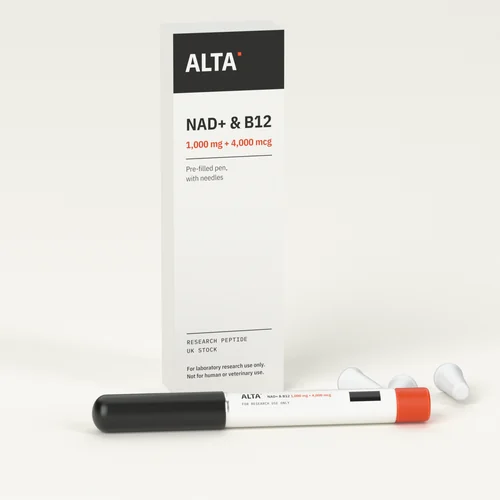
The coenzyme itself. Carries electrons in energy metabolism and feeds sirtuins and PARPs. Studying NAD+ directly avoids relying on an enzyme blocker to raise it. ALTA supplies the sealed Synedica NAD+ & B12 pen, £119.99, for laboratory research only.
Indirect route. Blocks NNMT so more nicotinamide may be recycled into NAD+. Cell and mouse data only. Not stocked by ALTA.
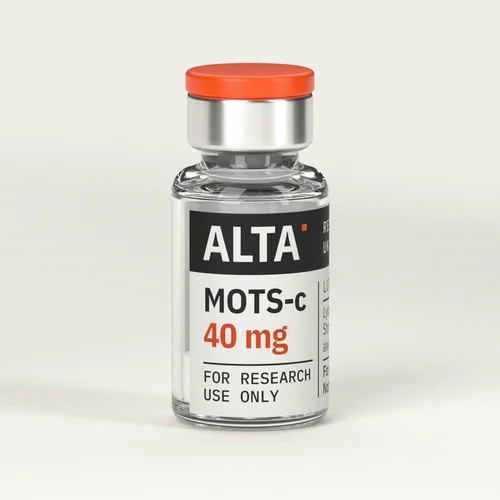
Mitochondrial signal. A 16-amino-acid peptide encoded in mitochondrial DNA that activates AMPK; protected mice from diet-induced weight gain. ALTA stocks 40 mg vials, £74.99, for laboratory research only.
ALTA journal: nad-plus-injections-uk and what-is-mots-c.
The scientific reason 5-amino-1MQ draws interest is NAD+. If your research is about NAD+ itself, the direct route is to study NAD+ rather than an enzyme blocker that may raise it indirectly.
We supply the Synedica NAD+ & B12 pen (£119.99), sealed as received from the manufacturer with a published lot certificate. Our guide to NAD+ in the UK explains what the NAD+ & B12 pen contains and how NAD+ relates to NMN and NR.
For metabolic research in the same mouse models, MOTS-c is the peptide most often studied alongside. It is a 16-amino-acid peptide encoded in mitochondrial DNA that activates AMPK, and in mice it protected against diet-induced weight gain.
Read our MOTS-c explainer; we stock MOTS-c vials (40 mg, £74.99). Both are for laboratory research only, not for human use.
Everything above is the quick version. The sections below go deeper.
The NNMT reaction in detail
In shortThe chemistry of the methyl sink.
NNMT moves a methyl group from SAM to the ring nitrogen of nicotinamide, giving 1-MNA and SAH. SAH is then turned into homocysteine. Because the methyl group ends up on a molecule that is excreted, NNMT works as a "methyl sink", and when it is very active it can lower the SAM to SAH ratio that controls many other methylation reactions, including those on DNA and histones.
5-amino-1MQ is shaped like the methylated product, 1-MNA, a design meant to fit the enzyme's nicotinamide-binding site. The 2018 paper found that the amino group at position 5 helped it cross membranes, by both passive and active transport, which is why it worked inside cells.
Reading the mouse data critically
In shortWhat the small, short studies can and cannot tell us.
The obesity result came from 9 treated mice over 11 days. A 5% weight change in 11 days is meaningful in a mouse, but short studies cannot show whether weight loss continues, levels off or reverses. The NAD+ rise was measured in fat cells in a dish, not in the treated mice's fat tissue.
The 5-amino-1MQ muscle studies came from the same research group, whose quinoline-based NNMT inhibitors are covered by patents. That does not make the results wrong, but independent replication and human trials are what would turn an interesting target into proven 5-amino-1MQ research findings.
5-amino-1MQ dosage in the published animal studies
Every published dose of this small molecule NNMT inhibitor belongs to an animal. In the 2018 Biochemical Pharmacology study, diet-induced obese mice were given three subcutaneous injections a day of 20 mg/kg each, about 34 mg/kg a day in total, for 11 days, 9 mice per cohort. The amount came from an escalation study in obese mice covering 10 to 150 mg/kg a day, in which 60 mg/kg a day was tolerated with no observable adverse effects.
Later work used less. In the 2024 Scientific Reports study, 22-month-old female mice were given once-daily subcutaneous injections of 10 mg/kg for eight weeks; a pharmacokinetic experiment in the same paper found rapid absorption after subcutaneous dosing, a half-life of about 7 hours and no build-up with repeat dosing. The 2019 muscle study in 24-month-old mice compared 5 and 10 mg/kg for a week after injury.
No human 5-amino-1MQ dose has been established. Nothing is registered on ClinicalTrials.gov under the compound's name or as an NNMT inhibitor, and PubMed lists no human study, so there is no evidence on safety and effectiveness in people. The longest published course of any kind is eight weeks, in mice.
What NNMT inhibition changed in white adipose tissue
The 2018 results are specific to fat. Enough 5-amino-1MQ to inhibit NNMT lowered 1-MNA inside cultured adipocytes to about 40% of untreated levels and raised intracellular NAD+ and SAM, the cellular energy link that makes the compound interesting. In the treated obese mice, epididymal white adipose tissue weighed about 35% less than in controls, adipocyte size fell by more than 30%, giving smaller fat cells, and plasma total cholesterol was about 30% lower.
Two things the study did not show are worth stating. Cumulative food intake was the same in both groups, 28.1 g against 26.2 g, so there was no sign of appetite suppression. The study measured neither energy expenditure nor insulin sensitivity directly: the inference that inhibiting NNMT raises energy use comes from earlier work in which NNMT was knocked down. Whether blocking NNMT can reverse diet-induced obesity over longer than 11 days remains untested.
Injection and capsule: how 5-amino-1MQ has actually been given
Mouse studies of this small synthetic molecule used subcutaneous injection. The oral question has been examined once, in rats: a 2021 pharmacokinetic paper in the Journal of Pharmaceutical and Biomedical Analysis gave 5-amino-1-methyl quinolinium by both the intravenous and the oral route and reported oral bioavailability of 38.4%, with a terminal half-life of about 3.8 hours after the intravenous dose and 6.9 hours after the oral one. That is the only published measurement of oral absorption, and it is a rat measurement.
No capsule has been tested in any published study, in any species. Capsules sold online are a formulation decision made by sellers, not a dose form carried over from the cell and animal studies, and nobody has measured NNMT activity, NAD+ or fat metabolism in human adipose tissue and liver after one. These figures describe the cited studies. ALTA does not stock 5-amino-1MQ, and the compounds it does supply are for laboratory research use only.
Sources
- Neelakantan H, Vance V, Wetzel MD et al. Selective and membrane-permeable small molecule inhibitors of nicotinamide N-methyltransferase reverse high fat diet-induced obesity in mice. Biochemical Pharmacology, January 2018; 147: 141 to 152.
- Neelakantan H et al. Small molecule nicotinamide N-methyltransferase inhibitor activates senescent muscle stem cells and improves regenerative capacity of aged skeletal muscle. Biochemical Pharmacology, May 2019; 163: 481 to 492.
- Dimet-Wiley AL et al. Nicotinamide N-methyltransferase inhibition mimics and boosts exercise-mediated improvements in muscle function in aged mice. Scientific Reports, 5 July 2024.
- Kraus D et al. Nicotinamide N-methyltransferase knockdown protects against diet-induced obesity. Nature, 10 April 2014; 508: 258 to 262.
- Medicines and Healthcare products Regulatory Agency. A guide to what is a medicinal product (Guidance Note 8). GOV.UK.
Questions people ask
What is 5-amino-1MQ?
5-amino-1MQ (5-amino-1-methylquinolinium) is an experimental small molecule that blocks an enzyme called NNMT. Scientists at the University of Texas Medical Branch developed it to study obesity and muscle ageing. All published results come from cells and mice.
Is 5-amino-1MQ a peptide?
No. It is a small molecule built on a quinoline ring with a methyl group and an amino group attached. A peptide is a chain of amino acids; 5-amino-1MQ contains none. It is often sold by peptide shops, which is where the confusion comes from.
What does 5-amino-1MQ do?
It blocks NNMT, an enzyme that uses up nicotinamide (a form of vitamin B3) and SAM, a molecule cells use for methylation. In cultured fat cells this raised NAD+ and SAM and reduced fat building. In obese mice it reduced body weight and fat mass over 11 days without changing food intake.
Does 5-amino-1MQ work for fat loss in humans?
Nobody knows. There are no published human trials. The fat-loss results come from one 11-day study in 9 treated obese mice and a few follow-up animal studies, and mouse metabolism results often fail to carry over to people.
Does 5-amino-1MQ increase NAD+?
In cultured fat cells, yes: NAD+ rose about 1.2 to 1.6-fold. The idea is that blocking NNMT leaves more nicotinamide to be recycled into NAD+. NAD+ levels in human tissue after 5-amino-1MQ have never been measured in a published study.
What are the side effects of 5-amino-1MQ?
Unknown in humans. The 2018 mouse study reported no observable adverse effects over 11 days, but at high concentrations it was mildly toxic to cultured cells. No human safety data exist, and unregulated products add uncertainty about purity.
Is 5-amino-1MQ legal in the UK?
It is not a licensed medicine: the MHRA has not authorised any 5-amino-1MQ product, so it cannot legally be sold or advertised as a treatment. It is sold online as a research chemical, which is a different status from an approved medicine and comes with no quality guarantees.
5-amino-1MQ vs MOTS-c: what's the difference?
5-amino-1MQ is a synthetic small molecule that blocks the NNMT enzyme. MOTS-c is a natural 16-amino-acid peptide encoded in mitochondrial DNA that switches on the energy sensor AMPK. Both have been studied in obese and ageing mice, through different mechanisms, and neither has completed human trials.
Does ALTA sell 5-amino-1MQ?
No. ALTA PEPTIDES does not stock 5-amino-1MQ. For research on the NAD+ pathway we supply a sealed NAD+ & B12 pen, and for metabolic research we stock MOTS-c, both with published lot certificates and for laboratory research only.
Is 5 amino 1mq a peptide, and is there a 5 amino 1mq dosage?
No to both. Sellers call it the 5 amino 1mq peptide, but it is a small molecule, not a chain of amino acids. It has never been tested in a published human trial, so no human dose exists. The 2018 study gave it to obese mice for 11 days.
How often was 5-amino-1MQ given in the animal studies?
Three times a day in the 2018 obesity study, as subcutaneous injections of 20 mg/kg given to mice at roughly four-hour intervals for 11 days. The 2024 muscle study in aged mice used one subcutaneous injection a day for eight weeks. Those are animal schedules. No human schedule exists in published research.
How long did 5-amino-1MQ take to show an effect in mice?
Body weight separated from controls over the 11 days of the 2018 obesity study, the gap widening across the period. In the 2024 study of 22-month-old mice, grip strength after eight weeks of once-daily treatment was about 40% higher than in untreated sedentary animals. Neither timescale has been reproduced in people, because no human study exists.
Is 5-amino-1MQ a research compound or a supplement?
It is a research compound. It has no marketing authorisation from the MHRA or any comparable regulator, no monograph and no food supplement status, which is why it is listed for laboratory research use. The published record is cell and animal studies from a small number of groups, and no standard covers the purity or content of what is sold online.
Is 5-amino-1MQ related to BPC-157?
No. The two are sold side by side online, but they are chemically unrelated. 5-amino-1MQ is a small quinolinium molecule that blocks the enzyme NNMT. BPC-157 is a peptide, a chain of 15 amino acids. Neither is a licensed medicine in the UK.
Does 5-amino-1MQ increase energy expenditure or fat oxidation?
That has been inferred, not measured, for 5-amino-1MQ itself. The 2018 study in obese mice did not measure energy expenditure or fat oxidation. Its authors attributed the weight loss to altered metabolism because food intake stayed the same, and pointed to earlier work in which the NNMT gene was silenced in fat tissue, which they describe as correlating with increased cellular energy expenditure. Whether the compound changes how the mitochondrion burns fat in a living animal has not been shown by direct measurement.
Information, not advice. This article summarises published research; nothing here is guidance on human or veterinary use. Products are sold under our research use policy.