In this article17 sections
Once-weekly injectable peptides that switch on two receptors, GLP-1 and glucagon. Mazdutide is approved in China; survodutide is in phase 3, with a strong fatty-liver (MASH) focus. Neither is licensed in the UK.
Survodutide and mazdutide are the two leading glucagon/GLP-1 dual agonists: once-weekly injectable peptides that copy two hormones at once, (eat less) and glucagon (burn more, especially in the liver). Mazdutide became the first drug of this type approved anywhere when China cleared it in June 2025. Survodutide, from Boehringer Ingelheim, reported up to 16.6% weight loss in its first trial in 2026 and is being pushed hardest as a fatty liver drug. Neither is licensed in the UK. Here is what they are, what the trials found, and how they relate to tirzepatide and retatrutide.
- Survodutide (BI 456906) is a once-weekly glucagon/GLP-1 receptor dual agonist developed by Boehringer Ingelheim under licence from Zealand Pharma.
- Mazdutide (IBI362, LY3305677) is an oxyntomodulin analogue discovered by Eli Lilly and developed in China by Innovent Biologics, which licensed the Chinese rights in 2019.
- China's NMPA approved mazdutide (brand Xinermei) for chronic weight management on 27 June 2025 and for type 2 diabetes in September 2025, the first approvals for any glucagon/GLP-1 dual agonist.
- In GLORY-1 (610 Chinese adults, 48 weeks, NEJM 2025), mazdutide 4 mg and 6 mg arms lost 12.0% and 14.8% of body weight against 0.5% on placebo.
- In SYNCHRONIZE-1 (725 adults without diabetes, 76 weeks), survodutide produced up to 16.6% weight loss against 3.2% on placebo, and an MRI sub-study found liver fat fell by up to 63.1%.
- In SYNCHRONIZE-MASLD (218 adults, 48 weeks), 61.0% on survodutide reached normal liver fat (below 5%) against 5.7% on placebo.
- Survodutide holds US FDA Breakthrough Therapy designation (September 2024) for MASH with moderate or advanced fibrosis and is in the LIVERAGE phase 3 trials.
- Neither survodutide nor mazdutide is authorised by the MHRA, and ALTA PEPTIDES stocks neither.
Survodutide and mazdutide are among the new GLP-1 drugs that add a second hormone, glucagon; apart from mazdutide's approval in China, both are still weight loss drugs in development.
What are survodutide and mazdutide?
In shortTwo weekly injections that copy GLP-1 and glucagon. Mazdutide is approved in China.
| Survodutide | Mazdutide | |
|---|---|---|
| Codes | BI 456906 | IBI362 / LY3305677 |
| Developer | Boehringer Ingelheim (from Zealand Pharma) | Innovent in China (from Eli Lilly) |
| Receptors | GLP-1 + glucagon | GLP-1 + glucagon (oxyntomodulin analogue) |
| Main focus | Obesity and MASH | Obesity and type 2 diabetes |
| Status | Phase 3; not approved | Approved in China (Xinermei), 2025 |
| UK | Not authorised | Not authorised |
Boehringer Ingelheim, April 2026; Innovent, June and September 2025.
Survodutide (development code BI 456906) came out of Boehringer Ingelheim's collaboration with Zealand Pharma in Denmark and is licensed to Boehringer, which runs its development worldwide. It is a weekly injection in two big phase 3 programmes: SYNCHRONIZE for obesity and LIVERAGE for MASH, the inflamed form of fatty liver disease. It is not approved anywhere yet.
Mazdutide was discovered by Eli Lilly (code LY3305677) and licensed to Innovent Biologics for China in 2019, where it is coded IBI362. China's NMPA approved it as Xinermei for chronic weight management on 27 June 2025 and for type 2 diabetes in September 2025. Lilly holds the rights outside China, where it remains in development.
What does a glucagon GLP-1 dual agonist do?
In shortGLP-1 cuts appetite; glucagon makes the liver burn fat.
Fuller sooner, slower stomach, more insulin after meals.
Liver burns stored fat; energy use rises.
GLP-1 offsets glucagon's push on blood sugar.
A gut hormone that weakly hits both receptors.
Simplified. Boehringer Ingelheim; Innovent.
It switches on two receptors with one molecule. GLP-1 makes you feel full sooner, slows the stomach and boosts insulin after meals. Glucagon is better known for raising blood sugar, but it also tells the liver to burn stored fat and nudges up the body's energy use.
A drug that only activated glucagon receptors would push blood sugar up. Pairing it with GLP-1, which brings blood sugar down, cancels that out while keeping the fat-burning effect. The body already does something similar: oxyntomodulin, a gut hormone released after eating, weakly activates both receptors, and mazdutide was designed as a long-acting oxyntomodulin analogue. A glucagon GLP-1 dual agonist is, in effect, a stronger, longer-lasting version of that natural signal.
Where do they sit between tirzepatide and retatrutide?
In shortThey share glucagon with retatrutide but skip GIP.
Swipe the table to compare →
| GLP-1 | GIP | Glucagon | |
|---|---|---|---|
| Semaglutide | Yes | ||
| Tirzepatide | Yes | Yes | |
| Survodutide | Yes | Yes | |
| Mazdutide | Yes | Yes | |
| Retatrutide | Yes | Yes | Yes |
The dual agonists share glucagon with retatrutide but leave out GIP.
Tap a compound to see its receptors, best trial result and status
GLP-1 + glucagon, weekly injection (Boehringer Ingelheim). Up to 16.6% weight loss at 76 weeks in SYNCHRONIZE-1; liver fat down up to 63.1% in an MRI sub-study. Phase 3 for obesity and MASH; FDA Breakthrough Therapy for MASH. Not approved.
GLP-1 + glucagon, weekly injection, an oxyntomodulin analogue (Innovent, from Lilly). 14.8% at 48 weeks on 6 mg in GLORY-1; 18.6% at 60 weeks on 9 mg in GLORY-2 (topline). Approved in China since June 2025.
GLP-1 + , weekly injection (Mounjaro). 22.5% at 72 weeks on the top arm in SURMOUNT-1. Licensed in the UK.
GLP-1 + GIP + glucagon, weekly injection (Lilly). 28.3% at 80 weeks in TRIUMPH-1; liver fat down around 82% in 24 weeks in a sub-study. Not approved; US filing planned for early 2027. ALTA supplies it only as a research reagent.
Company releases and trial publications to November 2026. Efficacy-estimand figures; separate trials.
Each generation of these drugs has added a hormone. Semaglutide copies GLP-1 only. Tirzepatide adds GIP. Survodutide and mazdutide take a different second hormone, glucagon. Retatrutide combines all three: GLP-1, GIP and glucagon. So the dual agonists share glucagon with retatrutide but leave out GIP, which makes them a useful natural experiment for what glucagon adds on its own.
The answer so far: a strong liver effect, and weight loss roughly in semaglutide's range rather than tirzepatide's. On mazdutide vs tirzepatide there is no head-to-head trial. Tirzepatide's top arm gave 22.5% at 72 weeks in SURMOUNT-1, while mazdutide's 6 mg arm gave 14.8% at 48 weeks in GLORY-1, in Chinese adults who started at a lower weight. Our GLP-1 receptor agonists explainer sets out the whole family.
What did the survodutide trials show?
In shortUp to 16.6% weight loss at 76 weeks, with big falls in liver fat.
Top arm, efficacy estimand. Boehringer Ingelheim, 28 April, 7 June and 1 October 2026.
Fat around the organs.
Relative to baseline.
Share of tissue lost at the top arm.
Boehringer Ingelheim, 7 June 2026; BioPharm International, 9 June 2026.
A phase 2 trial (le Roux et al., Lancet Diabetes and Endocrinology, 2024) in 387 adults found up to 14.9% weight loss at 46 weeks on the highest arm (4.8 mg) against 2.8% on placebo, with digestive side effects common.
SYNCHRONIZE-1, the first phase 3 trial, enrolled 725 adults with obesity or overweight and no diabetes, randomised to weekly survodutide 3.6 mg or 6.0 mg or placebo for 76 weeks. Survodutide results: up to 16.6% average weight loss against 3.2% on placebo, and 85.1% lost at least 5% against 38.8%. In an MRI sub-study, visceral (belly organ) fat fell by up to 34.0%, liver fat by up to 63.1%, and made up no more than 10.8% of the tissue lost. The full results were published in the New England Journal of Medicine in June 2026.
SYNCHRONIZE-2, in adults with obesity and type 2 diabetes, reported on 1 October 2026: up to 13.1% weight loss at 76 weeks against 3.1% on placebo, with significant improvements in blood sugar control.
What did the mazdutide trials show?
In short14.8% at 48 weeks on 6 mg, and it beat semaglutide in a diabetes trial.
Average weight loss, efficacy estimand. Ji et al., NEJM 2025; Innovent, October and November 2025. Chinese adults.
The mazdutide results so far come mainly from Chinese adults. GLORY-1 (Ji et al., NEJM, June 2025) randomised 610 Chinese adults with obesity or overweight to mazdutide 4 mg, 6 mg or placebo for 48 weeks. Counting people who stayed on treatment, average weight loss was 12.0% and 14.8% against 0.5% on placebo; 50.6% on the 6 mg arm lost at least 15%. Liver fat fell sharply in those who started with a fatty liver.
GLORY-2 tested a higher 9 mg arm for 60 weeks. Innovent's topline in November 2025 reported 18.6% average weight loss against 3.0% on placebo, with 44.0% losing at least 20%; the JAMA paper in June 2026 reported 16.7% against 1.5%. In diabetes, DREAMS-3 compared mazdutide 6 mg head to head with semaglutide 1 mg for 32 weeks: 48% on mazdutide reached both an HbA1c below 7% and at least 10% weight loss, against 21% on semaglutide, and average weight loss was 10.3% against 6.0%.
Why the liver matters: survodutide and MASH
In shortGlucagon works on the liver directly, so these drugs target fatty liver disease.
MASH improved without worse fibrosis (NEJM 2024).
SYNCHRONIZE-MASLD, 48 weeks.
Below 5% at 48 weeks.
LIVERAGE phase 3, about 1,800 adults.
Sanyal et al., NEJM 2024; Kaplan et al., Nature Medicine 2026; Boehringer Ingelheim.
- May 2021FDA Fast Track
For MASH.
- Nov 2023EMA PRIME
Priority medicines scheme.
- Sep 2024FDA Breakthrough Therapy
MASH with fibrosis stage 2 or 3; LIVERAGE trials start.
- Jun 2026Phase 3 liver-fat data
SYNCHRONIZE-MASLD published in Nature Medicine.
Boehringer Ingelheim press releases.
MASH (metabolic dysfunction-associated steatohepatitis) is fatty liver disease with inflammation and damage, and it can progress to scarring (fibrosis), cirrhosis and liver failure. Boehringer cites estimates that about a third of people with obesity have it. Glucagon receptors are plentiful on liver cells, and glucagon agonism is thought to act on the liver directly, cutting fat, rather than only through weight loss.
In a 48-week phase 2 trial in adults with biopsy-confirmed MASH and fibrosis (Sanyal et al., NEJM 2024), up to 83% of those treated with survodutide showed improvement in MASH without worsening of fibrosis, against 18% on placebo. In the phase 3 SYNCHRONIZE-MASLD trial, 84.2% cut their liver fat by at least 30% against 24.3% on placebo, and 61.0% reached a normal liver fat level against 5.7%.
That is why survodutide MASH work leads the programme. The FDA granted it Fast Track (May 2021) and Breakthrough Therapy (September 2024) designations for MASH with moderate or advanced fibrosis, and the EMA added it to its PRIME scheme in November 2023. The LIVERAGE (about 1,800 adults, fibrosis stages 2 to 3) and LIVERAGE-Cirrhosis (about 1,590 adults) phase 3 trials will test whether it improves liver tissue on biopsy.
What side effects were reported?
In shortMostly nausea and other gut effects; quite a few stopped survodutide.
ClaimDual agonists have no new side effects.Tap to check
The main ones are the familiar GLP-1 digestive effects. Heart rate is watched closely with any glucagon-containing drug. Survodutide's heart outcomes trial, SYNCHRONIZE-CVOT, reported in November 2026 that it did not raise the risk of major cardiovascular events compared with placebo.
ClaimSurvodutide is well tolerated.Tap to check
BioPharm International reported 19.0% stopped survodutide because of digestive events in SYNCHRONIZE-1, against 2.9% on placebo, though events were mostly mild to moderate and temporary.
ClaimGlucagon will raise blood sugar.Tap to check
The GLP-1 side lowers blood sugar. Mazdutide is even approved in China to improve blood sugar control in type 2 diabetes.
ClaimWeight lost is mostly muscle.Tap to check
In the SYNCHRONIZE-1 MRI sub-study, lean mass was at most 10.8% of the tissue lost at the top arm.
Tap a claim to check it. Boehringer Ingelheim; Innovent; BioPharm International, June 2026.
The familiar GLP-1 pattern: nausea, vomiting, diarrhoea and constipation, mostly mild to moderate and mostly while the amount was being stepped up. Survodutide side effects led to more stopping than most drugs in the class. BioPharm International reported that 19.0% stopped survodutide because of digestive events in SYNCHRONIZE-1, against 2.9% on placebo; Boehringer described the events as mostly mild to moderate and temporary, with no new safety concerns.
In GLORY-2, 2.9% on mazdutide's 9 mg arm stopped because of side effects, against none on placebo. With glucagon-containing drugs researchers also watch heart rate (retatrutide's phase 2 trial saw a temporary rise). Survodutide's heart outcomes were tested in SYNCHRONIZE-CVOT, a trial in about 5,500 adults that reported on 9 November 2026: survodutide was no worse than placebo for major cardiovascular events (hazard ratio 0.89, 95% confidence interval 0.67 to 1.18).
Are survodutide and mazdutide approved?
In shortMazdutide in China only. Survodutide nowhere. Neither in the UK.
| Survodutide | Mazdutide | |
|---|---|---|
| China | No | Approved 2025 |
| United States | No | No |
| European Union | No | No |
| United Kingdom (MHRA) | No | No |
| Sold by ALTA | No | No |
Status to 9 November 2026. Statuses change; check the latest filings.
Mazdutide is approved in China only, for weight management (June 2025) and type 2 diabetes (September 2025). Lilly has run a US phase 2 obesity trial (NCT06124807, 179 adults), but we found no announced filing in the US, EU or UK as of November 2026.
Survodutide is not approved anywhere. Its heart outcomes trial, SYNCHRONIZE-CVOT, reported on 9 November 2026; its MASH phase 3 trials are still running. Boehringer says it is preparing regulatory submissions for obesity, and we found no confirmed submission as of November 2026.
There is no survodutide UK licence and no mazdutide UK licence. Neither is authorised by the MHRA, so neither can be prescribed, sold or supplied as a medicine here, and the only legitimate access to survodutide is through clinical trials. Our guide to UK peptide law explains the difference between a licensed medicine and a research compound.
Survodutide vs retatrutide: where the research link is
In shortRetatrutide adds GIP on top of the same two receptors.
| Survodutide | Retatrutide | |
|---|---|---|
| Receptors | GLP-1, glucagon | GLP-1, GIP, glucagon |
| Best weight result | 16.6% at 76 weeks | 28.3% at 80 weeks |
| Liver fat | Down up to 63.1% (MRI sub-study) | Down around 82% at 24 weeks (phase 2) |
| Status | Phase 3; not approved | Phase 3 complete; filing early 2027 |
| At ALTA | Not stocked | Vial £109.99; pen £139.99 |
SYNCHRONIZE-1; TRIUMPH-1; Sanyal et al., Nature Medicine 2024. Separate trials. Research reagents only.
Retatrutide is, in receptor terms, survodutide plus GIP. Both switch on the GLP-1 and glucagon receptors; retatrutide adds the third. Their published results differ in size: retatrutide's top arm lost 28.3% at 80 weeks in TRIUMPH-1, against survodutide's 16.6% at 76 weeks in SYNCHRONIZE-1. On the liver, a retatrutide phase 2 sub-study found liver fat fell by around 82% in 24 weeks on the higher arms. The trials were separate, so these are not head-to-head comparisons.
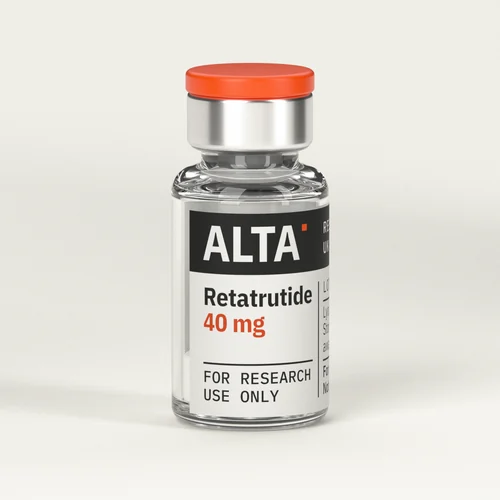
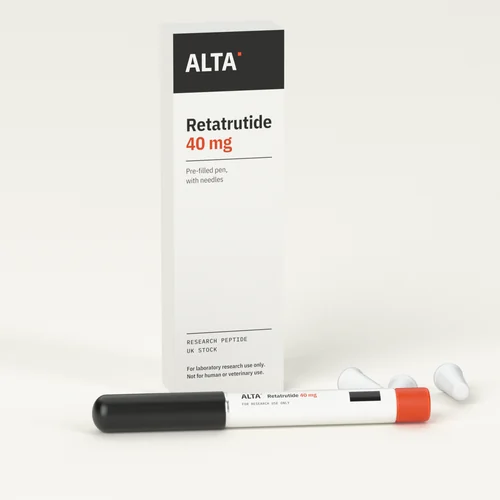
ALTA PEPTIDES does not stock survodutide or mazdutide. For lab research on glucagon-receptor pharmacology, retatrutide is the closest compound with a large published evidence base: it activates the same glucagon and GLP-1 receptors as the dual agonists, plus GIP, so it lets a lab study what glucagon agonism does inside a triple-receptor molecule. We hold retatrutide research vials (40 mg, £109.99) and a sealed retatrutide pen (£139.99), each retatrutide lot matched to a published certificate, for laboratory research only and not for human use.
Our retatrutide explainer covers its trials, muscle loss on GLP-1 peptides compares lean-mass data across the class, and our orforglipron guide covers the single-receptor GLP-1 pill at the other end of the spectrum.
Everything above is the quick version. The sections below go deeper.
How the glucagon balance is tuned
In shortThe pharmacology behind glucagon dual agonists.
Published trials and company announcements to November 2026.
The design problem in every glucagon-containing dual agonist is balance. Too much glucagon activity and blood sugar rises; too little and the liver benefit fades. Developers tune how strongly the molecule activates each receptor. Retatrutide, for example, is less potent than the natural hormones at the GLP-1 and glucagon receptors and more potent at GIP (Coskun et al., Cell Metabolism 2022). Survodutide's preclinical profile was described by Zimmermann et al. in Molecular Metabolism in 2022.
The idea is older than either drug: AstraZeneca's once-daily dual agonist cotadutide reported weight and blood sugar effects in type 2 diabetes in 2018 (Ambery et al., Lancet). GLP-1 receptors are scarce on liver cells themselves, which is why GLP-1-only drugs lower liver fat mainly through weight loss, while glucagon is thought to work on the liver directly.
The trial numbers in detail
In shortEvery trial figure, with its analysis method.
Which analysis a figure uses matters. The efficacy estimand counts people as if they had stayed on treatment; the treatment-policy (or treatment-regimen) estimand counts everyone randomised, so it is lower. Most company headlines use the first. SYNCHRONIZE-1's 16.6% and SYNCHRONIZE-2's 13.1% are efficacy-estimand figures. GLORY-1 gave 12.05% (4 mg) and 14.84% (6 mg) against 0.47% on the efficacy estimand, but 11.00% and 14.01% on the treatment-policy estimand. GLORY-2's 18.55% is Innovent's topline; the JAMA paper reported 16.7%. DREAMS-3 lowered HbA1c by 2.03 points against 1.84 for semaglutide. Cross-trial comparisons are never head-to-head.
Survodutide (BI 456906) clinical trial results in people with overweight or obesity
The two SYNCHRONIZE papers in the New England Journal of Medicine (2026) report the stricter treatment-regimen estimand, which counts every participant whether or not they stayed on once-weekly survodutide or placebo. In SYNCHRONIZE-1, a phase 3 clinical trial in 725 adults with obesity without diabetes, the mean percentage change in body weight from baseline to week 76 was minus 12.2% in the 3.6 mg survodutide group and minus 13.0% in the 6.0 mg group, against minus 5.4% on placebo. A body weight reduction of at least 5% was reached by 72.6%, 71.9% and 46.3%. The most common adverse events with survodutide were gastrointestinal, reported by 80.9% and 89.7% of the survodutide groups and 47.9% on placebo.
SYNCHRONIZE-2 enrolled 752 adults with type 2 diabetes and a BMI of 27 or more. Weight reduction at week 76 was 8.2% and 9.8% in the two survodutide groups against 3.9% on placebo, and glycated haemoglobin fell by 0.9 and 0.8 percentage points against 0.2. Both papers describe survodutide as an investigational medicine.
SYNCHRONIZE-CVOT: a study to test the effect of survodutide in obesity with cardiovascular disease
This global phase 3 trial was published in The Lancet in November 2026. It randomised 5,530 adults at 524 sites in 34 countries: people living with obesity or overweight, with a BMI of 27 or more and established cardiovascular disease, or at least two obesity complications or cardiovascular risk factors. The primary endpoint, a composite that included cardiovascular death, stroke, myocardial infarction and heart failure events, occurred in 3.7% of the pooled survodutide group and 4.1% of the placebo group. On efficacy and safety, nausea was reported by 48.0% and 49.0% of the two survodutide groups against 12.1% on placebo, and gastrointestinal events led 19.3% and 20.8% to stop treatment against 1.9%. Serious adverse events occurred at similar rates: 22.5%, 20.8% and 23.9%.
Liver fat, obesity and MASH: what the 2026 papers add
SYNCHRONIZE-MASLD (Nature Medicine, 2026) included 216 adults with obesity and at-risk metabolic dysfunction-associated steatotic liver disease, recruited in the United States and Spain, and compared survodutide and placebo for 48 weeks. On the treatment-regimen estimand, 68.5% of the survodutide group and 28.6% of the placebo group had a reduction in liver fat of at least 30%. A mediation analysis of the phase 2 MASH trial (Hepatology, 2026, 170 participants) estimated that weight reduction explained 36.3% of the improvement in fibrosis. The authors read the inflammation and fibrosis results as predominantly independent of weight reduction.
For mazdutide, Lilly's phase 2 trial in the United States (Lancet Diabetes and Endocrinology, 2026) randomised 179 adults with obesity or overweight and without type 2 diabetes at 24 centres. At 32 weeks the change in bodyweight was minus 7.3% on the 3 to 6 mg arm, minus 15.6% on the 10 mg arm and minus 18.1% on the 16 mg arm, against minus 0.9% on placebo. In the 16 mg arm, 20% of participants stopped treatment because of adverse events. These figures describe the cited studies. ALTA stocks neither compound and gives no guidance on human use.
How a glucagon and GLP-1 receptor dual agonist differs: the survodutide preclinical data
Boehringer Ingelheim scientists described survodutide's discovery and preclinical pharmacology, under the code BI 456906, in Molecular Metabolism in 2022 (Zimmermann et al.). It is an acylated peptide carrying a C18 fatty acid, a half-life extending feature intended to support once-weekly dosing in humans. In mice, pharmacological doses gave greater bodyweight reductions than maximally effective doses of the GLP-1 receptor agonist semaglutide, and the authors attributed this to increased energy expenditure as well as reduced food intake.
The paper checked each receptor in turn. GLP-1 receptor activity showed in glucose tolerance, food intake and gastric emptying tests. Glucagon receptor activity showed in liver nicotinamide N-methyltransferase mRNA and in circulating amino acids and fibroblast growth factor-21. Work in GLP-1 receptor knockout mice supported activity at both receptors. These are animal data; the human results are the trials described above.
Sources
- Boehringer Ingelheim. Survodutide achieved significant weight loss of 16.6% in people with obesity or overweight in Phase III trial (SYNCHRONIZE-1). Press release, 28 April 2026.
- le Roux CW, Wharton S, et al. Survodutide once weekly for the treatment of adults with obesity. New England Journal of Medicine, 2026.
- Kaplan LM, et al. Survodutide in adults with obesity and MASLD: SYNCHRONIZE-MASLD. Nature Medicine, 2026.
- Feliza Mirasol. Survodutide reduces visceral and liver fat in phase 3 obesity and MASLD trials. BioPharm International, 9 June 2026.
- Boehringer Ingelheim. Survodutide achieves up to 13.1% weight loss in new Phase III trial alongside significant improvements in glycaemic control (SYNCHRONIZE-2). Press release, 1 October 2026; reported by The Clinical Trial Vanguard, 2 October 2026.
- le Roux CW, et al. Glucagon and GLP-1 receptor dual agonist survodutide for obesity: a randomised, double-blind, placebo-controlled, dose-finding phase 2 trial. Lancet Diabetes and Endocrinology 2024;12(3):162-173.
- Sanyal AJ, et al. A phase 2 randomized trial of survodutide in MASH and fibrosis. New England Journal of Medicine 2024;391:311-319.
- Ji L, et al. Once-weekly mazdutide in Chinese adults with obesity or overweight (GLORY-1). New England Journal of Medicine 2025;392:2215-2225.
- Innovent Biologics. NMPA approvals of mazdutide for chronic weight management (press release, 27 June 2025) and for type 2 diabetes (September 2025).
- Innovent Biologics. Mazdutide 9 mg GLORY-2 study meets primary and all key secondary endpoints. Press release, November 2025; and Drug Topics, Mazdutide shows weight reductions for patients with obesity, 8 June 2026.
- Innovent Biologics. DREAMS-3 head-to-head trial of mazdutide versus semaglutide. Topline results, 26 October 2025; reported by HCPLive, 28 October 2025.
- Coskun T, et al. LY3437943, a novel triple glucagon, GIP, and GLP-1 receptor agonist. Cell Metabolism 2022;34:1234-1247.
- Ambery P, et al. MEDI0382, a GLP-1 and glucagon receptor dual agonist, in obese or overweight patients with type 2 diabetes. Lancet 2018;391:2607-2618.
- Jastreboff AM, et al. Tirzepatide once weekly for the treatment of obesity (SURMOUNT-1). NEJM 2022;387:205-216.
Questions people ask
What is survodutide?
Survodutide is an experimental once-weekly injectable peptide from Boehringer Ingelheim, licensed from Zealand Pharma, that activates both the GLP-1 and glucagon receptors. It has completed phase 3 obesity trials (SYNCHRONIZE) and is in phase 3 for the fatty liver disease MASH. It is not approved anywhere yet.
What is mazdutide?
Mazdutide is a once-weekly injectable glucagon/GLP-1 dual agonist, a long-acting analogue of the gut hormone oxyntomodulin. Eli Lilly discovered it (as LY3305677) and Innovent Biologics develops it in China (as IBI362), where it is approved as Xinermei for weight management and type 2 diabetes.
Is mazdutide approved?
Only in China. The NMPA approved it for chronic weight management on 27 June 2025 and for blood sugar control in type 2 diabetes in September 2025. It is not approved in the US, EU or UK.
How much weight do people lose on survodutide?
In SYNCHRONIZE-1, adults without diabetes lost up to 16.6% of their body weight on average after 76 weeks, against 3.2% on placebo, counting people who stayed on treatment. In SYNCHRONIZE-2, adults with type 2 diabetes lost up to 13.1% against 3.1%.
Survodutide vs retatrutide: what is the difference?
Both activate GLP-1 and glucagon receptors, but retatrutide also activates GIP, making it a triple agonist. On the published numbers retatrutide gave more weight loss: 28.3% at 80 weeks in TRIUMPH-1 against survodutide's 16.6% at 76 weeks in SYNCHRONIZE-1, from separate trials. Both reduce liver fat strongly.
Mazdutide vs tirzepatide: which is stronger?
There is no head-to-head trial. Tirzepatide gave 22.5% weight loss at 72 weeks in SURMOUNT-1 on its top arm, while mazdutide's 6 mg arm gave 14.8% at 48 weeks in GLORY-1, in Chinese adults with a lower starting weight. Mazdutide has beaten semaglutide 1 mg head to head in the DREAMS-3 diabetes trial.
What are the side effects of survodutide?
Mainly digestive: nausea, vomiting, diarrhoea and constipation, mostly mild to moderate and most common while the amount was being stepped up. Discontinuations were higher than with placebo; BioPharm International reported that 19.0% stopped survodutide because of digestive events in SYNCHRONIZE-1, against 2.9% on placebo.
Can you get survodutide or mazdutide in the UK?
No. Neither is authorised by the MHRA, so neither can be prescribed or sold as a medicine in the UK. The only legitimate access to survodutide is through clinical trials. ALTA PEPTIDES does not stock either compound.
Is survodutide better than tirzepatide?
No trial has tested survodutide versus tirzepatide directly. In separate phase 3 trials, tirzepatide's top arm gave 22.5% weight loss at 72 weeks in SURMOUNT-1 and survodutide's gave 16.6% at 76 weeks in SYNCHRONIZE-1. The participants and methods differed. Survodutide's distinguishing data are its effects on liver fat.
What is survodutide used for?
Nothing outside research yet. Survodutide is an investigational drug with no approved use. Boehringer Ingelheim is studying it in clinical trials for the treatment of obesity and of MASH, a liver disease, and a phase 3 trial in people with type 2 diabetes was recruiting on ClinicalTrials.gov on 16 November 2026.
How does survodutide compare with semaglutide?
The published comparison is a 16-week phase 2 trial in 413 people with type 2 diabetes (Diabetologia, 2024) with an open-label semaglutide arm. Bodyweight fell by up to 8.7% with survodutide against 5.3% in the semaglutide arm of that trial, and the fall in HbA1c was similar at a low survodutide dose. It was a short dose-finding study, not a phase 3 comparison.
Is a survodutide clinical trial still recruiting?
Yes. On 16 November 2026 ClinicalTrials.gov listed LIVERAGE and LIVERAGE-Cirrhosis as recruiting. Both are phase 3 studies to test whether survodutide helps people with a liver disease called MASH. The SYNCHRONIZE-1, SYNCHRONIZE-2 and cardiovascular trials were listed as completed.
Is survodutide licensed to Boehringer Ingelheim?
Yes. Zealand Pharma's release of 28 April 2026 states that survodutide is licensed to Boehringer Ingelheim from Zealand Pharma, and that Boehringer is solely responsible for its development and commercialisation globally. Zealand is eligible for high single to low double-digit percentage royalties on global sales and up to EUR 315 million in potential outstanding milestone payments.
Information, not advice. This article summarises published research; nothing here is guidance on human or veterinary use. Products are sold under our research use policy.