In this article17 sections
Drugs that copy amylin, a fullness hormone the pancreas releases with insulin after meals. Paired with GLP-1, as in Novo Nordisk's CagriSema, they produced about 23% average weight loss in trials. CagriSema's US decision is expected in late 2026; none is licensed in the UK yet.
Amylin is the hormone behind the next big step in weight-loss drugs. It is released by the pancreas with insulin after every meal and tells the brain you have had enough. Drug makers have spent two decades turning it into a weekly injection, and the first of these, Novo Nordisk's CagriSema, could be approved in the US within months. This guide explains what amylin does, which amylin drugs are coming, what their trials showed and where they stand in the UK.
- Amylin is a 37-amino-acid hormone made by the same pancreatic beta cells as insulin and released with it after meals. It signals fullness through the brainstem and slows how fast the stomach empties.
- The first amylin drug, pramlintide (Symlin), was approved by the US FDA in March 2005 for diabetes. It has to be injected with meals because it lasts only a few hours.
- Cagrilintide is Novo Nordisk's long-acting amylin analogue, designed for once-weekly injection. CagriSema combines it with semaglutide in one injection.
- In REDEFINE 1 (3,417 adults, 68 weeks), people who stayed on CagriSema lost 22.7% of their body weight on average, against 16.1% on semaglutide alone, 11.8% on cagrilintide alone and 2.3% on placebo.
- Novo Nordisk filed CagriSema with the US FDA in December 2025. In November 2026 it said it expected a US decision in the fourth quarter of 2026 and a US launch at the start of 2027.
- Lilly's eloralintide produced 9.5% to 20.1% weight loss at 48 weeks in a 263-person trial published in The Lancet in November 2025. Combined with tirzepatide (EloraTZP), it produced up to 23.3% at 48 weeks.
- Petrelintide, from Zealand Pharma and Roche, produced up to 10.7% weight loss at 42 weeks in the ZUPREME-1 phase 2 trial, with tolerability Roche described as similar to placebo.
- No amylin-based weight-loss drug is licensed by the MHRA, and none is available on the NHS or from UK pharmacies as of November 2026.
What is amylin?
In shortA fullness hormone released with insulin after meals.
The same cells that make insulin.
Both rise when you eat.
Signals the brainstem to stop eating sooner.
Food leaves the stomach more slowly; blood sugar rises less.
Summary of the actions described in this section.
Amylin is a small hormone, 37 amino acids long, made by the beta cells of the pancreas. These are the same cells that make insulin, and the two hormones are released together when you eat. Insulin moves sugar out of the blood; amylin works on appetite and digestion.
Amylin does three main things. It signals fullness to the brainstem, so you stop eating sooner. It slows how quickly food leaves the stomach. And it holds back glucagon, the hormone that raises blood sugar after a meal. People with type 1 diabetes make almost no amylin, and many people with type 2 diabetes make less than normal.
How do amylin agonists work?
In shortThey copy amylin's fullness signal, but last days instead of minutes.
- 01Meal
Food arrives; blood sugar starts to rise.
- 02Beta cells
The pancreas releases insulin and amylin together.
- 03Brainstem
Amylin acts on the area postrema, a fullness centre.
- 04Stomach
Emptying slows, so fullness lasts longer.
- 05Result
Less food eaten; less glucagon after the meal.
Simplified. Amylin agonists copy this signal and last days instead of minutes.
An agonist is a molecule that switches a receptor on. Amylin agonists switch on the amylin receptor, copying the natural hormone. They reach appetite centres in the brainstem, including an area called the area postrema, which sits partly outside the blood-brain barrier and can sense hormones in the blood directly.
Natural amylin is hard to use as a drug. It lasts only minutes in the blood and it clumps into sticky fibres. So every amylin drug is an engineered analogue: a modified version that stays dissolved and lasts much longer. Newer analogues such as cagrilintide carry a fatty-acid chain that binds to a blood protein called albumin, which stretches their action to about a week.
Amylin also works through a different route from , the hormone copied by semaglutide and tirzepatide. That is why drug makers are combining the two: two separate fullness signals may add up to more weight loss than either alone.
Which amylin drugs are in development?
In shortFive main candidates; CagriSema is furthest ahead.
Swipe the table to compare →
| Company | Acts on | Where it stands | |
|---|---|---|---|
| CagriSema | Novo Nordisk | Amylin + GLP-1 (two drugs) | Filed with FDA, Dec 2025 |
| Cagrilintide | Novo Nordisk | Amylin | Phase 3 (RENEW) |
| Eloralintide | Eli Lilly | Amylin | Phase 3 (ENLIGHTEN) |
| EloraTZP | Eli Lilly | Amylin + GLP-1 + GIP (two drugs) | Phase 3 planned |
| Amycretin | Novo Nordisk | Amylin + GLP-1 (one molecule) | Phase 3 (AMAZE) |
| Petrelintide | Zealand / Roche | Amylin | Phase 2 complete |
| Pramlintide | (Symlin) | Amylin | US approved 2005, diabetes |
Company announcements to November 2026. Statuses change; check the latest filings.
Tap an amylin drug
Cagrilintide plus semaglutide in one weekly injection. REDEFINE 1: 22.7% average weight loss at 68 weeks (20.4% counting everyone). Filed with the FDA in December 2025; Novo expects a US decision in Q4 2026.
Lilly's weekly amylin agonist. Phase 2: 9.5% to 20.1% at 48 weeks against 0.4% on placebo (The Lancet, November 2025). Now in the ENLIGHTEN programme.
Eloralintide added to tirzepatide. Up to 23.3% at 48 weeks in 367 adults with type 2 diabetes, against 14.8% on tirzepatide alone (EASD, September 2026). 10.8% to 27.0% stopped for side effects.
Zealand Pharma and Roche. ZUPREME-1: up to 10.7% at 42 weeks, with tolerability described as similar to placebo. Aimed at a gentler, stand-alone option.
One Novo molecule acting on amylin and GLP-1 receptors. Up to 24.3% at 36 weeks in a phase 1b/2a trial (The Lancet, 2025). Also named zenagamtide; AMAZE phase 3 began in 2026.
The first amylin drug, approved in the US in 2005 for diabetes. Short-acting, so injected with meals. Proved the idea; the weekly analogues solved its main limit.
Interactive. Figures from the sources at the end of this article.
Five names matter in 2026. Cagrilintide is Novo Nordisk's long-acting amylin analogue. CagriSema is Novo's combination of cagrilintide and semaglutide in one weekly injection, and is the furthest ahead. Eloralintide is Eli Lilly's amylin agonist, now in phase 3. Petrelintide comes from Zealand Pharma, developed with Roche since 2025. Amycretin, which Novo's 2026 filings also call zenagamtide, is a single molecule that acts on both the amylin and GLP-1 receptors.
They take two approaches. Some pair an amylin drug with a GLP-1 drug (CagriSema, and Lilly's EloraTZP, which adds eloralintide to tirzepatide). Others put both actions into one molecule (amycretin). Celltrion's experimental CT-G32 goes further still, building GLP-1, , glucagon and amylin activity into one molecule, though it has only been tested in animals.
What did the CagriSema trials show?
In short22.7% average weight loss at 68 weeks in REDEFINE 1.
People who stayed on treatment (efficacy estimand). Counting everyone who started: CagriSema 20.4%, placebo 3.0%. Garvey et al., NEJM 2025.
CagriSema's main trial, REDEFINE 1, followed 3,417 adults with obesity or overweight for 68 weeks. People who stayed on CagriSema lost 22.7% of their body weight on average. Those on semaglutide alone lost 16.1%, those on cagrilintide alone 11.8% and those on placebo 2.3%. Counting everyone who started, whether or not they stayed on treatment, the figure for CagriSema was 20.4% against 3.0% on placebo.
REDEFINE 2 tested CagriSema in adults with type 2 diabetes, who usually lose less weight on these drugs. They lost 15.7% against 3.1% on placebo. In REIMAGINE 4, a direct comparison reported in Novo's 2026 half-year results, CagriSema produced 15.2% weight loss against 15.8% for tirzepatide. It met the test for being no worse on weight, but not on blood-sugar control (HbA1c).
Those results put CagriSema ahead of semaglutide. Against tirzepatide the evidence is mixed: in REDEFINE 4, a head-to-head trial in adults with obesity reported in February 2026, CagriSema gave 23.0% weight loss at 84 weeks against 25.5% for tirzepatide and did not meet its test for being no worse. It remains behind retatrutide. Our retatrutide, tirzepatide and semaglutide comparison sets out those trials.
What is eloralintide?
In shortLilly's amylin agonist: up to 20.1% alone, 23.3% with tirzepatide.
Highest arm in each trial; different trials, lengths and people, so not a head-to-head comparison. Company releases and journal papers listed in the sources.
Eloralintide is Eli Lilly's amylin agonist, given as a weekly injection. In a phase 2 trial of 263 adults without diabetes, published in The Lancet in November 2025, every group lost weight. Average losses at 48 weeks ranged from 9.5% to 20.1%, the highest in the 9 mg arm, against 0.4% on placebo.
Lilly is also testing eloralintide with tirzepatide, its own GLP-1 and GIP drug, under the name EloraTZP. At the European diabetes meeting (EASD) in Milan on 30 September 2026, a phase 2 trial in 367 adults with type 2 diabetes reported up to 23.3% weight loss at 48 weeks, against 14.8% for tirzepatide alone. The cost was tolerability: between 10.8% and 27.0% of people in the combination arms stopped because of side effects. Eloralintide alone is now in a phase 3 programme called ENLIGHTEN.
Petrelintide and amycretin
In shortA gentler stand-alone option, and a one-molecule GLP-1 and amylin drug.
Petrelintide, from Zealand Pharma and Roche, is being developed as an amylin drug that could be used on its own, with a focus on gentler side effects. In the ZUPREME-1 phase 2 trial of 493 people, reported in March 2026, it produced up to 10.7% weight loss at 42 weeks against 1.7% on placebo, with tolerability Roche described as similar to placebo. ZUPREME-2, in 220 people with type 2 diabetes, reported up to 9.2% at 28 weeks in October 2026.
Amycretin takes the single-molecule route: one peptide that switches on both the amylin and GLP-1 receptors. In a phase 1b/2a trial published in The Lancet in 2025, it produced up to 22.0% weight loss at 36 weeks in the 20 mg arm and 24.3% in the 60 mg arm. Novo started its AMAZE phase 3 programme in 2026, and its 2026 filings use the new name zenagamtide.
Do amylin drugs give better quality weight loss?
In shortHoped for, but not shown in the scans so far.
Share of weight lost that was fat, DXA scans in 252 people. European Congress on Obesity, 12 May 2026. The rest is lean mass: muscle, water, organs and bone.
ClaimAmylin drugs protect muscleTap to check
In REDEFINE 1 scans, fat was 66.9% of weight lost on CagriSema and 69.7% on semaglutide alone. No clear muscle advantage.
ClaimCagriSema beats tirzepatideTap to check
REDEFINE 4 (obesity): 23.0% on CagriSema against 25.5% on tirzepatide, non-inferiority not met. REIMAGINE 4 (type 2 diabetes): 15.2% against 15.8%.
ClaimAmylin alone causes less nauseaTap to check
Petrelintide's ZUPREME-1 tolerability was described as similar to placebo. Combinations still cause frequent nausea.
ClaimYou can get CagriSema in the UKTap to check
No MHRA licence as of November 2026. Products sold online under the name are unlicensed and unverifiable.
Interactive. Tap a claim to see what the trials say.
That is one of the hopes for amylin, but the evidence does not show it yet. The idea is that amylin might help keep more muscle while fat is lost. A body-composition study from REDEFINE 1, presented at the European Congress on Obesity on 12 May 2026, scanned 252 people. Fat made up 66.9% of the weight lost on CagriSema, 69.7% on semaglutide alone and 62.9% on cagrilintide alone.
In other words, adding amylin did not clearly improve the share of weight lost as fat. also includes water, organs and bone, so these scans do not measure muscle directly. Our article on muscle loss on GLP-1 drugs covers what the scans can and cannot show.
What side effects do amylin drugs cause?
In shortMainly nausea and other digestive effects, like GLP-1 drugs.
Share of people reporting each, 68 weeks. Mostly mild to moderate. Garvey et al., NEJM 2025.
Mostly the same digestive effects as GLP-1 drugs. In REDEFINE 1, 79.6% of people on CagriSema reported gastrointestinal side effects against 39.9% on placebo, and 55% reported nausea against 12.6%. These were usually mild to moderate and most common while the amount given was being stepped up.
Amylin drugs on their own appear gentler. Petrelintide's ZUPREME-1 results were described as close to placebo for tolerability, which is the reason Zealand and Roche are developing it as a possible stand-alone option. Combinations are harder: the EloraTZP arms had high stopping rates.
Are cagrilintide and other amylin drugs available in the UK?
In shortNo. None has an MHRA licence yet.
No NICE appraisal; no licence.
No MHRA licence for any amylin weight-loss drug.
Phase 3 programmes recruit in several countries.
No reference product to test it against.
Status as of 9 November 2026.
No. No amylin-based weight-loss drug has an MHRA licence as of November 2026, so none is available on the NHS or from UK pharmacies. The original amylin drug, pramlintide, was approved in the US in 2005 but does not appear to have been licensed in the UK or Europe.
CagriSema is the most likely to arrive first. After a US decision, expected in late 2026, Novo would need a separate MHRA licence, and NHS use would then need a NICE appraisal. Products sold online as "cagrilintide" or "CagriSema" are unlicensed, and there is no manufacturer reference to test them against. Our guide to UK peptide law explains the difference between licensed medicines and research compounds.
Cagrilintide vs retatrutide: where the research link is
In shortTwo routes to the same goal, and what ALTA stocks for research.
Amylin agonists and retatrutide come at the same problem from different directions. Cagrilintide adds a second fullness signal, amylin, to GLP-1. Retatrutide, Eli Lilly's triple agonist, adds GIP and glucagon instead, raising energy use as well as cutting appetite. On published numbers retatrutide produced more weight loss, 28.3% at 80 weeks in TRIUMPH-1, though no trial has compared the two directly.
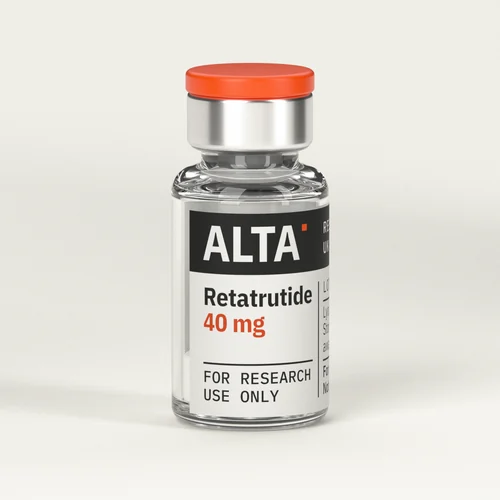
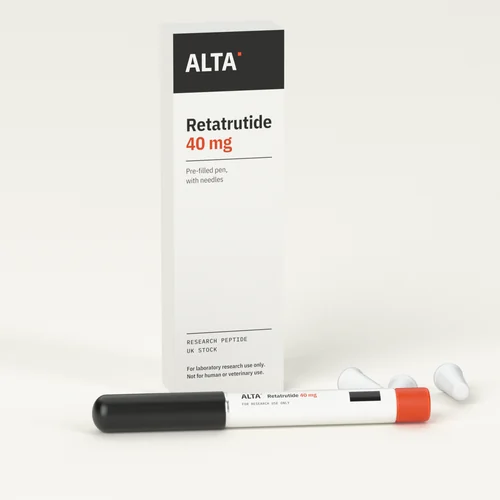
ALTA PEPTIDES does not stock cagrilintide or any amylin analogue. For laboratory research on multi-receptor incretin pharmacology, the most-studied compound is retatrutide, which has five completed phase 3 trials. We hold retatrutide research vials (40 mg, £109.99) and a sealed manufacturer retatrutide pen (40 mg, £139.99), each with a published certificate for its lot, for laboratory research only. Our retatrutide explainer covers its trials.
Everything above is the quick version. The sections below go deeper.
Pramlintide: the first amylin drug
In shortHow amylin became a medicine in 2005.
Pramlintide (Symlin) showed that amylin could be made into a medicine. Approved by the FDA in March 2005, it is an analogue of human amylin with three amino acids swapped for proline, at positions 25, 28 and 29, borrowed from rat amylin, which does not clump. That change keeps it dissolved, but it still lasts only a few hours, so it has to be injected with each meal alongside insulin.
That short action limited its use. The newer analogues solve it with a fatty-acid chain that rides on albumin in the blood, giving weekly action. Cagrilintide's phase 2 trial, published in The Lancet in 2021, showed 10.8% weight loss at 26 weeks against 9.0% for liraglutide, the first sign that a long-acting amylin drug could compete with GLP-1 on its own.
Amylin drugs: the timeline
In shortEvery key date, in order.
- 2005Pramlintide
First amylin drug, approved in the US for diabetes.
- 2021Cagrilintide phase 2
10.8% at 26 weeks, The Lancet.
- Dec 2024REDEFINE 1 topline
CagriSema 22.7% at 68 weeks.
- Nov 2025Eloralintide phase 2
Up to 20.1% at 48 weeks, The Lancet.
- Dec 2025CagriSema filed
New Drug Application to the US FDA.
- Sep 2026EloraTZP
Up to 23.3% at 48 weeks, EASD.
- Q4 2026Expected US decision
Novo's stated timing for CagriSema.
Company announcements and journal papers listed in the sources.
March 2005: pramlintide approved in the US. 2021: cagrilintide phase 2 results in The Lancet. December 2024: REDEFINE 1 topline results. June 2025: REDEFINE 1 published in the New England Journal of Medicine. November 2025: eloralintide phase 2 in The Lancet. December 2025: CagriSema filed with the FDA. March 2026: petrelintide ZUPREME-1 results. May 2026: REDEFINE 1 body-composition data. September 2026: EloraTZP results at EASD. Fourth quarter of 2026: expected US decision on CagriSema.
Cagrilintide mechanism of action: amylin and calcitonin receptors
The development of cagrilintide was set out by Novo Nordisk chemists in the Journal of Medicinal Chemistry in 2021 (Kruse and colleagues, J Med Chem). Human amylin, a peptide with a disulfide bridge between the cysteines at positions 2 and 7 (J Med Chem, 2025), forms amyloid fibrils, and the older analogue pramlintide needs three injections a day because of its short half-life. Cagrilintide is the stable, lipidated analogue that work selected for the treatment of obesity, and the paper noted it had induced significant weight loss in early trials, alone or with semaglutide.
Its mechanism of action is agonism at two related targets. A peer-reviewed 2024 paper in the same journal states that cagrilintide binds both the amylin receptors and the calcitonin receptor. The two are linked: an amylin receptor is a calcitonin receptor paired with one of three accessory proteins. In a phase 1b trial of 95 adults (The Lancet, 2021), cagrilintide had a half-life of 159 to 195 hours, about a week. Novo Nordisk's releases call it a 'long-acting amylin analog'.
Cagrilintide and semaglutide doses in clinical trials
The trial of cagrilintide alone was a multicentre, double-blind, placebo-controlled and active-controlled, dose-finding phase 2 study (Lau and colleagues, The Lancet, 2021). The trial assigned 706 adults without diabetes to once-weekly cagrilintide at 0.3, 0.6, 1.2, 2.4 or 4.5 mg, once-daily liraglutide 3.0 mg, or placebo, for 26 weeks. The reduction in body weight was 6.0% to 10.8% across the cagrilintide arms, against 3.0% in the placebo group. Gastrointestinal adverse events were reported by 41% to 63% on cagrilintide and 32% on placebo.
REDEFINE 1, a phase 3a clinical trial, gave 2.4 mg of each drug once weekly. A trial of lower strengths has now reported. On 14 November 2026 Novo Nordisk announced REDEFINE 9, a 68-week trial of the efficacy and safety of CagriSema at 1.7 mg and 1.0 mg of each component in 309 adults, published in The Lancet Diabetes and Endocrinology. Novo reported weight reduction of 20.7% and 21.0% if all participants stayed on treatment, against 2.0% on placebo, or 19.4% and 18.6% against 4.6% counting everyone. The same release states that a US decision is still expected in the fourth quarter of 2026 and that CagriSema is not approved in the United States.
These figures describe the cited studies. ALTA does not stock cagrilintide and gives no guidance on human use.
The cagrilintide papers: who ran each study
The cagrilintide evidence rests on a short list of papers. The six trials below were funded by Novo Nordisk, and each was built to randomise participants between the study drug and placebo or an active comparator. Author names follow the PubMed records.
- Phase 1b. Enebo, Berthelsen, Kankam, Lund, Rubino, Satylganova and Lau published 'Safety, tolerability, pharmacokinetics, and pharmacodynamics of concomitant administration of multiple doses of cagrilintide with semaglutide 2.4 mg for weight management' in The Lancet in 2021, a trial run at a single centre in the USA.
- Dose-finding phase 2. Lau, Erichsen, Francisco, Satylganova, le Roux, McGowan, Pedersen, Pietiläinen, Rubino and Batterham published 'Once-weekly cagrilintide for weight management in people with overweight and obesity' in The Lancet in 2021. It ran at 57 sites in ten countries, the UK among them.
- Phase 2 in type 2 diabetes. Frias, Deenadayalan, Erichsen, Knop, Lingvay, Macura, Mathieu, Pedersen and Davies published 'Efficacy and safety of co-administered once-weekly cagrilintide 2.4 mg with once-weekly semaglutide 2.4 mg in type 2 diabetes' in The Lancet in 2023, a trial at 17 sites in the USA.
- REDEFINE 1, phase 3a. Garvey, Blüher, Osorto Contreras, Davies and colleagues published 'Coadministered Cagrilintide and Semaglutide in Adults with Overweight or Obesity' in the New England Journal of Medicine in 2025, for the REDEFINE 1 Study Group.
- REDEFINE 2, phase 3a. Davies, Bajaj, Broholm, Eliasen, Garvey, le Roux, Lingvay and colleagues published 'Cagrilintide-Semaglutide in Adults with Overweight or Obesity and Type 2 Diabetes' in the same journal in 2025. It assigned 1,206 patients in 12 countries.
- REIMAGINE 2, phase 3. Buse, Bajaj, Dalskov, Donaldson and colleagues published 'Cagrilintide-semaglutide (CagriSema) versus semaglutide or cagrilintide in people with type 2 diabetes (REIMAGINE 2)' in The Lancet Diabetes and Endocrinology in 2026. It assigned 2,713 people in 30 countries, 152 of them to cagrilintide alone.
- Review. D'Ascanio, Mullally and Frishman, of New York Medical College, published 'Cagrilintide: A Long-Acting Amylin Analog for the Treatment of Obesity' in Cardiology in Review in 2024. It argues that an amylin analogue and a GLP-1 receptor agonist reduce appetite through separate but related mechanisms, and that the effects appear to add together.
- Pooled analysis. Dutta, Nagendra, Harish, Sharma, Joshi, Hathur and Kamrul-Hasan published 'Efficacy and Safety of Cagrilintide Alone and in Combination with Semaglutide (Cagrisema) as Anti-Obesity Medications: A Systematic Review and Meta-Analysis' in the Indian Journal of Endocrinology and Metabolism in 2024.
This list describes published papers. ALTA does not stock cagrilintide and gives no guidance on human use.
Sources
- Garvey WT, et al. Coadministered cagrilintide and semaglutide in adults with overweight or obesity (REDEFINE 1). New England Journal of Medicine, June 2025.
- Davies MJ, et al. Cagrilintide and semaglutide in adults with overweight or obesity and type 2 diabetes (REDEFINE 2). New England Journal of Medicine, June 2025.
- Novo Nordisk. CagriSema demonstrates superior weight loss in adults with obesity or overweight in the REDEFINE 1 trial. Company announcement, 20 December 2024.
- Novo Nordisk. Novo Nordisk files for FDA approval of CagriSema. Company announcement, 18 December 2025; Q3 2026 investor presentation, 4 November 2026; half-year report 2026 (REIMAGINE 4).
- REDEFINE 1 body-composition analysis. European Congress on Obesity, 12 May 2026.
- Lau DCW, et al. Once-weekly cagrilintide for weight management in people with overweight and obesity. The Lancet, 2021.
- Eli Lilly and Company. Eloralintide phase 2 results in adults with obesity or overweight. Press release, 6 November 2025; published in The Lancet.
- Eli Lilly and Company. EloraTZP, the combination of eloralintide and tirzepatide, phase 2 results. Press release, 30 September 2026 (EASD, Milan).
- Roche. Petrelintide ZUPREME-1 phase 2 results. Press release, 5 March 2026. Zealand Pharma. ZUPREME-2 results. Company announcement, 7 October 2026.
- Amycretin phase 1b/2a results. The Lancet, 2025. Novo Nordisk. Annual Report 2025 and 2026 company filings.
- US Food and Drug Administration. Symlin (pramlintide acetate) approval, March 2005.
Questions people ask
What is amylin?
Amylin is a hormone made by the beta cells of the pancreas, the same cells that make insulin, and released with insulin after you eat. It tells the brain you are full, slows how fast the stomach empties and holds back glucagon after meals. People with type 1 diabetes make almost none, and people with type 2 diabetes often make less.
What is an amylin agonist?
An amylin agonist is a drug that switches on the amylin receptor, copying the natural hormone. Natural amylin breaks down in minutes and clumps together, so the drugs are engineered analogues that stay stable and last longer. Cagrilintide, eloralintide and petrelintide are amylin agonists; amycretin acts on both the amylin and GLP-1 receptors.
What is cagrilintide?
Cagrilintide is Novo Nordisk's long-acting amylin analogue, built to last about a week so it can be injected once weekly. On its own it produced 11.8% average weight loss at 68 weeks in REDEFINE 1. It is best known as one half of CagriSema, alongside semaglutide.
What is CagriSema?
CagriSema is Novo Nordisk's combination of cagrilintide (amylin) and semaglutide (GLP-1) in one weekly injection. In REDEFINE 1 it produced 22.7% average weight loss at 68 weeks in people who stayed on treatment, or 20.4% counting everyone who started. It was filed with the US FDA in December 2025.
When will CagriSema be approved?
Novo Nordisk said in November 2026 that it expects a US FDA decision in the fourth quarter of 2026 and a US launch at the start of 2027. It is not approved anywhere yet. A UK licence would need a separate MHRA decision, and NHS use a NICE appraisal after that.
Is CagriSema available in the UK?
No. CagriSema has no MHRA licence and is not sold by UK pharmacies. Anything offered online as CagriSema or cagrilintide is unlicensed and its contents cannot be checked against the manufacturer's product.
Is cagrilintide better than retatrutide?
On the published numbers, retatrutide produced more weight loss: 28.3% at 80 weeks in TRIUMPH-1, against 11.8% for cagrilintide alone and 22.7% for CagriSema at 68 weeks in REDEFINE 1. The trials were separate, so this is a rough comparison, not a head-to-head result. Neither is licensed in the UK.
What is eloralintide?
Eloralintide is Eli Lilly's amylin receptor agonist, given once weekly. In phase 2 it produced 9.5% to 20.1% weight loss at 48 weeks, against 0.4% on placebo, and it is now in the ENLIGHTEN phase 3 programme. Lilly is also testing it combined with tirzepatide as EloraTZP.
What is amycretin?
Amycretin is a single Novo Nordisk molecule that switches on both the GLP-1 and amylin receptors, rather than combining two drugs. In a phase 1b/2a trial it produced up to 24.3% weight loss at 36 weeks. Novo's 2026 filings also use the new name zenagamtide, and its AMAZE phase 3 programme began in 2026.
Do amylin drugs protect muscle?
Not clearly, on the evidence so far. In a REDEFINE 1 body-composition study presented in May 2026, fat made up 66.9% of the weight lost on CagriSema, 69.7% on semaglutide and 62.9% on cagrilintide. Better 'quality' of weight loss remains a hypothesis, not a shown result.
Is amylin a peptide?
Yes. The amylin peptide is a hormone 37 amino acids long, made by the beta cells of the pancreas and released with insulin after meals. Drugs such as cagrilintide are engineered analogues of it, built to stay dissolved and to last about a week rather than minutes.
Which next-generation obesity drugs are closest to approval?
Of the next-generation weight loss drugs covered here, CagriSema is furthest ahead: it was filed with the US FDA in December 2025, with a decision expected in the fourth quarter of 2026. Eloralintide and amycretin are in phase 3 and petrelintide has completed phase 2. None is licensed in the UK.
What is cagrilintide peptide used for?
It has no licensed use, as a weight loss treatment or otherwise. Cagrilintide is an investigational medicine tested in clinical trials for weight management in adults with overweight or obesity, mostly combined with semaglutide as CagriSema. Anything sold online as a cagrilintide research peptide is unlicensed.
Is cagrilintide better than semaglutide?
The trials were built to test the combination, not to rank the two. In the REDEFINE 1 trial, people who stayed on treatment lost 11.8% of body weight on cagrilintide alone and 16.1% on semaglutide alone, each at 2.4 mg once weekly. In a 2023 phase 2 trial of the efficacy and safety of cagrilintide with semaglutide in 92 adults with type 2 diabetes (The Lancet), weight fell 8.1% on cagrilintide and 5.1% on semaglutide, while HbA1c fell 0.9 points on cagrilintide and 1.8 on semaglutide.
Has cagrilintide been tested on its own?
Yes, in trials. The 2021 phase 2 trial tested once-weekly cagrilintide alone at five dose levels, and REDEFINE 1 had a cagrilintide-only arm of 302 participants. ClinicalTrials.gov also lists RENEW 1, a phase 3 trial of cagrilintide alone in people with overweight or obesity, as active in November 2026.
Does cagrilintide keep amylin's disulfide bridge?
Yes, according to a 2025 structural paper in Nature Communications (Cao and colleagues). Its sequence alignment records a disulfide bridge between cysteines 2 and 7 of the amylin-based peptides, the group cagrilintide belongs to, and notes that all the peptides shown are amidated at the C-terminus. The same paper describes cagrilintide as built on the pramlintide backbone and acylated at the N-terminus with a C20 fatty diacid on a gamma-glutamic acid linker.
Does receptor balance matter for amylin agonists?
That question is the title of a 2022 paper by Larsen, Mohamed, Sonne and colleagues in Biomedicine and Pharmacotherapy. They compared cagrilintide with KBP-336, a salmon calcitonin-based peptide, in rats. Both activated the amylin and calcitonin receptors. KBP-336 was biased towards the calcitonin receptor, and its highest dose was superior to cagrilintide for weight loss in rats fed a high-fat diet. This is animal data, and all the authors were employed by Nordic Bioscience.
What did the pooled analysis of cagrilintide trials find?
Dutta and colleagues (2024) pooled 3 randomised trials involving 430 people. In those trials, at 26 to 32 weeks, weight loss on cagrilintide 2.4 mg was similar to that on semaglutide or liraglutide, with significantly less vomiting. CagriSema gave greater weight loss than semaglutide alone at 20 to 32 weeks, with more gastrointestinal adverse events. The analysis covers short trials and was published before REDEFINE 1 reported.
Information, not advice. This article summarises published research; nothing here is guidance on human or veterinary use. Products are sold under our research use policy.