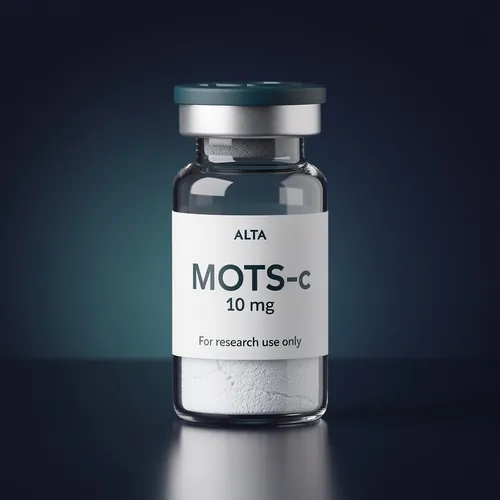
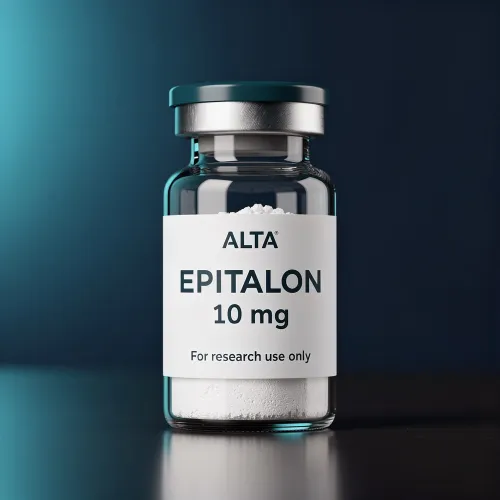
MOTS-c and epitalon are the two compounds in our longevity and cellular category, and they could hardly be more different in origin. One was discovered in 2015 by a group at the University of Southern California looking inside the mitochondrial genome for hidden genes. The other was synthesised in St Petersburg in the 1980s as a defined replacement for a crude extract of calf pineal gland. This article explains what each is, what the research base looks like, and where each stands. It is a summary for laboratory purposes; neither is licensed for any use in people.
What is MOTS-c?
MOTS-c stands for mitochondrial open reading frame of the 12S rRNA type-c. It is a 16-amino-acid peptide, sequence MRWQEMGYIFYPRKLR, encoded by a short open reading frame inside the 12S ribosomal RNA gene of mitochondrial DNA, a region that was assumed to be non-coding. Changhan Lee and Pinchas Cohen's group reported it in Cell Metabolism in 2015 as a mitochondrial-derived peptide that is expressed in tissues, circulates in plasma, and declines with age.
The reported mechanism is metabolic. In mouse skeletal muscle MOTS-c activates AMP-activated protein kinase (AMPK), the cellular energy sensor, through inhibition of the folate cycle and accumulation of AICAR, an AMPK activator. In the 2015 study, treated mice on a high-fat diet gained less weight and maintained insulin sensitivity. In a 2021 paper in Nature Communications the same group showed that MOTS-c translocates to the nucleus under metabolic stress and regulates nuclear gene expression, and that treated old mice showed improved physical performance in a running test, which is where the "exercise mimetic" description comes from. Plasma MOTS-c has been reported to rise after exercise in humans.
A synthetic analogue, CB4211, was taken into a phase 1 trial by CohBar in 2019 to 2021 for non-alcoholic steatohepatitis and obesity; the company reported preliminary signals and the programme did not proceed further after the company merged. There is no licensed product.
What is epitalon?
Epitalon (also epithalon or epitalone) is the tetrapeptide Ala-Glu-Asp-Gly, mass 390.4 g/mol. It was designed by Vladimir Khavinson's group at the St Petersburg Institute of Bioregulation and Gerontology as a synthetic version of the active component of epithalamin, a polypeptide extract of the bovine pineal gland that had been used in Soviet gerontology since the 1970s.
The claims made for it are large and the evidence is narrow. The most-cited finding is that epitalon induced telomerase activity and telomere elongation in cultured human somatic cells, reported by the same group in 2003. Rodent and fruit-fly studies from the group report extended lifespan, normalised melatonin rhythms and reduced tumour incidence. A number of small human studies of epithalamin, not epitalon, in elderly Russian patients reported reductions in mortality over long follow-up. Almost all of this work comes from one institute, much of it in Russian-language journals, and independent replication of the telomerase finding in particular has not been published in a major international journal.
How the two compare
MOTS-c has a clear molecular origin (a defined mitochondrial gene), a characterised mechanism (AMPK activation), replication across several groups, and an industry-sponsored phase 1 trial of an analogue. Epitalon has a defined chemistry but a mechanism that rests on a small number of papers from a single group and no independent trial. Both are in the longevity category because ageing is what their research programmes were about, not because either has been shown to affect ageing in people.
In the laboratory
MOTS-c is supplied in 40 mg sealed vials; formula C101H152N28O22S, mass 2174.6 g/mol; it contains methionine and tryptophan, so keep it cold and dark. Epitalon is supplied in 100 mg vials; formula C14H22N4O9; it is a short, very stable, acidic peptide that dissolves readily. Both are 99% or better by HPLC with per-lot mass spectrometry, and both are stored and reconstituted as described in our storage and reconstitution guides. Research use only under our research use policy.