In this article12 sections
A tiny peptide, 16 amino acids long, made by your mitochondria, the cell's power plants. In mice it helps muscle burn fuel, protects against weight gain on a fatty diet and keeps old mice fitter. Exercise raises it in people. It has never been tested as a treatment in a human trial, and it's banned in sport.
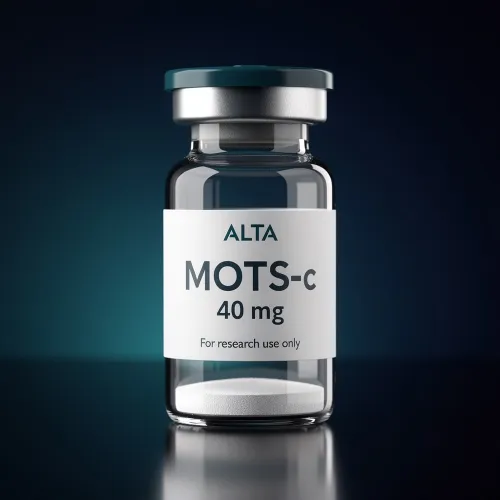
MOTS-c is a small peptide, just 16 amino acids long, that your body makes in an unusual place: inside the mitochondria, the tiny power plants in every cell. It was found in 2015 by scientists looking for hidden genes in mitochondrial DNA, and it has since become one of the most-searched peptides in the longevity category. This article explains what it is, what the research in cells, mice and people has shown, and where it stands legally. It describes published research only; there is no licensed use in people, and ALTA PEPTIDES supplies MOTS-c for laboratory research only.
- MOTS-c is a 16-amino-acid peptide (MRWQEMGYIFYPRKLR) encoded in mitochondrial DNA, inside the 12S rRNA gene. It was reported by Pinchas Cohen and Changhan Lee's group at the University of Southern California in 2015.
- In mice it switches on AMPK, the cell's energy sensor, mainly in skeletal muscle, and protected against obesity and insulin resistance on a high-fat diet.
- Under stress it moves into the cell nucleus and changes the activity of stress-response and antioxidant genes (Cell Metabolism, 2018).
- Exercise raises MOTS-c in human muscle and blood; in mice, treatment started late in life improved physical capacity (Nature Communications, 2021).
- There is no licensed MOTS-c product. The only human trial was of an analogue, CB4211: a phase 1a in 65 healthy volunteers followed by a four-week phase 1b in 20 people with obesity and fatty liver; the programme ended when its developer, CohBar, wound down in 2023.
- MOTS-c is named on the WADA Prohibited List under S4.4.1 (AMPK activators) and has been since 2024.
What does MOTS-c do?
In shortIn mice, it tells muscle to burn more fuel. That protected them from weight gain on a fatty diet.
- 01MOTS-c
Made from a gene inside mitochondria
- 02A cell cycle slows
The folate cycle, in muscle
- 03A switch molecule builds up
Called AICAR
- 04Energy sensor on
AMPK: tells muscle to burn fuel
In mice.
In mice, including with age.
Treated late in life.
Lee et al., Cell Metabolism 2015; Reynolds et al., Nature Communications 2021.
In cells and in mice, MOTS-c acts as a signal about energy. It switches on AMPK, the enzyme that tells a cell it is short of fuel and should burn more, and it does this mostly in skeletal muscle. In the 2015 study that first described it, mice given MOTS-c on a high-fat diet gained less weight and stayed sensitive to insulin, and the peptide also prevented the insulin resistance that comes with age in mice. Muscle took up more glucose. That is why MOTS-c is often called an "exercise mimetic": in mice, it nudged muscle metabolism in a direction exercise also does.
Does exercise raise MOTS-c?
In shortYes, in people. That's why it's called an exercise mimic.
Yes, in people as well as mice. A 2021 study in Nature Communications from the same research group found that exercise raised MOTS-c levels in human skeletal muscle and in the blood. In mice of all ages, MOTS-c treatment improved physical performance, and treatment started late in life in old mice improved their physical capacity. The authors described MOTS-c as an exercise-induced regulator of muscle health in ageing. The human part of that work measured natural levels during exercise; it did not give anyone MOTS-c.
What is known in people?
In shortOnly natural levels have been measured, and they're linked with age, diabetes and exercise.
In muscle and blood.
But higher inside older men's muscle.
Small studies: a link, not a cause.
27,527 people in Japan.
Human studies measured natural MOTS-c; none gave it. Sources in this article.
Everything known in people comes from measuring the body's own MOTS-c, not from giving it. Blood levels in healthy men were lower with age, while levels inside muscle were about one and a half times higher in middle-aged and older men than in young men. People with type 2 diabetes had lower blood levels than people without, and lower levels have been reported in obese boys and adolescents but not girls. These are small observational studies: they show links, not causes.
The most striking human finding is genetic. A mitochondrial DNA variant common in East Asia, m.1382A>C, changes one amino acid in MOTS-c (a change called K14Q). Across three Japanese cohorts totalling 27,527 people, men carrying it had more type 2 diabetes, and in one cohort the link appeared only in the least physically active men. Women showed no link. In the laboratory the variant form worked less well at improving insulin sensitivity. It is the strongest evidence so far that MOTS-c matters for human metabolism, and it is still indirect.
Has MOTS-c been tested in a human trial?
In shortOnly a modified version, in a small early-stage trial. The programme was dropped.
Healthy volunteers, then obesity with fatty liver.
Phase 1b.
No serious adverse events.
CohBar wound down.
CohBar press release, 10 Aug 2021; SEC filings, 2023.
Not MOTS-c itself. A company called CohBar developed an analogue, CB4211, a modified version designed to be more drug-like, and tested it in a phase 1a/1b trial. After a phase 1a in 65 healthy volunteers, the 1b part randomised 20 adults with obesity and fatty liver disease to CB4211 or placebo for four weeks. It met its safety goal with no serious adverse events, and in exploratory results the liver enzymes ALT and AST and blood glucose fell compared with placebo; liver fat fell in both groups. In 2023 CohBar said that the formulation was not suitable for further development, a planned merger collapsed, and the company announced it would wind down. No other human trial has been run.
Is MOTS-c legal, and is it banned in sport?
In shortLegal to buy for lab research in the UK. Banned for athletes.
FDA panel backed compounding 7 to 5, July 2026 (not binding).
Named under S4.4.1 since 2024.
From this article.
In the UK, MOTS-c is not a controlled drug and has no marketing authorisation anywhere. It can be bought and held as a laboratory reagent; supplying it for human use is an offence under the Human Medicines Regulations 2012, and our guide to peptides and UK law explains why. In the United States, the FDA's compounding advisory committee narrowly voted (7 to 5) in July 2026 to recommend MOTS-c for the list of substances pharmacies may compound; that vote is not binding and MOTS-c remains unapproved. In sport, WADA names MOTS-c on its Prohibited List under S4.4.1, AMPK activators, banned at all times, and has done since the 2024 list.
MOTS-c vs epitalon: how do they compare?
In shortMOTS-c has the stronger, more widely repeated research.
| MOTS-c | Epitalon | |
|---|---|---|
| Discovered | 2015, USC | Soviet-era research, St Petersburg |
| Length | 16 amino acids | 4 amino acids |
| Mechanism | AMPK, well characterised | Telomerase, fewer papers |
| Research groups | Several | Mostly one; one UK cell study |
| Human trial | Analogue only (CB4211) | None of epitalon itself |
| Banned in sport | Yes, named | Yes, under S0 |
Comparison from this article and our epitalon article.
MOTS-c and epitalon are often mentioned together because both are studied for ageing, but their evidence is very different. MOTS-c has a clear origin (a defined gene), a characterised mechanism (AMPK activation), work from more than one research group, and an industry phase 1 trial of an analogue. Epitalon is a four-amino-acid peptide whose evidence rests mostly on one institute in St Petersburg. Our article what is epitalon covers it in full.
Everything above is the quick version. The sections below go deeper.
Where MOTS-c comes from
In shortFound in 2015, hidden in a part of mitochondrial DNA thought to code for nothing.
Orange: methionine and tryptophan, which oxidise easily, so keep it cold and dark.
Sequence from Lee et al., 2015.
For decades, mitochondrial DNA was thought to code for only 13 proteins plus the RNAs needed to make them. In 2015, Changhan Lee, Pinchas Cohen and colleagues at the University of Southern California reported in Cell Metabolism a short open reading frame hidden inside the mitochondrial 12S rRNA gene, a region assumed not to code for any protein. It produces a 16-amino-acid peptide they named MOTS-c, for mitochondrial open reading frame of the 12S rRNA type-c. It belongs to a small family of "mitochondrial-derived peptides" that also includes humanin.
How MOTS-c works inside the cell
In shortIt switches on the cell's energy sensor, and under stress moves into the nucleus to change genes.
The 2015 paper traced the mechanism: MOTS-c slows the folate cycle, a metabolic loop the cell uses to make DNA building blocks. That causes a molecule called AICAR to build up, and AICAR is a natural activator of AMPK. With AMPK switched on, muscle cells take up more glucose and shift their metabolism. In 2018, Kim and colleagues showed in Cell Metabolism that under metabolic stress, such as nutrient starvation or oxidative stress, MOTS-c moves from the cytoplasm into the nucleus in an AMPK-dependent way, binds chromatin, and changes the activity of nuclear genes involved in stress responses and antioxidant defence. A peptide made by mitochondria regulating genes in the nucleus was a new idea, and it is why MOTS-c is studied as a messenger between the two genomes.
What newer research has added
In shortAn independent 2025 study found it protected insulin-making cells in mice.
Most of the core work comes from the Lee and Cohen groups, so independent studies matter. In 2025 a separate Korean group reported in Experimental & Molecular Medicine that MOTS-c reduced senescence, a form of age-related cell damage, in pancreatic islet cells and delayed the onset of diabetes in mice. Independent work like this is growing but is still in cells and animals.
In the laboratory
In shortSupplied as tested powder in sealed vials. Keep it cold and dark.
MOTS-c is supplied by ALTA PEPTIDES as a freeze-dried powder in sealed vials, purity 99% or better by with identity confirmed by mass spectrometry for each lot. Formula C101H152N28O22S2, mass about 2174.6 g/mol. The sequence contains two methionines and a tryptophan, which oxidise easily, so it should be kept cold and dark; our guides to storage and reconstitution cover the handling. Research use only, under our research use policy.
Sources
- Lee C, Zeng J, Drew BG, et al., Cohen P. The mitochondrial-derived peptide MOTS-c promotes metabolic homeostasis and reduces obesity and insulin resistance. Cell Metabolism 2015;21(3):443-454.
- Kim KH, Son JM, Benayoun BA, Lee C. The mitochondrial-encoded peptide MOTS-c translocates to the nucleus to regulate nuclear gene expression in response to metabolic stress. Cell Metabolism 2018;28(3):516-524.
- Reynolds JC, Lai RW, Woodhead JST, et al., Lee C. MOTS-c is an exercise-induced mitochondrial-encoded regulator of age-dependent physical decline and muscle homeostasis. Nature Communications 2021;12:470.
- D'Souza RF, et al. MOTS-c in skeletal muscle and plasma of healthy men of different ages. Aging (Albany NY) 2020.
- Ramanjaneya M, et al. Mitochondrial-derived peptides are down regulated in diabetes subjects. Frontiers in Endocrinology 2019;10:331.
- Du C, et al., 2018, circulating MOTS-c in obese children and adolescents, as summarised in the review MOTS-c: an equal opportunity insulin sensitizer, Journal of Molecular Medicine 2019.
- Zempo H, et al., Lee C. A pro-diabetogenic mtDNA polymorphism in the mitochondrial-derived peptide, MOTS-c. Aging (Albany NY) 2021.
- CohBar press release, 10 August 2021: topline results from the phase 1a/1b study of CB4211; CohBar SEC filings, 2023: formulation not suitable for further development, merger termination and plan to dissolve.
- USADA, What is the MOTS-c peptide? (updated August 2026) and Key changes to the 2024 Prohibited List: MOTS-c named under S4.4.1.
- FDA Pharmacy Compounding Advisory Committee, 23 to 24 July 2026 meeting; AJMC report of the vote.
- Kong BS, Lee H, L'Yi S, Hong S, Cho YM. Experimental & Molecular Medicine 2025: MOTS-c, pancreatic islet senescence and diabetes onset in mice.
Questions people ask
What does MOTS-c do?
In cells and mice it activates AMPK, the cell's energy sensor, mostly in skeletal muscle. That helps muscle take up and use glucose. Treated mice resisted weight gain and insulin resistance on a high-fat diet, and old mice performed better physically. Whether any of this happens in people taking it has not been tested.
Is MOTS-c a natural peptide?
Yes. Your mitochondria make it from a short gene inside their own DNA, and it circulates in the blood. Research peptide vials contain a synthetic copy of the same 16-amino-acid sequence.
Is MOTS-c banned in sport?
Yes. WADA names MOTS-c under S4.4.1, AMPK activators, a section prohibited at all times. It was added as a named example on the 2024 Prohibited List.
Is MOTS-c legal in the UK?
It is not a controlled drug and has no marketing authorisation anywhere, so it can be bought and held as a laboratory reagent. Supplying it for human use is an offence under the Human Medicines Regulations 2012. ALTA PEPTIDES sells it for research only.
Information, not advice. This article summarises published research; nothing here is guidance on human or veterinary use. Products are sold under our research use policy.