In this article15 sections
A four-amino-acid peptide, also called elamipretide, that goes to the mitochondria and binds cardiolipin, a fat that holds the cell's energy machinery together. The US FDA approved it in September 2025 for the rare disease Barth syndrome. Larger trials in other conditions missed their goals, and it is not licensed in the UK.
SS-31 is a tiny peptide, just four building blocks long, that goes straight to the mitochondria, the power plants inside our cells. There it sticks to a fat called cardiolipin that holds their energy machinery together.
- SS-31 is a synthetic tetrapeptide, D-Arg-Dmt-Lys-Phe-NH2, where Dmt is 2',6'-dimethyltyrosine. SS stands for Szeto-Schiller, after scientists Hazel Szeto and Peter Schiller.
- Elamipretide is the drug name for SS-31; earlier names include MTP-131 and Bendavia, and the approved US product is Forzinity (elamipretide hydrochloride).
- SS-31 gathers in the inner mitochondrial membrane and binds cardiolipin, a phospholipid that holds the cell's energy-making machinery together (Birk et al., Journal of the American Society of Nephrology, 2013).
- On 19 September 2025 the US FDA granted Forzinity accelerated approval to improve muscle strength in people with Barth syndrome weighing at least 30 kg, after rejecting an earlier application in May 2025.
- The approval rested on knee extensor muscle strength in TAZPOWER, a trial of 12 people with Barth syndrome; a confirmatory randomised, placebo-controlled trial is required.
- In MMPOWER-3, 218 adults with primary mitochondrial myopathy were randomised for 24 weeks; elamipretide did not beat placebo on the six-minute walk or fatigue (Karaa et al., Neurology, 2023).
- Elamipretide has no UK marketing authorisation from the MHRA and no EU approval. Its developer renamed itself from Stealth BioTherapeutics to Mighty Therapeutics in June 2026.
Under its drug name, elamipretide, it became in September 2025 the first medicine the US FDA approved for Barth syndrome, a rare inherited mitochondrial disease. This guide explains what SS-31 is, what it did in cells, animals and human trials, and where it stands in the UK.
What is SS-31?
In shortA tiny four-amino-acid peptide that targets mitochondria. Its drug name is elamipretide.
MTP-131, Bendavia, SS31. Brand: Forzinity.
Four amino acids, two of them unnatural.
A fat in the inner mitochondrial membrane.
Accelerated approval, 19 September 2025.
FDA, 19 September 2025; Birk et al., 2013.
SS-31 is a synthetic peptide made of four amino acids: D-arginine, dimethyltyrosine, lysine and phenylalanine, written D-Arg-Dmt-Lys-Phe-NH2. It is a mitochondria-targeted peptide, built to reach the inside of mitochondria rather than act on the cell surface. SS stands for Szeto-Schiller, after Hazel Szeto and Peter Schiller, whose labs described this family of peptides in the early 2000s, so you will also see it called a Szeto-Schiller peptide.
People write it SS-31, SS31 or SS 31, or search for "SS-31 peptide". Its developer, Stealth BioTherapeutics of Massachusetts, renamed itself Mighty Therapeutics in June 2026.
What are mitochondria and cardiolipin?
In shortMitochondria make the cell's energy; cardiolipin is the fat that holds their machinery together.
Separates the mitochondrion from the rest of the cell.
Folded into cristae; holds the electron transport chain.
Found almost only here; keeps folds and machines together.
The cell's energy currency; leaks free radicals when things go wrong.
Simplified. Based on Birk et al., Journal of the American Society of Nephrology, 2013.
Mitochondria are small compartments inside almost every cell that turn food into usable energy, a molecule called ATP. They have two membranes. The inner one is folded into ridges called cristae and holds the electron transport chain, a set of protein machines that pass electrons along and use that flow to make ATP.
Cardiolipin is a fat (a phospholipid) found almost only in that inner membrane. It helps the folds keep their shape and helps the protein machines sit close together and work well. When cardiolipin is damaged or built wrongly, energy output falls and more reactive oxygen species, the harmful by-products often called free radicals, leak out.
How does SS-31 work?
In shortIt binds cardiolipin and helps the energy machinery work, in lab and animal studies.
- 01Enters the cell
Its alternating charges and ring groups let it cross membranes.
- 02Finds the inner membrane
It collects where cardiolipin sits.
- 03Binds cardiolipin
The key step, shown in cell and animal studies.
- 04Steadies the machinery
Cristae keep their shape; the electron transport chain works better.
- 05Less leakage
Fewer reactive oxygen species; more efficient ATP production.
Mechanism from cell and animal studies (Birk 2013; Campbell 2019). Not directly measured in people.
SS-31 alternates positive charges with ring-shaped (aromatic) groups. That pattern lets it cross cell membranes and collect at the inner mitochondrial membrane, where it binds cardiolipin. Lab studies suggest this binding protects the cristae, supports the electron transport chain and cuts the leakage of reactive oxygen species.
Early papers called SS-31 a mitochondria-targeted antioxidant. Later work, including Birk and colleagues in 2013, pointed to cardiolipin binding as the main action, and the US label now describes Forzinity as a "mitochondrial cardiolipin binder". In old mice it improved endurance without adding mitochondria, so it seems to help existing ones work better.
Is SS-31 the same as elamipretide?
In shortYes. Same molecule, several names.
Yes. SS-31 is the laboratory name and elamipretide the official drug name. MTP-131 and Bendavia are older names used in trials around 2015, and Forzinity is the brand of the approved US product, elamipretide hydrochloride.
Why was elamipretide approved for Barth syndrome?
In shortBarth syndrome is a cardiolipin disease, and SS-31 improved leg strength in a small trial.
- 2004Peptide family described
Szeto and Schiller's labs report cell-permeable peptides targeting the inner mitochondrial membrane.
- 2021First application not accepted
The FDA said it lacked an adequate, well-controlled trial.
- Jan 2024New application filed
Later given priority review.
- Oct 2024Advisory committee vote
Panel voted in favour.
- May 2025Rejected
Complete response letter: the six-minute walk goal had been missed.
- 19 Sep 2025Accelerated approval
Forzinity, for muscle strength in Barth syndrome, 30 kg and over.
- Jun 2026Company renamed
Stealth BioTherapeutics becomes Mighty Therapeutics.
FDA; Pharmaceutical Technology, 22 Sep 2025; Mighty Therapeutics, 16 Jun 2026.
Barth syndrome is an inherited, X-linked disease that mainly affects boys. Faults in the TAFAZZIN gene stop cells from finishing cardiolipin properly, so mitochondria in the heart and muscles work poorly.
It causes heart muscle weakness, muscle weakness, tiredness, low white-cell counts and slow growth, and about 150 people in the US have it. Because the disease is a cardiolipin problem, testing a cardiolipin binder made sense.
On 19 September 2025 the FDA granted accelerated approval to elamipretide for Barth syndrome, as Forzinity, to improve muscle strength in people who weigh at least 30 kg. Accelerated approval means the FDA judged an in-between measure, here the strength of the knee extensor (the muscle that straightens the leg), reasonably likely to predict a real benefit such as standing or walking more easily. The company must run a randomised, placebo-controlled confirmatory trial.
It took a long time. The FDA would not accept a first application in 2021.
A second, filed in January 2024, won a positive advisory committee vote in October 2024 but was rejected in May 2025 because the trial had missed its six-minute walk goal. A resubmission based on muscle strength was approved four months later, and the company also received a US rare pediatric disease priority review voucher.
What did the human trials show?
In shortOne small success in Barth syndrome; larger trials missed their main goals.
Tap a trial
Barth syndrome, 12 people. The 28-week placebo-controlled part missed its main goal (six-minute walk). In the open-label extension (10 people, up to 168 weeks) walking distance rose 96.1 m on average and knee strength improved. Basis of the 2025 FDA approval.
Primary mitochondrial myopathy, 218 adults, 24 weeks. No benefit over placebo on the six-minute walk or fatigue. A post hoc hint in people with nuclear DNA faults led to further work in POLG disease. Karaa et al., Neurology 2023.
Dry AMD with geographic atrophy, 176 people, 48 weeks. Missed its main goals on low-light vision and lesion growth. Showed less ellipsoid zone loss, now the main goal of the ReNEW trial, due to finish in late 2027.
Heart attack, phase 2a. Given as a one-hour infusion during emergency angioplasty. Did not reduce heart attack size (CK-MB area under the curve). Gibson et al., European Heart Journal 2016.
Heart failure with reduced ejection fraction, 71 people, 4 weeks. No change in heart volume or ejection fraction compared with placebo. Well tolerated. Butler et al., Journal of Cardiac Failure 2020.
Published trial reports and company releases. Only TAZPOWER led to an approval.
Summary of the trials and studies cited in this article.
The SS-31 results in people are mixed. The one approval rests on a very small trial; the larger ones missed their main goals.
Barth syndrome (TAZPOWER). Twelve people took part. The 28-week placebo-controlled part did not meet its main goal, the six-minute walk.
Ten continued in an open-label extension for up to 168 weeks, where walking distance rose by an average of 96.1 metres and knee strength improved. With no placebo group, that is weaker evidence.
Primary mitochondrial myopathy (MMPOWER-3). 218 adults were randomised for 24 weeks. Elamipretide did no better than placebo on the six-minute walk (a difference of 3.2 metres in placebo's favour) or on fatigue. An after-the-fact analysis hinted at benefit in people with nuclear DNA faults, such as POLG disease, which the company is now pursuing.
Dry AMD (ReCLAIM-2). 176 people with geographic atrophy were treated for 48 weeks. The trial missed its main goals on low-light vision and growth of the damaged area, but showed less loss of the ellipsoid zone, a layer of light-sensing cells. That measure is the main goal of the phase 3 ReNEW trial, due to finish in late 2027.
Heart attack and heart failure. EMBRACE STEMI did not reduce heart attack size, and PROGRESS-HF found no change in heart volumes after four weeks in 71 people with heart failure.
What does SS-31 do in ageing studies?
In shortIt helped old mice's muscles and hearts. Not shown in people.
Better mitochondrial energetics and fatigue resistance after one treatment. Siegel 2013.
Eight weeks in 26-month-old mice; no extra mitochondria. Campbell 2019.
Eight weeks reversed age-related diastolic stiffness. Chiao 2020.
No peer-reviewed human ageing trial.
Animal studies only: Aging Cell 2013; Free Radical Biology and Medicine 2019; eLife 2020.
SS-31 ageing research is why many people search for it, and it rests on animal work. In old mice, a single treatment quickly improved how well muscle mitochondria made energy and how well the muscle resisted fatigue (Siegel et al., Aging Cell, 2013). Eight weeks of SS-31 in 26-month-old female mice improved treadmill endurance and the balance of oxidants in muscle (Campbell et al., 2019).
In the heart, eight weeks of SS-31 in old mice largely reversed the age-related stiffening that stops the heart relaxing properly between beats (Chiao et al., eLife, 2020). No peer-reviewed human trial has shown that SS-31 slows ageing, so talk of "SS-31 benefits" for longevity goes beyond the evidence.
SS-31 side effects in trials
In shortMostly skin reactions where it was injected; allergic reactions are possible.
Across the trials, elamipretide was generally well tolerated. The most common problems were skin reactions where it was injected: redness, pain, hardening, itching, bruising and hives. The US label also warns of allergic reactions, some serious, and notes modest rises in eosinophils (a type of white blood cell) that peaked at about 90 days without symptoms.
In ReCLAIM-2, 86% of people on elamipretide reported some adverse event, against 71% on placebo. These figures come from a pharmaceutical-grade product; nothing is known about unregulated vials.
Is SS-31 approved in the UK?
In shortNo. It has no MHRA licence.
| Status | |
|---|---|
| United States | Approved (accelerated), Barth syndrome only |
| United Kingdom | No MHRA licence; paediatric plan agreed |
| European Union | Not approved |
| For ageing or fitness | Not approved anywhere |
FDA, Sep 2025; Mighty Therapeutics, Jun 2026; MHRA paediatric investigation plan decision.
People searching "SS-31 UK" or "elamipretide UK" get a short answer: no. Elamipretide has no marketing authorisation from the MHRA, so it cannot be sold or advertised as a medicine in the UK. It is not approved in the EU either: in June 2026 its developer noted there was no EMA-approved therapy for Barth syndrome.
Pharmanovia licensed the UK and European rights in May 2023 and has an agreed paediatric investigation plan with the MHRA, a required step before a licence application, not a licence. Our guide to UK peptide law explains what unlicensed means.
Can you buy SS-31?
In shortNot as a UK medicine. ALTA does not stock it.
ClaimResearch-grade SS-31 is the same as Forzinity.Tap to check
Forzinity is a regulated US medicine made under pharmaceutical controls. Online vials are unregulated and only a proper certificate can show what is in them.
ClaimSS-31 is a proven anti-ageing peptide.Tap to check
The ageing results come from old mice. No peer-reviewed human trial has shown it slows ageing.
ClaimSS-31 is an antioxidant.Tap to check
Early papers called it a mitochondria-targeted antioxidant. Later work shows its main action is binding cardiolipin, which reduces free-radical leakage indirectly.
ClaimSS-31 is approved by the FDA.Tap to check
Accelerated approval only for muscle strength in Barth syndrome, 30 kg and over, pending a confirmatory trial.
ClaimSS-31 is licensed in the UK.Tap to check
There is no MHRA marketing authorisation for elamipretide.
Tap each claim. Based on the FDA approval and the studies cited in this article.
Not as a medicine in the UK. Vials labelled "SS-31" are sold online, but they are not Forzinity and have no regulatory oversight.
SS-31 contains a D-amino acid and a non-standard amino acid (Dmt), so only a proper certificate with mass spectrometry and data can show a vial holds the right molecule; our guide to reading a certificate of analysis shows what to look for. ALTA PEPTIDES does not stock SS-31.
Where SS-31 fits with ALTA's research peptides
In shortMOTS-c and NAD+ are the related mitochondrial compounds we stock.
Swipe the table to compare →
| SS-31 | MOTS-c | NAD+ | |
|---|---|---|---|
| What it is | Synthetic 4-amino-acid peptide | Natural 16-amino-acid peptide | Coenzyme, not a peptide |
| Where it acts | Inner mitochondrial membrane | Signals from mitochondria to the cell | Electron transport chain and enzymes |
| Main target | Cardiolipin | AMPK energy sensor | Complex I, sirtuins, PARPs |
| Human evidence | Approved for Barth syndrome | No completed trials of MOTS-c itself | Studied mainly via precursors |
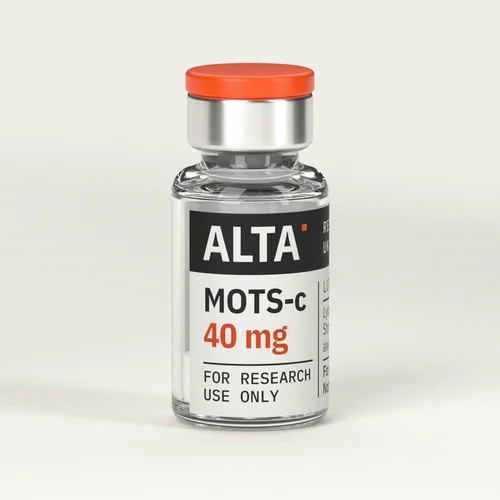
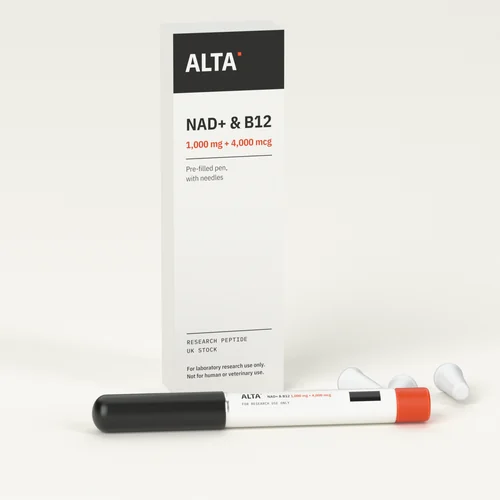
| At ALTA | Not stocked | 40 mg vial, £74.99 | NAD+ & B12 pen, £119.99 |
ALTA journal: what-is-mots-c and nad-plus-injections-uk. Research use only.
If your research interest is mitochondria and cellular energy, two compounds we do stock are relevant. The first is MOTS-c, a 16-amino-acid peptide that is itself encoded in mitochondrial DNA. Where SS-31 works inside the mitochondrial membrane, MOTS-c acts as a signal from the mitochondria to the rest of the cell, mainly through the energy sensor AMPK.
In mouse studies MOTS-c protected against diet-induced weight gain and improved physical capacity in old age. Our MOTS-c explainer covers that research, and we hold MOTS-c research vials (40 mg, £74.99) with a published lot certificate.
The second is NAD+, the coenzyme that carries electrons into the first machine of the electron transport chain, the same chain cardiolipin holds together. Its levels fall with age in animal studies, which is why it sits alongside SS-31 and MOTS-c in mitochondrial ageing research.
See our guide to NAD+ in the UK; we supply a sealed NAD+ & B12 pen (£119.99). All are for laboratory research only, not for human use.
Everything above is the quick version. The sections below go deeper.
How SS-31 binds cardiolipin: the chemistry
In shortThe charge pattern that makes it stick to cardiolipin.
SS-31 has an alternating aromatic-cationic design: positively charged arginine and lysine alternate with the ring-bearing Dmt and phenylalanine. The D-form arginine resists the enzymes that break down normal peptides, and the end amide (NH2) removes a negative charge, leaving a net charge of +3 at body pH.
Cardiolipin is unusual too: it has four fatty tails and a negatively charged head. Birk and colleagues (2013) showed that SS-31 binds it, protects the cristae and stops cardiolipin turning cytochrome c into a membrane-damaging peroxidase. Later work found SS-31 binding model membranes only when they contained cardiolipin.
Why most SS-31 trials missed their main goals
In shortDifferent diseases, noisy measures and short trials.
Three reasons stand out. Barth syndrome is a direct cardiolipin defect, while mitochondrial myopathy covers many genetic faults that may not respond to a cardiolipin binder.
Measures like the six-minute walk vary a lot from day to day, hiding small effects. And some trials were short: PROGRESS-HF lasted four weeks and EMBRACE STEMI was a single one-hour infusion.
The company has since narrowed its focus to Barth syndrome, POLG disease and dry AMD.
Sources
- US Food and Drug Administration. FDA grants accelerated approval to first treatment for Barth syndrome. Press release, 19 September 2025.
- Stealth BioTherapeutics. Stealth BioTherapeutics announces FDA accelerated approval of FORZINITY (elamipretide HCl), the first therapy for progressive and life-limiting ultra-rare genetic disease Barth syndrome. Press release, 19 September 2025.
- Robert Barrie. Stealth Bio's Forzinity finally approved as first Barth syndrome therapy. Pharmaceutical Technology, 22 September 2025.
- Mighty Therapeutics. Mighty Therapeutics, formerly Stealth BioTherapeutics, announces new name honoring the mitochondrial disease community. Press release, 16 June 2026.
- Thompson WR et al. Long-term efficacy and safety of elamipretide in patients with Barth syndrome: 168-week open-label extension results of TAZPOWER. Genetics in Medicine, 2024; 26(7): 101138.
- Karaa A et al. Efficacy and safety of elamipretide in individuals with primary mitochondrial myopathy: the MMPOWER-3 randomized clinical trial. Neurology, 2023.
- Ehlers JP et al. ReCLAIM-2: a randomized phase II clinical trial evaluating elamipretide in age-related macular degeneration, geographic atrophy growth, visual function and ellipsoid zone preservation. Ophthalmology Science, January 2025.
- Gibson CM et al. EMBRACE STEMI study: a phase 2a trial to evaluate the safety, tolerability and efficacy of intravenous MTP-131 on reperfusion injury in patients undergoing primary percutaneous coronary intervention. European Heart Journal, 2016; 37(16): 1296 to 1303.
- Butler J et al. Effects of elamipretide on left ventricular function in patients with heart failure with reduced ejection fraction: the PROGRESS-HF trial. Journal of Cardiac Failure, 2020.
- Birk AV et al. The mitochondrial-targeted compound SS-31 re-energizes ischemic mitochondria by interacting with cardiolipin. Journal of the American Society of Nephrology, 2013.
- Siegel MP et al. Mitochondrial-targeted peptide rapidly improves mitochondrial energetics and skeletal muscle performance in aged mice. Aging Cell, 2013; 12(5): 763 to 771.
- Zhao K et al. Cell-permeable peptide antioxidants targeted to inner mitochondrial membrane inhibit mitochondrial swelling, oxidative cell death and reperfusion injury. Journal of Biological Chemistry, 2004.
- Campbell MD et al. Improving mitochondrial function with SS-31 reverses age-related redox stress and improves exercise tolerance in aged mice. Free Radical Biology and Medicine, 2019.
- Chiao YA et al. Late-life restoration of mitochondrial function reverses cardiac dysfunction in old mice. eLife, 2020; 9: e55513.
- Pharmanovia. Pharmanovia enters new chemical entity licensing agreement with Stealth BioTherapeutics for a potential novel treatment for Barth syndrome. Press release, 30 May 2023.
Questions people ask
What is SS-31?
SS-31 is a small synthetic peptide of four amino acids that travels to the mitochondria, the energy-making parts of cells, and binds a membrane fat called cardiolipin. Its drug name is elamipretide. In the US it is approved, as Forzinity, for the rare inherited disease Barth syndrome.
Is SS-31 the same as elamipretide?
Yes. SS-31 is the original laboratory name and elamipretide is the official drug name. MTP-131 and Bendavia are older names for the same molecule, and Forzinity is the brand of the approved US product. People also search for it as SS31 or SS 31.
What does SS-31 do?
In cell and animal studies, SS-31 binds cardiolipin in the inner mitochondrial membrane, helps keep the energy machinery in shape and reduces the leakage of harmful reactive oxygen species. In people, the clearest result is better knee extensor strength in Barth syndrome.
Is SS-31 FDA approved?
Yes, for one use. On 19 September 2025 the FDA granted accelerated approval to Forzinity (elamipretide) to improve muscle strength in people with Barth syndrome weighing at least 30 kg. Continued approval depends on a confirmatory trial. It is not approved for ageing or any other condition.
Is SS-31 approved in the UK?
No. Elamipretide has no marketing authorisation from the MHRA, and as of June 2026 there was no EU-approved therapy for Barth syndrome either. Pharmanovia holds the rights for the UK and Europe and has an agreed paediatric investigation plan with the MHRA, which is a planning step, not a licence.
What are the side effects of SS-31?
In human trials the most common problems were skin reactions where it was injected, such as redness, pain, itching, bruising and hives. The US label also lists allergic reactions, some serious, and modest rises in eosinophils, a type of white blood cell. Long-term effects outside the approved disease have not been studied in large trials.
Does SS-31 work for ageing?
Not shown in people. In old mice, SS-31 improved muscle performance, treadmill endurance and heart relaxation. No completed, peer-reviewed human trial has shown an anti-ageing effect, and the larger human trials in other conditions mostly missed their main goals.
SS-31 vs MOTS-c: what's the difference?
Both are linked to mitochondria but they are different molecules. SS-31 is a synthetic four-amino-acid peptide that binds the inner mitochondrial membrane. MOTS-c is a natural 16-amino-acid peptide encoded in mitochondrial DNA that acts as a signal to the rest of the cell, mainly through the energy sensor AMPK.
Information, not advice. This article summarises published research; nothing here is guidance on human or veterinary use. Products are sold under our research use policy.