In this article17 sections
A three-amino-acid peptide, Glu-Asp-Arg, from the family of short peptides developed in St Petersburg by Vladimir Khavinson and sold as peptide bioregulators. The published work is almost all in cells and rodents, from one institute, with no controlled human trial.
Search for pinealon and you find a three-letter peptide credited with protecting the brain, sharpening memory and slowing ageing. Search for the evidence and you find something much smaller: 22 records on PubMed, mostly cell and rodent studies in one Russian journal, and no controlled human trial. Pinealon belongs to a family of very short peptides developed over four decades in St Petersburg and sold as peptide bioregulators, or bioregulator peptides.
- Pinealon is a tripeptide, Glu-Asp-Arg, often abbreviated EDR. Khavinson's group describe it as a short peptide isolated from cortexin, a polypeptide preparation made from cerebral cortex.
- Vladimir Khavinson (27 November 1946 to 6 January 2024) founded the St Petersburg Institute of Bioregulation and Gerontology in 1992 and directed it until his death. Six preparations from his programme were approved for medical use in the USSR and Russia: thymalin, epithalamin, cortexin, prostatilen, retinalamin and thymogen.
- Thymalin and cortexin are not short peptides: they are polypeptide extracts of calf thymus and of cerebral cortex. Pinealon, epitalon (Ala-Glu-Asp-Gly), vilon (Lys-Glu) and cartalax are defined synthetic short peptides.
- As of November 2026, a PubMed search for pinealon returns 22 records, the earliest from 2008. Most are cell or rodent studies published in the Russian journal Advances in Gerontology.
- The proposed mechanism was tested in 2011: Fedoreyeva and colleagues reported in Biochemistry (Moscow) that fluorescence-labelled epitalon, pinealon and bronchogen entered HeLa cell nuclei and bound preferentially to DNA sequences containing CNG sites, the targets of DNA methylation.
- Khavinson and Morozov, Neuroendocrinology Letters 2003, followed 266 people over 60 for 6 to 8 years and reported mortality 2.0 to 2.1 times lower with thymalin and 1.6 to 1.8 times lower with epithalamin than control. It used the extracts, not pinealon, and the abstract does not describe randomisation or blinding.
- None of the Khavinson bioregulators holds a marketing authorisation from the MHRA, so none is a licensed medicine in the UK.
What is a peptide bioregulator?
In shortKhavinson's own term for very short peptides said to restore a tissue's normal gene activity.
Very short, even by peptide standards.
A signal to normalise gene activity, not a lever on one target.
Thymus peptides for immune tissue, cortex peptides for brain.
Khavinson's own term, not a regulatory or pharmacological category.
Khavinson et al., Molecules 2021;26(22):7053, and the institute's own descriptions.
"Bioregulator" is not a recognised drug class. It is a term the Russian gerontologist Vladimir Khavinson coined for his own compounds, and knowing what he meant by it is the key to reading anything else about them.
Conventional drugs push one target hard: a receptor is switched on, an enzyme blocked. The bioregulator idea is different. These are tiny peptides, two to four amino acids long, and the claim is that they act as signals telling a tissue to restore its normal pattern of gene activity rather than forcing one pathway. Each is said to be tissue-specific: thymus peptides for immune tissue, cortex peptides for brain. It is a hypothesis, proposed and largely tested by the group that commercialised the compounds, and no regulator recognises it as a category of medicine.
What is pinealon?
In shortA three-amino-acid peptide, Glu-Asp-Arg, linked to the brain preparation cortexin.
The pinealon peptide is a tripeptide: glutamic acid, aspartic acid and arginine, written Glu-Asp-Arg, or EDR. The name suggests the pineal gland, but Khavinson's own papers describe pinealon as a short peptide isolated from cortexin, a polypeptide preparation made from cerebral cortex. The pineal link belongs to a different compound in the family, epitalon.
It is sold in the UK as a research chemical and, in Russia, has been sold in capsules as a supplement. Searches for pinealon uk are rising, usually a sign that a compound has been picked up faster than its evidence has grown.
Who was Vladimir Khavinson?
In shortThe Russian gerontologist behind the whole family. He died in January 2024.
- 1970sThe programme begins
Low-molecular-weight peptide fractions are isolated from animal organs in Leningrad.
- USSR eraSix preparations approved
Thymalin, epithalamin, cortexin, prostatilen, retinalamin and thymogen enter Soviet and then Russian medical use, first in military medicine.
- 1992The institute is founded
Khavinson founds the St Petersburg Institute of Bioregulation and Gerontology and directs it.
- 2003The most quoted human paper
266 people over 60, followed 6 to 8 years: lower mortality with thymalin and epithalamin than control.
- 2011The mechanism is tested
Labelled short peptides are shown entering HeLa nuclei and binding DNA at CNG sites.
- 2021The theory is written up
Peptide Regulation of Gene Expression, a review in Molecules.
- 6 Jan 2024Khavinson dies
Aged 77, in Saint Petersburg. 196 patents, about 775 publications.
Khavinson's published curriculum vitae and biography. The Soviet approvals are dated only loosely in the English-language sources, so no year is given here.
Khavinson (27 November 1946 to 6 January 2024) was a Russian gerontologist and a colonel in the Soviet and then Russian medical service. He founded the St Petersburg Institute of Bioregulation and Gerontology in 1992 and directed it until his death, with 196 patents and around 775 papers.
The programme began in the 1970s with tissue extracts rather than synthetic peptides. Between 1973 and 2013 his group produced more than 20 peptide complexes from animal organs plus about 15 synthetic short peptides, and six preparations were approved in the USSR and later Russia and the CIS. Those approvals rest on evidence standards that are not the MHRA's, the EMA's or the FDA's, and the institute both researched and commercialised the compounds.
The main Khavinson peptides at a glance
In shortThymalin and cortexin are tissue extracts; pinealon and epitalon are defined synthetic peptides.
Swipe the table to compare →
| What it is | Source tissue | Published evidence | |
|---|---|---|---|
| Thymalin | Polypeptide extract | Calf thymus | Russian clinical reports |
| Epithalamin | Polypeptide extract | Pineal gland | Russian clinical reports |
| Cortexin | Polypeptide extract | Cerebral cortex | Russian clinical reports |
| Epitalon | Synthetic tetrapeptide, Ala-Glu-Asp-Gly | Designed from epithalamin | Largest; one 2025 replication |
| Pinealon | Synthetic tripeptide, Glu-Asp-Arg | Described as isolated from cortexin | Cells and rodents only |
| Vilon | Synthetic dipeptide, Lys-Glu | Designed from thymic activity | Preclinical |
| Cartalax | Synthetic tripeptide, usually Ala-Glu-Asp | Cartilage | Preclinical |
| Thymogen | Synthetic dipeptide, Glu-Trp | Extracted from thymalin, then synthesised | Approved in Russia |
Tap a compound for the detail
Glu-Asp-Arg, a tripeptide, also written EDR. Khavinson's group describe it as a short peptide isolated from cortexin and group it with the arginine-containing neuroprotective peptides, so the pineal-sounding name is misleading. Published work: cell viability and free radical work (Rejuvenation Research 2011), rat offspring after prenatal methionine loading (2012), old rats under hypoxia and hypothermia, and dendritic spines in 5xFAD Alzheimer's mice (Pharmaceuticals 2021). Human evidence: one small Russian occupational study.
Ala-Glu-Asp-Gly, a tetrapeptide designed from the pineal extract epithalamin. The best-studied compound in the family: telomerase activation and telomere lengthening in human cells (2003), modest lifespan extension in the longest-lived mice, melatonin rhythm in old monkeys, and a 2025 Brunel University London replication of the telomere finding in cell lines, the first outside Russia.
Not a short peptide but a polypeptide extract of calf thymus, described by Khavinson's group as the first drug of the bioregulator class. It is an approved medicine in Russia and the CIS as an immunity regulator. It supplies the headline human numbers quoted for this whole family, including the 2003 mortality paper and a small 2021 report in older patients with severe COVID-19 that compared 36 treated patients with 44 on standard care.
A polypeptide preparation from cerebral cortex, approved in Russia and widely used there as a neuroprotective drug. It is the parent material pinealon is said to come from, and several Russian rodent studies compare the two head to head under hypoxia or carotid occlusion. Being a registered medicine in Russia carries no weight with the MHRA.
Vilon (Lys-Glu) and cartalax (usually given as Ala-Glu-Asp) are synthetic short peptides with small preclinical literatures and no human trials. Published sequence lists disagree with each other for several of the lesser-known members of the family, including bronchogen, cardiogen and chonluten, which tells you how thinly documented this chemistry is in English.
Khavinson group publications; sequences as given in the papers cited in the sources. Lists in secondary sources conflict.
The names get muddled online because tissue extracts and synthetic short peptides are sold side by side as though they were the same kind of thing. Thymalin and cortexin are polypeptide extracts: mixtures pulled from calf thymus and from cerebral cortex, whose composition varies by batch. Pinealon, epitalon, vilon, cartalax and thymogen are defined synthetic short peptides with written sequences, set out in the table on this page.
One caveat: published lists disagree on several lesser-known sequences, with bronchogen, cardiogen and chonluten each appearing in more than one form, which says something about how thinly this chemistry is documented.
What does the pinealon research show?
In shortCell and rodent results on oxidative stress, learning and dendritic spines.
Rejuvenation Research 2011: higher viability, less necrotic cell death.
2012: offspring of methionine-loaded dams; 23 animals per group.
Pharmaceuticals 2021: EDR prevented spine loss in 5xFAD mice.
Locomotive crew workers, 2012, in Russian, no described control arm.
Primary papers listed in the sources. The thymalin and cortexin rows summarise Russian-language literature coarsely; every tile below is preclinical except the last, a small uncontrolled report.
Searches for pinealon results and pinealon benefits research lead to three strands of preclinical work and one small human report. In cells, Khavinson and colleagues reported in Rejuvenation Research in 2011 that pinealon raised cell viability by suppressing free radical levels, cut necrotic cell death and altered the timing of ERK 1/2 activation.
In rodents, the clearest study is Arutjunyan and colleagues in the International Journal of Clinical and Experimental Medicine in 2012. Pregnant rats were loaded with dietary methionine to raise homocysteine; offspring whose mothers also received pinealon showed better spatial orientation and learning, with fewer reactive oxygen species and fewer necrotic cells in the cerebellum, across three groups of 23 animals. Other Russian studies compared pinealon with cortexin in old rats under hypoxia, and work in Pharmaceuticals in 2021 reported that EDR peptides prevented dendritic spine loss in 5xFAD Alzheimer's mice.
In people there is one small study usually cited: a 2012 report in Advances in Gerontology on locomotive crew workers, concluding that pinealon helped maintain professional reliability on measures of biological age. It describes no randomisation, blinding or placebo arm.
What the evidence does not show
In shortNo controlled human trial, no safety profile, almost no independent replication.
ClaimPinealon is proven to protect the brainTap to check
The neuroprotection results are real but they are in cell cultures and in rats and mice: oxidative stress markers, caspase-3 activity, dendritic spine counts and maze performance. No controlled human trial of pinealon has reported results, so nothing about human brains has been shown.
ClaimShort peptides can enter the nucleus and bind DNATap to check
This is the strongest piece of the whole bioregulator case. Fedoreyeva and colleagues (Biochemistry (Moscow), 2011) labelled short peptides with a fluorescent tag, watched them enter HeLa cell nuclei, and measured preferential binding to DNA sequences containing CNG sites, the targets of cytosine methylation.
ClaimBioregulators cut mortality in older peopleTap to check
The 2003 Neuroendocrinology Letters paper did report mortality 1.6 to 2.1 times lower across 266 people over 60, and 4.1 times lower in one annually treated subgroup. But it used the crude extracts thymalin and epithalamin rather than the synthetic peptides, the published abstract does not describe randomisation or blinding, and the authors developed the drugs.
ClaimPinealon works taken as a capsuleTap to check
Short peptides are exactly what digestive peptidases break apart, and the peptide field has spent decades on the problem of getting peptides past the gut. Evidence that these particular peptides survive oral administration intact and reach a nuclear target is not published.
ClaimThe research has been independently replicatedTap to check
For pinealon, not at all: all 22 PubMed records trace to the same network. In the wider family there is one clear independent replication, a 2025 Brunel University London study reporting telomere lengthening with epitalon in human cell lines.
ClaimThymalin and cortexin are approved medicinesTap to check
Both are registered for medical use in Russia and the CIS, as are epithalamin, prostatilen, retinalamin and thymogen. Russian registration is not an MHRA, EMA or FDA approval, and none of these preparations holds a UK marketing authorisation.
Verdicts from the primary papers named in the sources, with the study type stated in each.
No controlled human trial of pinealon has reported results, and no human pharmacokinetic work is published, so how a person's body handles it is unknown. There is no established safety profile either: Khavinson's group stated that their preparations produced no toxic or allergic effects in their own studies, which is a developer's claim rather than demonstrated safety.
The replication gap is the central problem. Almost every positive pinealon finding traces to the same institute and often the same authors. The family has one clear independent replication, and it is not of pinealon: in 2025 a team at Brunel University London and the Royal Brompton Hospital reported in Biogerontology that epitalon lengthened telomeres in normal human cell lines, repeating the 2003 St Petersburg finding for the first time outside Russia.
Pinealon vs epitalon: what is the difference?
In shortDifferent peptides. Epitalon has far more research, including one 2025 replication.
| Pinealon | Epitalon | |
|---|---|---|
| Length | 3 amino acids | 4 amino acids |
| Sequence | Glu-Asp-Arg | Ala-Glu-Asp-Gly |
| Parent preparation | Cortexin (cerebral cortex) | Epithalamin (pineal gland) |
| Main research endpoint | Neuroprotection, oxidative stress | Telomerase, telomere length, lifespan |
| PubMed records | 22 | Substantially more |
| Independent replication | None | Yes, 2025 |
| Stocked by ALTA PEPTIDES | No | Yes, research only |
PubMed, retrieved 9 November 2026; Al-dulaimi et al., Biogerontology 2025.
Pinealon is a tripeptide tied to cortexin and the brain, studied for neuroprotection, with 22 PubMed records and no independent replication. Epitalon is a tetrapeptide from the pineal extract epithalamin, studied for telomerase, telomere length and lifespan, with a much larger literature and the 2025 Brunel replication. Our article on what epitalon is covers that evidence and its limits.
The much-quoted human mortality figures belong to neither exactly. Khavinson and Morozov, in Neuroendocrinology Letters in 2003, followed 266 people over 60 for 6 to 8 years. Mortality was 2.0 to 2.1 times lower with thymalin and 1.6 to 1.8 times lower with epithalamin than control, and 4.1 times lower in a subgroup given both every year for 6 years. Those are the crude extracts, not the synthetic peptides, and the abstract does not describe randomisation or blinding. An effect that large in an unblinded study, from the group that developed the drugs, is one to treat with caution.
Are bioregulators licensed in the UK?
In shortNone of them is. Russian registration does not carry over to the MHRA.
None holds a marketing authorisation from the MHRA, the licence a medicine needs before it can be sold or supplied for human use in the UK, which requires evidence of quality, safety and efficacy to a standard none of these compounds has been tested against. Russian registration has no bearing on that.
None is a controlled drug under the Misuse of Drugs Act 1971 either, so they can lawfully be held as laboratory reagents; supplying them for human use is an offence under the Human Medicines Regulations 2012, as our article on whether peptides are legal in the UK explains. In sport, pinealon is not named on the WADA Prohibited List, but any substance with no approval from a health regulator falls under section S0, prohibited at all times.
Can you buy pinealon?
In shortIt is sold widely, but very short peptides are the hardest to verify.
Short chains have low mass and few distinguishing features, so routine identity and purity checks discriminate less well than they do for a longer peptide.
Oral short peptides meet the same peptidases that break down dietary protein. Survival intact is not established for these compounds.
Expect a lot-specific certificate with purity by HPLC and identity by mass spectrometry, tied to the batch in front of you, not a generic PDF.
Almost every supporting study shares authors with the institute that commercialised the compounds. Treat marketing citations accordingly.
Thymalin and cortexin being registered medicines in Russia says nothing about MHRA status, quality standards or what is in a grey-market vial.
ALTA PEPTIDES does not stock pinealon, thymalin, cortexin, cartalax or vilon.
It is sold widely, and quality is harder to pin down for peptides this short. A tripeptide has a low molecular mass and few distinguishing features, so routine identity and purity checks discriminate less well than for a longer chain. Capsules add a second problem: short peptides taken by mouth meet the peptidases that break down dietary protein, and evidence that these ones survive intact is not published.
For any peptide, expect a lot-specific certificate with purity by and identity by mass spectrometry, matched to the vial in front of you; our guide to reading a certificate of analysis explains what a real one contains. ALTA PEPTIDES does not stock pinealon, thymalin, cortexin, cartalax or vilon; epitalon is the only compound from this family we supply.
Where bioregulators fit with ALTA's research peptides
In shortWe stock epitalon from this family, and DSIP for the adjacent sleep literature.
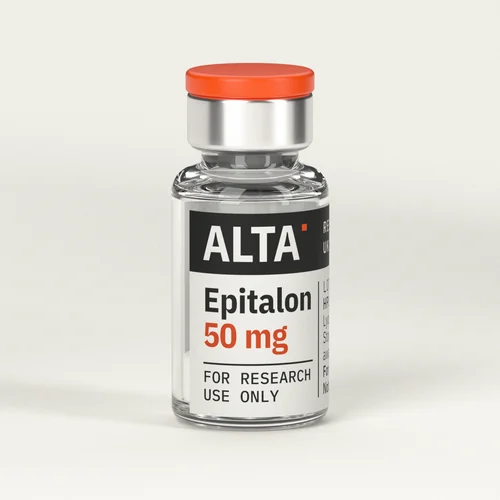
From this family we supply one compound: epitalon, a 50 mg vial at £59.99, for laboratory research only. The reason is the evidence record rather than the story: epitalon is the best-known Khavinson peptide, it has the largest published literature in the group, and it is the only one whose core finding has been replicated independently outside Russia. It is also a defined four-amino-acid sequence, Ala-Glu-Asp-Gly, so a vial can be checked by mass spectrometry against a published structure. Our articles on epitalon and on MOTS-c and epitalon set out what the studies support.
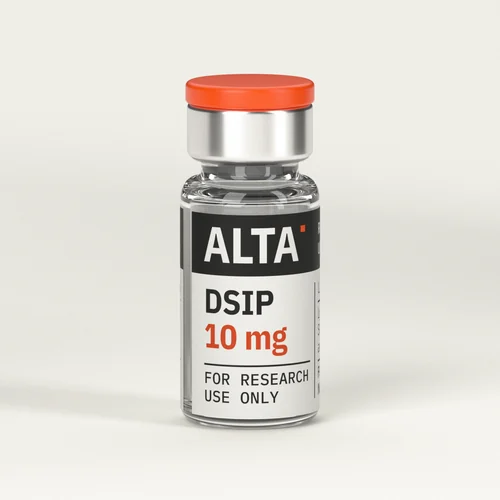
The other compound often discussed alongside pinealon is DSIP, delta sleep-inducing peptide, a 10 mg vial at £24.99. Both are short peptides with names that promise more than the literature delivers, and both are studied around sleep, stress and the brain. DSIP has its own puzzle: no gene for it has been found in any species, which our article on what DSIP is covers. Neither treats anything, and both are supplied for laboratory research only.
Everything above is the quick version. The sections below go deeper.
The proposed mechanism: can a short peptide reach DNA?
In shortThe one strong piece of evidence: short peptides do enter nuclei and bind DNA.
- 01A short peptide enters the cell
Two to four amino acids is small enough to cross membranes without a transporter.
- 02It reaches the nucleus
Labelled peptides were seen inside HeLa cell nuclei and nucleoli in 2011.
- 03It binds DNA
Epitalon, pinealon and bronchogen bound preferentially to sequences containing CNG sites.
- 04CNG sites are methylation targets
Cytosine methylation at those sites switches genes on or off.
- 05Gene activity shifts
The proposed result: a tissue's normal gene programme is restored.
- 06The gap
Binding DNA in a tube is not the same as restoring an ageing tissue in a person.
Fedoreyeva et al., Biochemistry (Moscow) 2011;76(11):1210 to 1219; Khavinson et al., Molecules 2021. Steps 1 to 4 are measured; step 5 is the hypothesis.
This is the interesting scientific question in the programme, and it has been tested. The proposal: these peptides are small enough to cross the cell membrane and the nuclear envelope, reach DNA and bind short sequences in gene promoters, changing which genes are read. Khavinson set it out in a 2021 review in Molecules, arguing that peptides of two to seven amino acids enter nuclei and interact with nucleosomes, histones and DNA, including its methylation status.
The most useful evidence came a decade earlier. Fedoreyeva and colleagues, in Biochemistry (Moscow) in 2011 with Khavinson as co-author, labelled short peptides with a fluorescent tag and watched them enter HeLa cell nuclei, then measured binding to synthetic DNA fragments: epitalon, pinealon and bronchogen bound preferentially to sequences containing CNG sites, the targets of cytosine methylation. That is a real physical finding and it makes the mechanism plausible rather than fanciful. What it does not do is bridge the gap to the marketing claims, and it has not been reproduced outside this network.
The replication problem in detail
In shortThree separate weaknesses: one source, weak designs, and the oral question.
First, source concentration: a literature in which almost every paper shares an author is fragile however good any single paper is, because assumptions propagate instead of being caught. Second, study design: the human work is mostly old, small and unblinded. The 2003 mortality paper is the clearest case, and the pattern repeats in the thymalin work in older patients with COVID-19, where a 2021 Advances in Gerontology report compared 36 treated patients with 44 on standard care and concluded that thymalin halved mortality. Third, the oral question set out in the buying section above.
None of this makes the bioregulator idea wrong: short peptides really do enter nuclei and bind DNA sequences. It means the honest description of pinealon in November 2026 is a compound with an interesting proposed mechanism, a small and geographically concentrated preclinical literature, and essentially no human evidence worth the name.
Pinealon and cognitive function: the rat studies in more detail
EDR is pinealon written in one-letter amino acid codes. The rodent work on the EDR peptide and cognitive function comes largely from one university group in Rostov-on-Don, usually with a co-author from the St Petersburg institute, and most of it is in Russian with an English abstract only. Four papers in Advances in Gerontology between 2011 and 2015 compared pinealon with cortexin in rats. In 2013 the authors reported that pinealon improved Morris maze learning in both young and old rats more than cortexin did. In 2015, in 18-month-old rats under hypoxia and hypothermia, cortexin had the more pronounced effect on free radical processes and caspase-3 activity in the brain. The 2011 paper reported that pinealon given before carotid artery occlusion moderately raised caspase-3 activity in the brain of old rats, so the findings do not all point one way.
A later study (Karantysh and colleagues, Neurochemical Journal, 2020) tested pinealon in rats with streptozotocin-induced diabetes and reported a dose-dependent effect on maze learning and on NMDA receptor subunit genes in the hippocampus. These are animal studies of neuronal and cellular markers in brain tissue. None measures cognition in people.
Pinealon in people: the other Russian reports and their limits
PubMed holds more human reports than the one usually cited. The primary reports are in Russian, and none of the abstracts describes a randomised, placebo-controlled design.
- The 2012 locomotive crew study reported that workers took one capsule containing 100 micrograms of pinealon twice a day for two weeks.
- Bashkireva and Artamonova, in a 2012 paper on the peptide correction of neurotic disorders among professional truck drivers that PubMed indexes as a clinical trial, examined 150 lorry drivers and 150 metal craftsmen and reported improved psychoemotional indices, with the largest effect from pinealon and vesugen combined.
- Meshchaninov and colleagues (2015) studied pinealon and vesugen in 32 people aged 41 to 83. They reported slower ageing on biological age indicators, but also prooxidant activity and a fall in CD34+ blood cell markers that they read as inhibition of haemopoiesis.
- A 2020 review by Khavinson's group in Molecules, titled EDR Peptide: Possible Mechanism of Gene Expression and Protein Synthesis Regulation Involved in the Pathogenesis of Alzheimer's Disease, describes oral pinealon added to usual therapy in 72 patients with the consequences of traumatic brain injury, with improved memory reported. The account is second-hand, cites a Russian review and does not describe a control group.
No human dose has been established, and the published safety data amount to these abstracts. These figures describe the cited studies. ALTA does not stock pinealon and gives no guidance on human use.
Pinealon, sleep and the antioxidant claim
No study indexed on PubMed has measured sleep, REM sleep or circadian rhythm in people given pinealon. The single PubMed record matching pinealon and sleep in November 2026 is an orthopaedic review that itself notes a lack of clinical trials. The melatonin studies in this family used the pineal preparations epithalamin and epitalon, covered in our article on peptides studied for sleep.
The antioxidant label needs the same care. Two 2008 papers in Advances in Gerontology reported that the short peptides showed no direct antioxidant activity in vitro, and proposed that pinealon may instead stimulate the cell's own antioxidant enzymes and limit the excitotoxic effect of NMDA. That is a proposed mechanism of action for a synthetic peptide of three amino acids, not evidence of an effect on brain health or age-related cognitive decline.
Sources
- Khavinson V, Ribakova Y, Kulebiakin K, et al. Pinealon increases cell viability by suppression of free radical levels. Rejuvenation Research 2011;14(5):535 to 541.
- Arutjunyan A, Kozina L, Stvolinskiy S, et al., Khavinson V. Pinealon protects the rat offspring from prenatal hyperhomocysteinemia. Int J Clin Exp Med 2012;5(2):179 to 185. PMID 22567179.
- Fedoreyeva LI, Kireev II, Khavinson VKh, Vanyushin BF. Penetration of short fluorescence-labeled peptides into the nucleus in HeLa cells and specific interaction with DNA. Biochemistry (Moscow) 2011;76(11):1210 to 1219.
- Khavinson VKh, et al. Peptide Regulation of Gene Expression: A Systematic Review. Molecules 2021;26(22):7053; and Neuroprotective Effects of Tripeptides in a Mouse Model of Alzheimer's Disease. Pharmaceuticals 2021;14(6):515.
- Khavinson VKh, Morozov VG. Peptides of pineal gland and thymus prolong human life. Neuroendocrinology Letters 2003;24(3-4):233 to 240. PMID 14523363.
- Kozina LS. Antihypoxic properties of short peptides. Adv Gerontol 2008;21(1):61 to 67; Nazimko VA, et al. Biological age and adaptation in locomotive brigade workers. Adv Gerontol 2012;25(1):57 to 62 (both in Russian).
- Kuznik BI, Khavinson VKh, et al. Thymalin in older patients with severe COVID-19. Advances in Gerontology 2021 (36 treated, 44 standard care).
- Al-dulaimi S, Thomas R, Matta S, Roberts T. Biogerontology 2025: epitalon, telomerase and telomere length in human cell lines (Brunel University London).
- Wikipedia, Vladimir Khavinson, and his published curriculum vitae at khavinson.info; PubMed search for "pinealon", 22 records, retrieved 9 November 2026.
Questions people ask
What is pinealon?
A synthetic tripeptide, Glu-Asp-Arg, also written EDR, from the family of short peptides developed at the St Petersburg Institute of Bioregulation and Gerontology. Khavinson's papers describe it as a short peptide isolated from cortexin, a cerebral cortex preparation. Published work is almost entirely in cells and rodents.
What does pinealon do?
In cell studies it reduced free radical levels and necrotic cell death. In rats whose mothers were given a high-methionine diet during pregnancy, it improved the offspring's spatial learning and made cerebellar neurons more resistant to oxidative stress. In a mouse Alzheimer's model it prevented dendritic spine loss. None of it has been tested in a controlled human trial.
What is a peptide bioregulator?
Khavinson's term, not a standard pharmacological class. The idea is that very short peptides, two to four amino acids long, act as signals telling a tissue to restore its normal pattern of gene activity rather than pushing one pathway hard. It is a hypothesis about mechanism, not a recognised regulatory category.
Is pinealon the same as epitalon?
No. Pinealon is a tripeptide, Glu-Asp-Arg, tied to the cortex preparation cortexin and studied for neuroprotection. Epitalon is a tetrapeptide, Ala-Glu-Asp-Gly, from the pineal extract epithalamin, studied for telomerase and lifespan, with far more published work behind it, including one independent replication in 2025.
Is there any human evidence for pinealon?
Very little. The clearest example is a small Russian study of locomotive crew workers, published in Advances in Gerontology in 2012, reporting improvements in measures of biological age and adaptation. It describes no randomisation, blinding or placebo group, and no controlled trial of pinealon has reported results.
What are the pinealon side effects?
Not established, because no controlled human safety study has been published. Khavinson's group stated that their preparations showed no toxic or allergic effects in their own work, but that claim comes from the developers, and absence of reported harm is not demonstrated safety.
Why is the evidence questioned?
Three reasons. Almost all of it comes from one institute, which also commercialised the compounds. Much of it appeared in Russian-language journals rarely cited outside that network. And independent replication is scarce: the one clear example in this family is a 2025 Brunel University London study of epitalon in cell lines, not of pinealon.
Can you buy pinealon in the UK?
It is not a controlled drug and has no marketing authorisation, so it can be bought and held as a laboratory reagent, but supplying it for human use is an offence under the Human Medicines Regulations 2012. ALTA PEPTIDES does not stock pinealon, thymalin, cortexin, cartalax or vilon.
Does pinealon make people sleepy?
It is not known. No study indexed on PubMed has measured sleep in people given pinealon. One 2011 rat study reported more behavioural sleep (the translated abstract says behavioral dream) when pinealon was given before carotid artery occlusion.
What is cortexin?
Cortexin is a polypeptide preparation extracted from the cerebral cortex of cattle or pigs and produced by the pharmaceutical company Geropharm. Unlike pinealon, cortexin has randomised trials in Russian neurology journals, including a 2025 trial in 490 patients with ischaemic stroke that compared its intravenous and intramuscular forms, with no placebo-only group. It has no UK marketing authorisation.
Is there a pinealon dosage from clinical trials?
No. PubMed lists no randomised controlled trial of pinealon, so no human dose has been established. The only amount stated in a PubMed abstract comes from the 2012 Russian study of locomotive crew workers, who took one capsule containing 100 micrograms twice a day for two weeks.
Is pinealon a synthetic peptide, and which amino acid sequence does it have?
Yes. The pinealon used in research is a synthetic peptide: three amino acids, glutamic acid, aspartic acid and arginine, joined in that order. The 2011 Rejuvenation Research paper calls it the synthetic tripeptide pinealon (Glu-Asp-Arg). Khavinson's group link this bioregulator peptide to a polypeptide complex called cortexin, but the material in the papers is made by chemical synthesis, not extracted from brain tissue. In a 2021 paper in Pharmaceuticals the same group described EDR as an epigenetic regulator and used computer docking to model it binding double-stranded DNA, reporting possible binding sites in the promoter regions of genes such as CASP3, APOE and SOD2. That is a molecular model, not a measurement in living cells.
What do the neuroprotective effects and cognition claims for pinealon rest on?
On laboratory and animal work, almost all from Khavinson's institute and its collaborators. In cell culture, the 2011 Rejuvenation Research study measured free radical accumulation and cell death in rat cerebellar granule cells, neutrophils and PC12 cells under oxidative stress. Because the effect on the cell cycle continued at higher concentrations, the authors inferred that pinealon may interact with DNA in the cell genome directly; that was an inference, not a binding measurement. In rats and mice, the readouts were maze learning, caspase-3 activity and dendritic spine counts. A 2020 review in Molecules by the same group describes EDR as possessing neuroprotective properties and reports improved memory in elderly patients, but that is the developers' own summary rather than a controlled trial. A PubMed search on 16 November 2026 found no pinealon record typed as a randomised controlled trial. Pinealon as a neuroprotective agent in people, and any effect on human cognition, remain untested.
Information, not advice. This article summarises published research; nothing here is guidance on human or veterinary use. Products are sold under our research use policy.