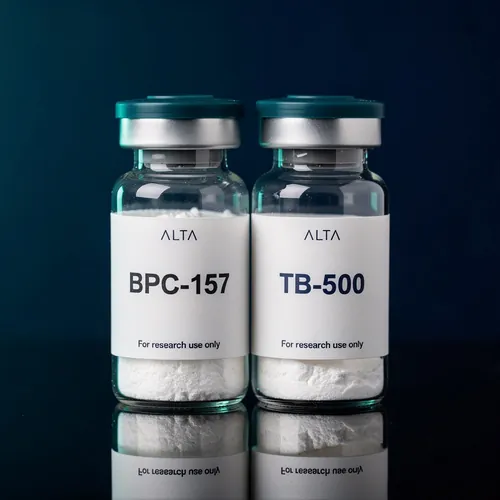
BPC-157 and TB-500 are the two most-searched research peptides in the recovery category and are so often mentioned together that the pairing has its own name: the Wolverine stack. They are not interchangeable and they are not variants of one another. This article sets out BPC-157 vs TB-500 on origin, chemistry, mechanism and research base, and explains why laboratories studying tissue repair tend to run them side by side. It is a summary of published research for laboratory purposes; neither compound is licensed for any use in people.
Origin and sequence
BPC-157 is a 15-residue fragment of a protein found in human gastric juice, developed at the University of Zagreb from the early 1990s. Sequence GEPPPGKPADDAGLV, mass 1419.5 g/mol. TB-500 is a 7-residue fragment of thymosin beta-4, a 43-residue actin-binding protein found in nearly all cells. Sequence Ac-LKKTETQ, mass 889.0 g/mol. One comes from the gut, the other from the cytoskeleton, and that difference in origin runs through everything else.
Mechanism
The characterised activity of BPC-157 is on signalling: it up-regulates VEGFR2 and activates downstream pathways in endothelial cells, modulates the nitric oxide system, and has been reported to interact with the growth hormone receptor in fibroblasts. The net effect in models is earlier vascularisation of injured tissue and more organised collagen deposition. It is, loosely, a peptide that changes what the cells at a wound site are told to do.
TB-500's activity is on the machinery of movement. As the actin-binding motif of thymosin beta-4 it sequesters G-actin, regulating the pool of monomers available for filament assembly, which is the process a cell uses to migrate. In scratch-wound assays, cells exposed to Tβ4 or its fragment close the gap faster because they move faster. The parent protein additionally up-regulates matrix metalloproteinases and dampens some inflammatory cytokines. It is, loosely, a peptide that changes how readily cells can get to a wound site.
Research base
BPC-157 has the larger literature, several hundred papers, but it is concentrated in one group and almost entirely in rodents, with tendon, ligament, muscle, gut and vascular models predominating. There are no published human trials. TB-500's fragment has a smaller literature; the parent protein thymosin beta-4 has been through human trials (as eye drops for dry eye and as an injectable after myocardial infarction) without reaching a licence. So the comparison is between a compound with a lot of animal data and no human data, and a compound whose parent has human data but whose fragment has been studied mainly in vitro.
Handling
Both are white lyophilised powders that reconstitute readily in bacteriostatic water. BPC-157 is exceptionally stable, tolerant of acid and of room temperature. TB-500 is a shorter sequence and equally robust in the vial but, like all peptides, should have diluent added down the wall of the vial rather than jetted onto the powder. Both are stored sealed at 2 to 8 °C or minus 20 °C and, once in solution, at 2 to 8 °C for up to four weeks; see the storage guide.
Why they are paired: the Wolverine stack
The logic of running the two together in a tissue-repair model is that they act on different steps of the same process. One drives the signalling that recruits blood supply and organises the matrix; the other frees the cellular machinery that lets fibroblasts, keratinocytes and endothelial cells migrate into the site. A laboratory studying wound closure can therefore compare each alone, the two combined, and vehicle, and separate the effects. That experimental design is what the Wolverine stack name refers to, and it is why our Wolverine stack is supplied as two separate labelled vials rather than a pre-mixed blend: a BPC-157 TB-500 blend in a single vial removes the ability to vary the ratio or run either arm alone, and it means both peptides share one reconstitution date and one stability clock.
Regulatory status
Neither is a controlled substance in the UK; neither is licensed anywhere; both are on the WADA prohibited list. Both are lawful to buy and possess as research reagents and unlawful to supply for human use. We sell them under our research use policy and refuse orders that indicate otherwise.